Picture this: You wake in a marble palace. You are the most powerful person in the world. The emperors before you drowned in their own indulgence, in greed, or fear. Outside, the crowd calls your name.
But you don’t begin your day with a performance. You don’t summon generals or scribes. You sit with a notebook. And you write—not to boast, not to issue decrees, but to remind yourself to be kind. To remind yourself that today you will meet resistance. And that this resistance is not your enemy. It is your path.
This happened. We still have the notebook.
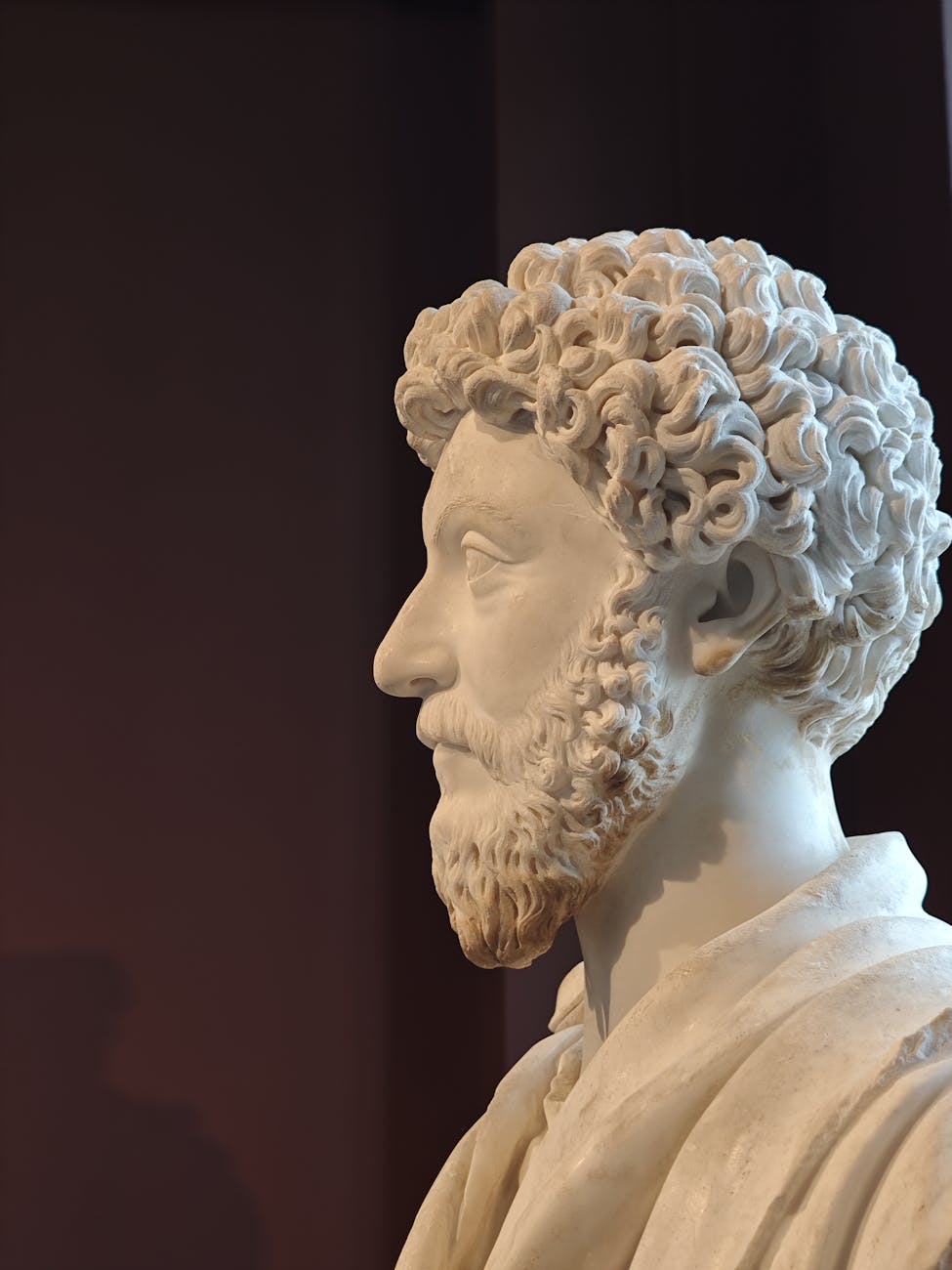
It belonged to Marcus Aurelius, emperor of Rome and one of the most profound Stoic philosophers. His Meditations are not a book written for others. They are personal reminders. Field notes from the front lines of his own mind.
And if that sounds like the opposite of modern leadership—where visibility is everything, where charisma sells and speed is mistaken for insight—that’s precisely why Marcus matters.
Too often today, stoicism is reduced to mere aesthetics. Ice baths. Cold showers. Grit, hustle, and rejection of feeling. We romanticise resilience as if it means silencing the soul.
But stoicism, properly understood, is less about hardening and more about softening into clarity. It’s not the rejection of emotion—it’s the training of emotion. Not the renunciation of the world—but a recalibration of one’s place within it.
Marcus Aurelius didn’t write the Meditations to impress. He wrote them to endure. To remember what he believed in when the palace and the politics threatened to make him forget. This wasn’t a performance. It was a quiet transformation.
And it invites us to our own.
During my time in leadership, I’ve learned that the heaviest burden is not decision-making. It’s visibility.
When we are visible, we are misunderstood. When we are misunderstood, we are attacked. And the work of leadership becomes not just a matter of making good choices, but of remaining whole while those around us cast fragments of who they think we are.
That’s what Marcus teaches us: that leadership is not a performance. It is presence. It is the quiet art of being with our responsibilities without collapsing into them. Of taking pressure and transmuting it into clarity.
And this is not reserved for emperors. Leadership takes many forms. Raising a family. Building a team. Guiding a creative project. Holding space for a friend. Or simply—no less meaningfully—learning to lead oneself.
Marcus didn’t dominate a room. He attended to it. And that attention—to self, to others, to the rhythm of nature and the seasonality of emotion—is what made him powerful.
He reminds us: You will meet frustrating people today. And your task is not to change them. Not even to fix them. But to notice them—and not let them disturb the integrity of your own mind.
This, in many ways, is the true work of self-leadership: not pretending the world is different than it is, but accepting what is and holding to what matters.
If we strip away the glamour from leadership, what remains is not emptiness—but depth.
Because what stands in the way becomes the way.
This is Marcus’s central teaching. And it’s a reminder we need more than ever in a world of spectacle. Where it’s easy to think we’re only as good as our last presentation, our last post, our last win.
But real strength doesn’t come from spectacle. It comes from silence. From beginning the day not with declarations, but with a return. A return to what we believe. A return to who we choose to be.
If you know the weight of being the person who holds it all together—at work, in your family, in your inner world—I’ve created an online course integrating these Stoic principles into daily practice. It’s not about quick wins. It’s about sustainable clarity. You’ll find a link below if that’s of interest.
And wherever you are on your path—remember this:
You don’t need to dominate the room to lead.
You just need to meet the day with presence.
Even, and especially, when marble palaces crumble and the crowd calls your name.
Unlock your potential with mindfulness! Discover how a few mindful moments can help spark breakthrough, overcome blocks, and transform your personal and professional journey. Subscribe to my blog today for more on the art of being present.
Discover more from Allan Johnson, PhD
Subscribe to get the latest posts sent to your email.
