Last year, writers, artists, academics, actors, and creative explorers came together to work through Julia Cameron’s The Artist’s Way in a supportive group setting. Over twelve weeks, they developed new creative habits, rediscovered forgotten passions, overcame creative blocks, and, perhaps most importantly, found a community of people committed to showing up for their creative lives.
Whether you’re completely new to The Artist’s Way, have always meant to read it, or want to experience it again alongside a group of fellow creatives, this Circle offers a structured and supportive space to reconnect with your creativity.
Each week, we’ll explore the themes and exercises from The Artist’s Way, reflect on our experiences, and support one another in building a sustainable creative practice. You’ll be encouraged to engage with your own projects—whether that’s writing, painting, research, music, crafting, or something else entirely—while benefiting from the group’s accountability and encouragement. Over twelve weeks, you’ll receive:
Weekly live online group coaching sessions (Tuesdays, 7.30–9.00 PM UK time)
A supportive creative community
Structured reflection and creative exercises
Accountability to help you maintain momentum
A private WhatsApp group for connection and support between sessions
If you’d like to experience the Artist’s Way Circle before committing, you’re warmly invited to our free online taster session on 31 August from 7.30-8.30pm UK time. During this session you’ll participate in guided exercises you can immediately apply to your own creative projects, meet other participants, and experience the supportive atmosphere that makes this Circle so powerful.
Whether you’re feeling creatively blocked, looking for accountability, or simply longing to reconnect with your creative self, I’d love to welcome you. I hope you’ll join us!
All the best,
Allan
P.S. If you’ve been waiting for the “right time” to start that creative project, there is a good chance you’re waiting for a feeling that never arrives. Community, accountability, and consistent practice are far more reliable than inspiration. That’s exactly what the Artist’s Way Circle is designed to provide. Trust me, it will be transformative! 🙂
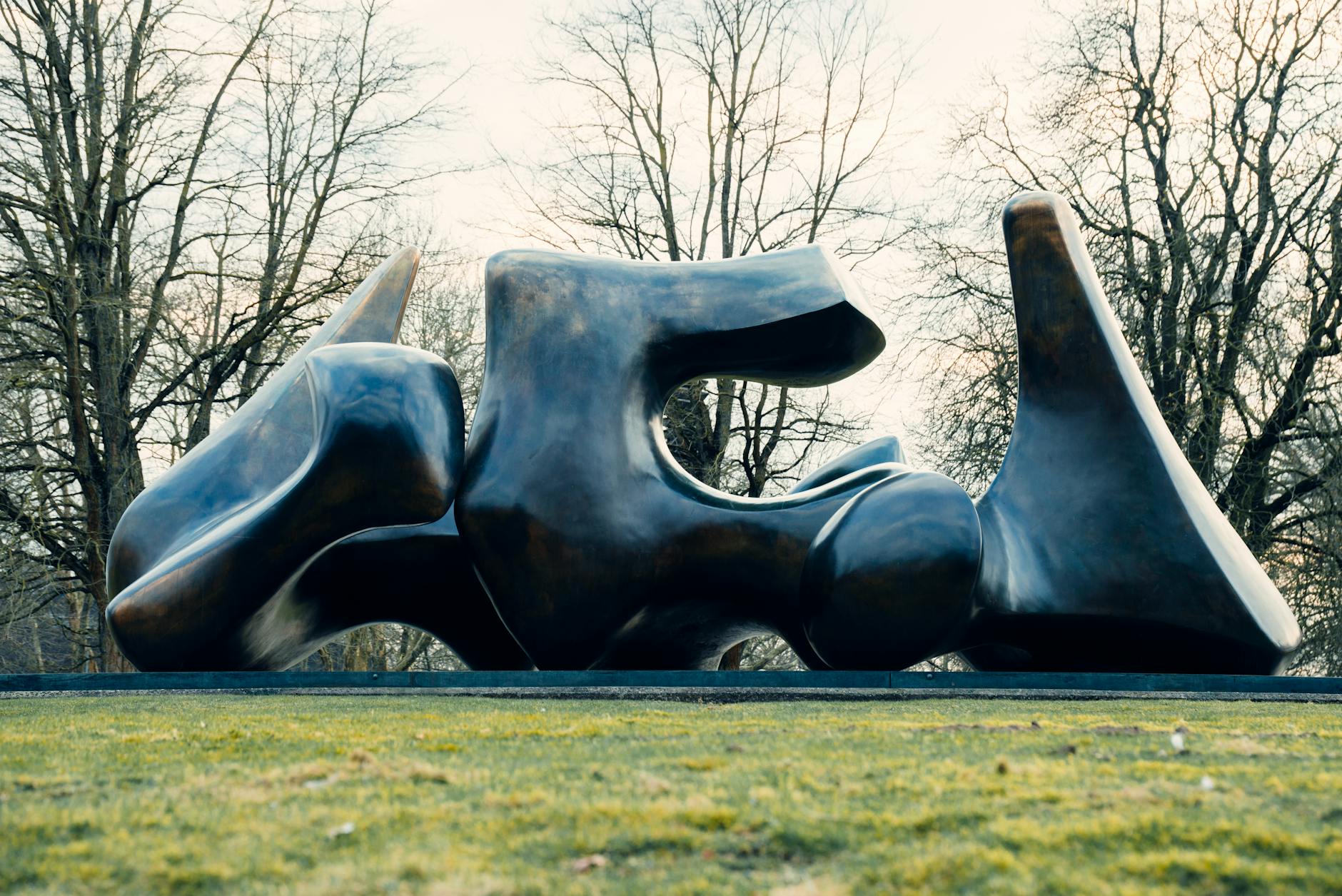
Henry Moore’s sculptures don’t have an obvious purpose or meaning. I found myself thinking at the recent exhibition of his monumental work at Kew Gardens, where I went to celebrate my partner’s birthday. We had just made it through the hottest May on record in the UK, but the weather was now colder and threatening to rain. I found myself standing in front of one of Moore’s reclining figures for quite a long time because it seemed to reward simple attention. It simply occupied space in a way that encouraged me to do the same.
That experience stayed with me, perhaps because it arrived during a period that has been unusually rich in encounters with things that don’t fit neatly into the categories through which contemporary culture often understands value. In short, I’ve been busy lately. Recently, I attended the centenary conference at University College London celebrating the 1926 publication of Lolly Willowes. Then, a week later, I found myself in Canterbury attending a tarot conference. Very different events, but both revolve around forms of meaning that require patience.
We live in a culture that has become remarkably efficient at extracting value from experience. Experiences are no longer allowed simply to be experiences. They must become content, products, strategies, frameworks, or outcomes. The philosopher Byung-Chul Han argues that ours is increasingly an achievement society, one in which human beings become entrepreneurs of themselves, constantly converting every aspect of life into a project. I think he is onto something. Increasingly, it feels as though we struggle to encounter anything without simultaneously asking what can be done with it. Yet some of the most important dimensions of human life seem to operate according to a different rhythm altogether.
One of the reasons Lolly Willowes continues to fascinate readers a century after its publication is that it refuses to reduce itself to a single meaning. Every time I return to it, I find a different book waiting for me–is the Devil real or is it a figment of Laura’s imagination? The psychologist James Hillman once suggested that modern culture has become overly attached to explanations when it might be better served by images. An explanation closes a question. An image keeps it alive. I’ve been turning that idea over in my mind ever since.
Perhaps this is why I find myself increasingly drawn to practices that create space for uncertainty rather than rushing to eliminate it. Much of my coaching work involves helping people navigate periods of transition, and one of the things I encounter repeatedly is the assumption that uncertainty itself is a problem. People arrive wanting clarity, certainty, and direction. Sometimes that is exactly what is needed. More often, however, what is required is the capacity to remain with a question long enough for a deeper answer to emerge.
We don’t talk enough about incubation. We celebrate breakthroughs, decisions, launches, and achievements, but far less attention is given to the long periods during which meaning slowly accumulates beneath the surface. Yet anyone who has written a book, developed a creative practice, changed careers, navigated grief, or undergone a significant personal transformation knows that the visible outcome is usually the final stage of a much longer process.
And I suspect many of us are carrying experiences whose significance we do not yet fully understand. Books that have affected us in ways we cannot articulate. Conversations that continue to echo years later. Encounters with art, landscapes, ideas, or people that seem somehow unfinished. We are often encouraged to resolve these experiences quickly, but perhaps some of them are not asking for resolution. Perhaps they are asking for companionship.
As I write this, summer is beginning to gather momentum. The temptation at this time of year is always to focus on goals, plans, projects, and ambitions. There is nothing wrong with any of those things. But I also find myself wondering what might happen if we gave equal attention to the slower work of reflection. What might emerge if we allowed experiences to become part of us before demanding that they become useful?
If these reflections resonate with you, I’d love to invite you into some of the upcoming events I’m hosting over the summer. Each, in its own way, is designed to create room for exactly the kinds of conversations and explorations I’ve been describing here. And if you find yourself at a significant threshold in your own life or work, I continue to offer one-to-one coaching for creatives, academics, practitioners, and thoughtful people navigating periods of transition.
Perhaps the most radical thing we can do in a culture obsessed with output is occasionally refuse to rush. To allow a question to remain open. To spend an afternoon with a sculpture. To sit with a symbol. To reread a novel. To trust.
Upcoming Events
Inner Alchemy: Practices for the New Season of You
Thursday 11 June | 8.00-9.00pm UK time | Free
As the seasons shift, so do we. This free workshop explores practical and contemplative approaches to navigating periods of personal transition with greater awareness and intention.
Returning to Yourself: A 4-Week Journaling Circle for Creatives
Mondays 7.30-9.00pm UK time beginning 15 June | £60
A month-long guided journey into reflective writing, self-discovery, and creative renewal. Together we’ll use journaling practices to reconnect with what matters most and cultivate greater clarity, depth, and presence.
The Symbolic Imagination: Tarot for Writers, Artists, & Creatives
Wednesday 8 July | 7.00-9.00pm UK time | £15
An exploration of tarot as a creative and symbolic tool. Ideal for writers, artists, coaches, facilitators, and anyone interested in working more consciously with imagination, archetype, and symbolic thinking.
I also offer individual coaching for academics, creatives, spiritual seekers, and professionals navigating transitions, creative blocks, questions of purpose, or significant life changes. If you’d like dedicated support in exploring what is emerging in your life and work, get in touch and I’d be delighted to discuss how we might work together.
Book your FREE Clarity Call to discuss ongoing 1-1 coaching:
For the past five years, I’ve been running a hypnotherapy practice alongside my work in teaching, coaching, and reflective practice. I wanted to share a little more about it here, for those of you who might be curious or wondering whether this kind of work might help you.
Clinical hypnotherapy is a calm, focused process that works with the deeper patterns of the mind. We begin with what’s actually going on in your life, and work from there. I often find that people appreciate how ordinary it feels — less like being “done to,” and more like a structured conversation with the subconscious patterns that are running in the background.
Over time, I’ve found myself especially drawn to working with thoughtful, self-aware people — often creatives, professionals, and people in transition — who have already done a lot of inner work, but feel they’ve reached a point where insight alone isn’t quite enough anymore.
If you’re curious, I offer free clarity calls. These are simply a chance to talk things through, explore what’s happening for you, and see whether this kind of work might be a good fit.
For over twenty-five years now, I’ve kept some form of journal. There were periods where I wrote every day, and periods where months passed between entries. Certain journals are full of ideas for books and lectures; others read more like field reports from difficult years of my life. Somehow, through every change in identity, work, relationship, ambition, and worldview, the practice itself remained.
Recently, while preparing the material for my new programme, Returning to Yourself: A 4-Week Journaling Circle for Creatives, I’ve found myself revisiting some of those older notebooks. I think many creatives underestimate how much of artistic practice is actually listening. Not performing; not producing. Listening.
There is also something important about the physicality of journaling. In a life spent increasingly online, notebooks retain texture and atmosphere. They carry evidence of particular moments. Different handwriting during stressful periods. Coffee stains. Pressed tickets from research trips. Shopping lists next to existential reflections. They become strangely human documents. People imagine diaries as places of confession, but often they reveal us indirectly: through repetition, obsession, avoidance, imagery, tone. Reading old entries now, I can often tell what I was unable to admit simply by noticing what I kept writing around.
This is one of the reasons I believe journaling is especially important for creatives. Creative people need spaces where they are allowed to be unfinished. Where ideas can remain embryonic. Where the inner voice can speak before it becomes polished into communication. Over the past year especially, I’ve become more aware of how many intelligent, capable, deeply creative people feel internally scattered. They consume constantly but rarely metabolise experience. They produce work but struggle to hear themselves beneath the noise of expectation and comparison.
Journaling is not a magical solution to this. But it is a stabilising practice. A way of remaining in conversation with your own life. And importantly, it does not require you to be “good” at writing. That has been very present for me while developing Returning to Yourself. More than anything, I wanted the programme to create a space where creatives could encounter themselves again outside performance, productivity, and pressure. Not another course about branding or output, but a gentler and more reflective practice of creative attention.
The older I get, the more I think creativity depends less on intensity than on sustained relationship with one’s own inner life. The journal becomes part of that relationship. A witness to change. A container for uncertainty. A place where the self can continue speaking across years.
And if this resonates, you’re warmly invited to join Returning to Yourself: A 4-Week Journaling Circle for Creatives Mondays 7.30–9.00pm UK time beginning 15 June | £60
We underestimate how much creativity depends on tolerating not-knowing.
One of the more radical ideas in creativity research comes from the psychoanalytic tradition, particularly from Wilfred Bion’s notion of “negative capability” (itself borrowed from John Keats). The capacity, as Keats originally put it, to remain with uncertainty without ‘irritable reaching after fact and reason.’ In practice, it means resisting the urge to immediately resolve uncertainty. To not rush to closure. To sit, for a moment longer than feels comfortable, in the space where meaning hasn’t yet crystallised.
We can see similar ideas elsewhere. In Mihaly Csikszentmihalyi’s work on ‘flow’, there is an emphasis on the balance between challenge and skill, but what is often overlooked is that entry into flow frequently involves a period of disorientation. Or take Donald Winnicott’s idea of the “transitional space”—that intermediate area of experience between inner and outer reality, where play and creativity happen. It is, by definition, not fully known. Not fully controlled. It requires a kind of psychological looseness that can feel, at times, like a loss of footing.
Even outside explicitly psychological frameworks, writers have long circled this point. Joan Didion’s famous line—“I don’t know what I think until I write it down”—is often quoted as a neat aphorism, but it carries a deeper implication: that writing is not the expression of prior clarity, but the means by which clarity is tentatively, sometimes reluctantly, arrived at.
One of the reasons I care so much about structured creative spaces—whether that’s the weekly Creative Flow coworking session, the ongoing Writers Flow Circle, 1:1 coaching, or workshops—is that they provide a container for this kind of work. A place where not-knowing is not only tolerated but expected. Where you don’t have to perform certainty in order to belong.
If you’re in a season where your work feels slightly out of reach—where you can sense something wanting to emerge but can’t yet articulate it—you don’t necessarily need a new strategy. You might need a different relationship to that feeling: a willingness to stay with the question a little longer than is comfortable.
If that resonates, I’m running an upcoming workshop that may be of interest:
We’ll be working directly with attention, distraction, and the subtle dynamics that either support or disrupt creative flow, very much including this question of how we meet the unknown.