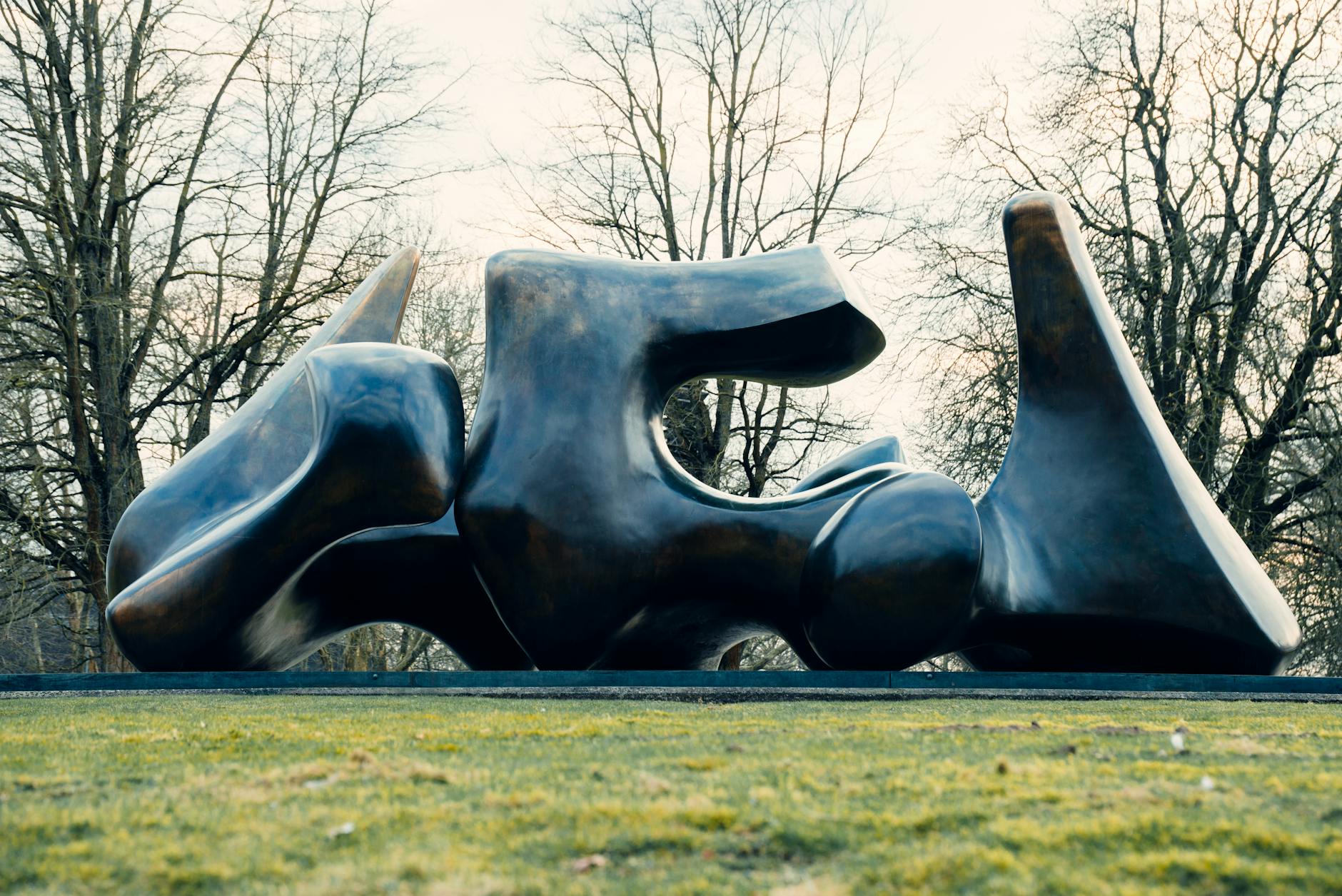
Henry Moore’s sculptures don’t have an obvious purpose or meaning. I found myself thinking at the recent exhibition of his monumental work at Kew Gardens, where I went to celebrate my partner’s birthday. We had just made it through the hottest May on record in the UK, but the weather was now colder and threatening to rain. I found myself standing in front of one of Moore’s reclining figures for quite a long time because it seemed to reward simple attention. It simply occupied space in a way that encouraged me to do the same.
That experience stayed with me, perhaps because it arrived during a period that has been unusually rich in encounters with things that don’t fit neatly into the categories through which contemporary culture often understands value. In short, I’ve been busy lately. Recently, I attended the centenary conference at University College London celebrating the 1926 publication of Lolly Willowes. Then, a week later, I found myself in Canterbury attending a tarot conference. Very different events, but both revolve around forms of meaning that require patience.
We live in a culture that has become remarkably efficient at extracting value from experience. Experiences are no longer allowed simply to be experiences. They must become content, products, strategies, frameworks, or outcomes. The philosopher Byung-Chul Han argues that ours is increasingly an achievement society, one in which human beings become entrepreneurs of themselves, constantly converting every aspect of life into a project. I think he is onto something. Increasingly, it feels as though we struggle to encounter anything without simultaneously asking what can be done with it. Yet some of the most important dimensions of human life seem to operate according to a different rhythm altogether.
One of the reasons Lolly Willowes continues to fascinate readers a century after its publication is that it refuses to reduce itself to a single meaning. Every time I return to it, I find a different book waiting for me–is the Devil real or is it a figment of Laura’s imagination? The psychologist James Hillman once suggested that modern culture has become overly attached to explanations when it might be better served by images. An explanation closes a question. An image keeps it alive. I’ve been turning that idea over in my mind ever since.
Perhaps this is why I find myself increasingly drawn to practices that create space for uncertainty rather than rushing to eliminate it. Much of my coaching work involves helping people navigate periods of transition, and one of the things I encounter repeatedly is the assumption that uncertainty itself is a problem. People arrive wanting clarity, certainty, and direction. Sometimes that is exactly what is needed. More often, however, what is required is the capacity to remain with a question long enough for a deeper answer to emerge.
We don’t talk enough about incubation. We celebrate breakthroughs, decisions, launches, and achievements, but far less attention is given to the long periods during which meaning slowly accumulates beneath the surface. Yet anyone who has written a book, developed a creative practice, changed careers, navigated grief, or undergone a significant personal transformation knows that the visible outcome is usually the final stage of a much longer process.
And I suspect many of us are carrying experiences whose significance we do not yet fully understand. Books that have affected us in ways we cannot articulate. Conversations that continue to echo years later. Encounters with art, landscapes, ideas, or people that seem somehow unfinished. We are often encouraged to resolve these experiences quickly, but perhaps some of them are not asking for resolution. Perhaps they are asking for companionship.
As I write this, summer is beginning to gather momentum. The temptation at this time of year is always to focus on goals, plans, projects, and ambitions. There is nothing wrong with any of those things. But I also find myself wondering what might happen if we gave equal attention to the slower work of reflection. What might emerge if we allowed experiences to become part of us before demanding that they become useful?
If these reflections resonate with you, I’d love to invite you into some of the upcoming events I’m hosting over the summer. Each, in its own way, is designed to create room for exactly the kinds of conversations and explorations I’ve been describing here. And if you find yourself at a significant threshold in your own life or work, I continue to offer one-to-one coaching for creatives, academics, practitioners, and thoughtful people navigating periods of transition.
Perhaps the most radical thing we can do in a culture obsessed with output is occasionally refuse to rush. To allow a question to remain open. To spend an afternoon with a sculpture. To sit with a symbol. To reread a novel. To trust.
Upcoming Events
Inner Alchemy: Practices for the New Season of You
Thursday 11 June | 8.00-9.00pm UK time | Free
As the seasons shift, so do we. This free workshop explores practical and contemplative approaches to navigating periods of personal transition with greater awareness and intention.
Register here:
https://www.meetup.com/the-art-of-creative-practice/events/314990631/
Returning to Yourself: A 4-Week Journaling Circle for Creatives
Mondays 7.30-9.00pm UK time beginning 15 June | £60
A month-long guided journey into reflective writing, self-discovery, and creative renewal. Together we’ll use journaling practices to reconnect with what matters most and cultivate greater clarity, depth, and presence.
Register here:
https://www.meetup.com/the-art-of-creative-practice/events/314827483/
The Symbolic Imagination: Tarot for Writers, Artists, & Creatives
Wednesday 8 July | 7.00-9.00pm UK time | £15
An exploration of tarot as a creative and symbolic tool. Ideal for writers, artists, coaches, facilitators, and anyone interested in working more consciously with imagination, archetype, and symbolic thinking.
Register here:
https://www.meetup.com/the-art-of-creative-practice/events/315091524/
One-to-One Coaching
I also offer individual coaching for academics, creatives, spiritual seekers, and professionals navigating transitions, creative blocks, questions of purpose, or significant life changes. If you’d like dedicated support in exploring what is emerging in your life and work, get in touch and I’d be delighted to discuss how we might work together.
Book your FREE Clarity Call to discuss ongoing 1-1 coaching: