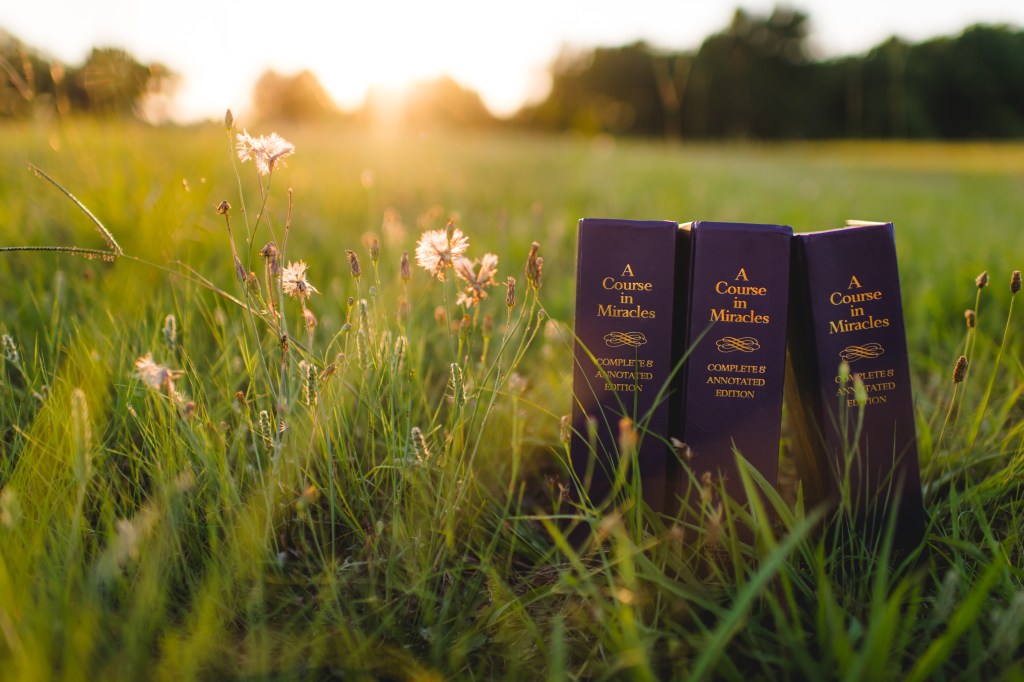
If you were to glance at the cover of A Course in Miracles, you might find it a little intimidating.
Gold-embossed title. No back cover blurb. Dense text. Three volumes.
It doesn’t exactly scream “approachable.”
Add to that a name like A Course in Miracles—and it’s understandable why many people assume it’s either ultra-religious, uncomfortably mystical, or some obscure New Age self-help project from the 1970s.
But here’s the truth, and it might surprise you: The Course is none of those things.
It’s not a religion. It’s not a belief system. And it’s not trying to sell you a new worldview.
At its heart, A Course in Miracles is a method of mental and emotional clarity. A structured way of exploring your perceptions, undoing habitual fear-based thinking, and reclaiming the peace that’s already available beneath the noise of the mind.
So What Is It, Then?
Let’s step back a moment.
The Course was written in the late 1960s and early 70s by Helen Schucman, a clinical psychologist at Columbia University. She described it as a form of inner dictation—words that came to her during a time of personal and professional strain, in response to a growing desire to find “a better way” of relating to the world.
Regardless of how we frame its origin, the Course is remarkable in one key respect: it speaks in symbolic, poetic language, but offers psychologically rigorous insights into how perception works—and how often we are the source of our own suffering without realising it.
It doesn’t ask you to believe in anything. Not in the traditional sense. In fact, one of its opening lines is:
“This is a course in miracles. It is a required course. Only the time you take it is voluntary.”
It’s not referring to belief or theology. It’s referring to a kind of deep inner retraining—a shift in how you meet your thoughts, how you interpret experience, and how you move through relationships, conflict, and uncertainty.
A Practice of Undoing, Not Adding More
Most spiritual systems (and most self-help programs) are about adding more.
More positive habits. More affirmations. More rituals. More goals. More ideas.
The Course is different. It’s not additive—it’s subtractive.
It says, essentially: you don’t need to become better, you need to remember who you already are beneath fear. And the way to remember is by undoing the thoughts that block your natural capacity for peace.
This includes thoughts like:
- “I need to control this situation to be okay.”
- “If I don’t prove my worth, I’ll be rejected.”
- “Other people’s approval determines my value.”
- “I can’t be happy until X happens.”
Rather than challenging those thoughts intellectually, the Course invites you to bring them into awareness and notice what they cost you. Not in moral terms, but in energy, clarity, and presence.
And then it offers an alternative—a quieter, more honest perception. One that doesn’t come from striving, but from stillness.
So, No Dogma? Really?
There’s a common misunderstanding that A Course in Miracles is part of a larger religious or spiritual institution. But it isn’t. There’s no church. No hierarchy. No initiations. y. And no penalties for disagreement.
The Course explicitly says:
“A universal theology is impossible, but a universal experience is not only possible but necessary.”
That experience, for the Course, is peace.
But not peace as a vague ideal. Peace as a felt experience of spaciousness. Of groundedness. Of being free from the constant effort to defend yourself against life.
Robert Holden, a longtime student and teacher of the Course, often describes it as “spiritual psychotherapy.” He calls it a practical, heartfelt path that clears away the false self—not by condemning it, but by recognising it was never needed in the first place.
What Happens in the Study Group?
This is why the Course is best approached with others.
Not because we need to believe the same thing—but because this kind of inner exploration thrives in gentle company. Somewhere between a book club, a reflection circle, and a slow-burn inner workout, our Sunday evening study group provides a regular space to unpack and embody the Course’s core ideas.
We meet weekly (Sundays 7.30–9.00 pm UK time) and work through the Text in small, digestible sections. There’s no pressure to speak, and no prior knowledge needed. The readings are thoughtfully paced to allow insight to land and ripple in your daily life.
Each session is rooted in quiet attention—not performance. You can reflect aloud, or simply listen and take in what resonates.
Over the course of 18 months, we’ll move through the entire Text—the foundation of the Course—together.
When you sign up, you’ll receive the full reading schedule so you always know what we’re covering.
A Language of Peace, Not Preaching
Because the Course uses words like “miracle” and sometimes borrows spiritual terms from Christian mysticism, some readers initially worry that it’s trying to impose a worldview. But the language is symbolic, not doctrinal.
If a word doesn’t resonate with you, you’re encouraged to reinterpret it in a way that does. The Course doesn’t ask for obedience—it asks for honesty. And it reminds us that truth doesn’t need to be defended; it simply needs to be experienced.
I often tell people: don’t let the language throw you. The Course isn’t asking you to believe in anything “supernatural.” It’s inviting you to recognise how many of your perceptions are distorted by fear—and how peace becomes available when those distortions dissolve.
It’s less “join us” and more “come and see.”
This Is a Practice of Clarity
And clarity, for many of us, is in short supply.
We’re overloaded with information, overwhelmed by choice, and often undernourished when it comes to stillness. What the Course offers is not a shortcut—but a framework. A rhythm. A return.
It’s not for everyone. But if you’re someone who’s felt that traditional paths don’t quite fit… or who’s looking for something deeper than the usual spiritual gloss… you may find in the Course a friend you didn’t know you were waiting for.
🌀 Want to explore with us?
Join the weekly group here → https://www.meetup.com/meetup-group-vjcggkfq/
You’ll receive the full reading schedule upon registration.
Discover more from Allan Johnson, PhD
Subscribe to get the latest posts sent to your email.
