
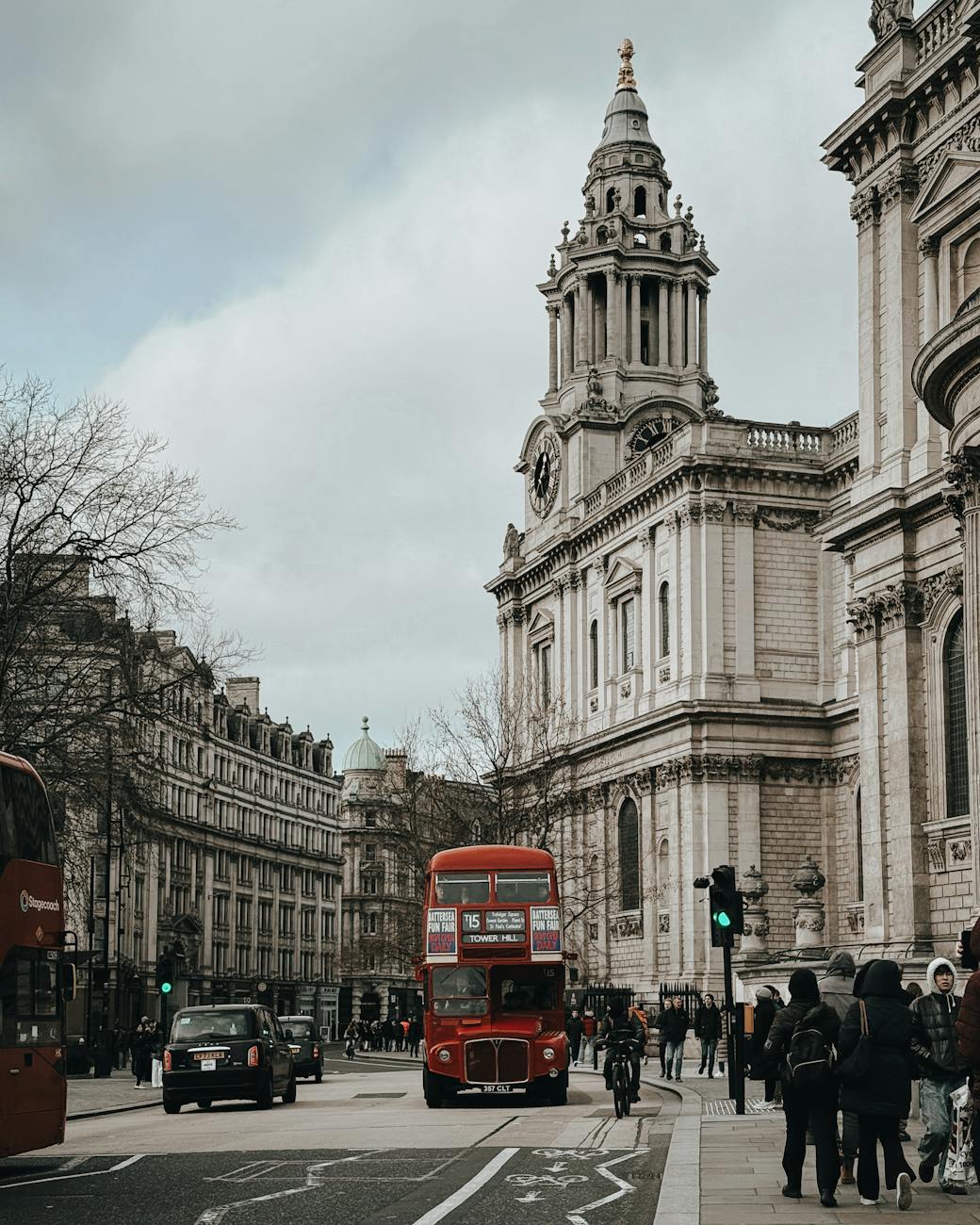
I notice how literature lingers in the pavements in London. I’ve found this more and more the longer I’ve lived here. After all, ‘when a man is tired of London, he is tired of life’, as Samuel Johnson wrote. Even on the most ordinary days, when I’m simply walking to the shops or having a coffee, a remembered passage from Woolf or Dickens reshapes the atmosphere, giving a quiet strangeness to what otherwise might seem familiar. Literary walks don’t need to be formal, nor do they require a tour group—although there is a place for those. Instead, they are an everyday practice of letting what we’ve read colour what we see, and in turn allowing the city to read us back.
Cities are always already read, even before we open a book about them. Our streets teem with signs and symbols: shopfront typography, graffiti tags, the peculiar poetics of street names, layering like muddy sediment the history of an ancient city, each one carrying some buried narrative. Roland Barthes, in Mythologies, reminds us that everyday signs are never innocent, but instead they come loaded with cultural meaning. Michel de Certeau goes further, describing walking itself as a kind of writing: each step a form of mark-making, each turn a marginal note. Perhaps this is why walking has become one of my most reliable contemplative practices; I can never quite shake the sense that London is, in spite of its sublime history, an unfinished text, and that my role as a walker is not only to read but to annotate.
Reading literature set in a city makes us feel less like visitors and more like participants. When I first read Mrs Dalloway, I hadn’t spent much time in London, but the rhythm of Woolf’s sentences gave me an immediate familiarity with the city. Later, when I actually walked those spaces and traced Clarissa’s journey on foot with my students the novel gave me entry points into belonging to a city that didn’t seem materially my own. Literature offers a way of settling without appropriation: it lets us walk streets we may never ‘own’ or even afford to live on, but with a kind of kinship. For me, reading the urban canon—Joyce’s Ulysses for Dublin, Smith’s NW for Willesden—has softened the edges of new places, helping me to live in them with curiosity rather than defensiveness.
Walking with a book’s shadow creates a double vision: the city as it is, and the city as it is imagined. Every time I find myself near Holborn, I see Dickens’s London superimposed on the glassy facades of insurance firms; the ghosts of debtors’ prisons and fog-bound alleys live on in the shadow of a Costa or Pret. And I can’t help but notice how nearly every pub in the vicinity has a plaque reporting that Dickens used to drink there and recounting a famous 17th-century stabbing that took place there. To walk with these texts is to carry a palimpsest in mind, where past and present are layered, sometimes clashing, sometimes harmonising. In my own recent walks, especially since returning to more teaching this year after six years in leadership, I’ve been acutely aware of this doubling. The university campus is also both a physical environment and a palimpsest of earlier student generations—I grow older, but my students, disconcertingly, stay the same age every year. Literature trains us to notice these overlays, and walking keeps the lesson alive.
Literary walking is not only about cities, it is also about the walker. What we bring to the page and to the street matters as much as what the author provides. Some days my walks are brisk and pragmatic; on others, they slow into reverie. I notice how my mood shapes the city I ‘read’, whether the buildings feel inviting or alienating, whether the metaphors I attach are hopeful or heavy. Theorists of psychogeography often emphasise dérive—the unplanned journey or drift—as a mode of breaking free from capitalist rationalisation of space. Yet for me, walking with literature offers a slightly different promise: not only resistance, but companionship. A door knocker shaped like a lion’s head, a tree whose branches look suddenly archetypal, a narrow side alley that seems like it should have its own subplot. Reading tunes our attention and primes us to see texture where before there was only function.
There is also a social dimension to literary walking. Books are companions, but so too are the people we share them with. When I’ve brought novels into reading groups or teaching seminars, I’ve been struck by how each reader brings a different walk through the same text. These conversations remind me that the city is never read alone—it is always interpreted collectively, shaped by a multiplicity of histories. I think of my own upcoming groups—the Living a Course a Course in Miracles study group or the weekly Creative Flow Sessions that are beginning this autumn—as spaces where such collective interpretations of experience can flourish, even if not always tethered to literal walking.
In many ways, literary walking is about staying with a place rather than consuming it. When I moved to Hong Kong, I was initially so overcome by the immensity of it that I bought a fancy camera to help me train my vision on the particulars; when I visit Stockholm, my favourite city in the world after London, I find a space that is, inversely, more human-scale. London is a capital somewhere in between, neither entirely comforting to the human spirit or form, nor entirely forbidding. One never tires of London because it takes work, practice, and grit to live in London.
Cities are often perceived as destinations to be ‘done’, sights to be checked off in rapid succession. But literary walking resists that tempo. It asks us to linger, to reread, to take a slower pace. To walk with a book in mind is to inhabit a place rather than extract from it. In this sense, walking becomes a small ecological ethic, a way of living lightly while seeing deeply. The practice is never finished, just as no book is ever fully read. Each walk is another opportunity for literature to accompany us, shaping how we see and how we are perceived.
An Invitation to Walk With Me (Figuratively at least)
What books have changed the way you walk your city? I’d love to hear your reflections—share them in the comments or reply if you’re reading this via newsletter. If you’d like to explore more practices that blend literature, creativity, and contemplative living, you’re warmly invited to join our Weekly Creative Flow Sessions this autumn or the new 18-month reading cycle of A Course in Miracles.
As autumn approaches, I hope your own walks—whether with books, with friends, or simply with yourself—offer you fresh ways of seeing the cities you call home.
Discover more from Allan Johnson, PhD
Subscribe to get the latest posts sent to your email.
