It’s not very often that my research requires me to get involved with something as interesting as archeology, but in tying up some last pieces for my new book The Vitality of Influence: Alan Hollinghurst and a History of Image (Palgrave Macmillan, early 2014) I have found myself tracking down archeological digs in some surprising places.
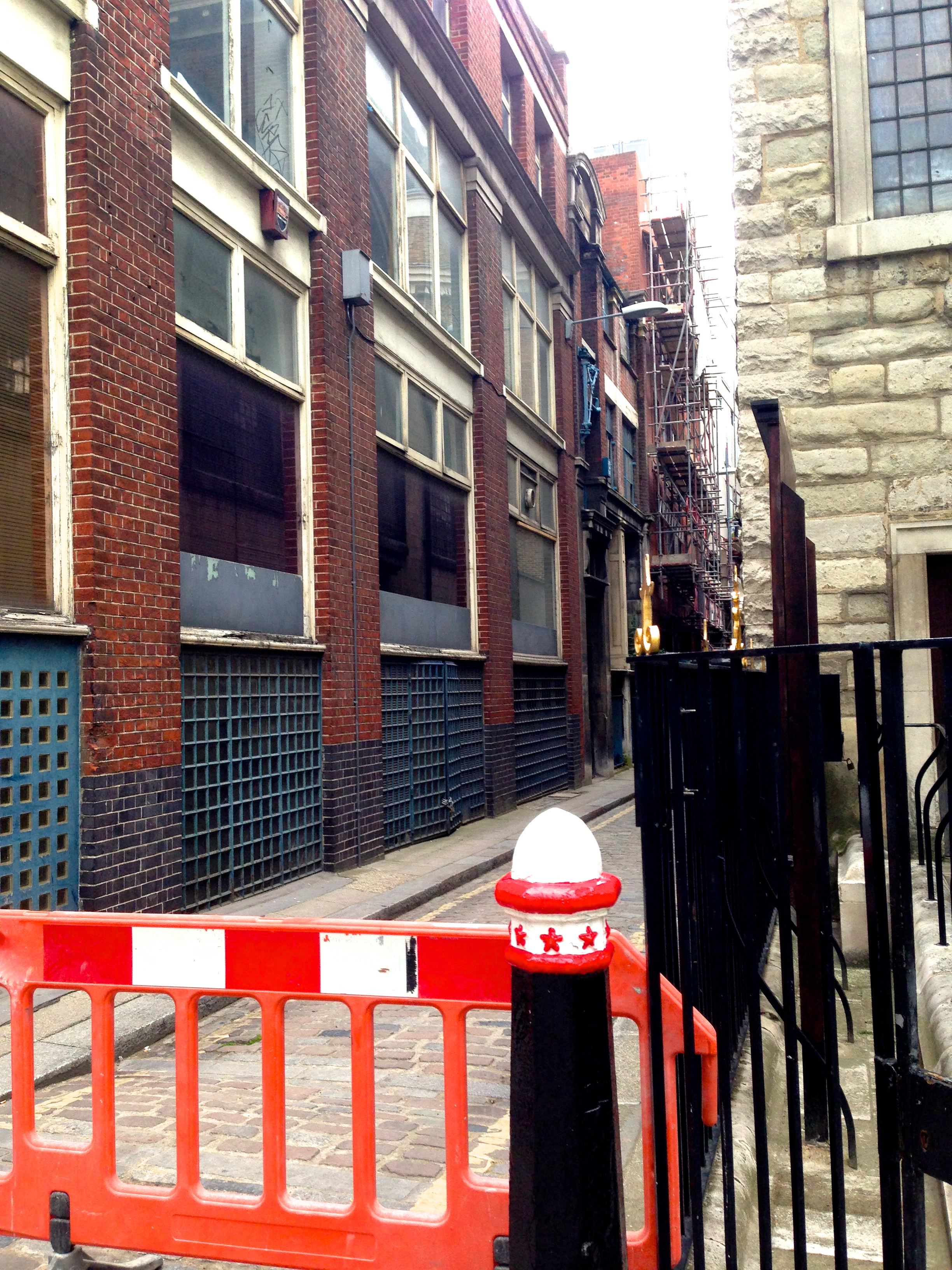
At the centre of Hollinghurst’s 1988 début The Swimming-Pool Library is the grand home of Lord Charles Nantwich, which is somewhat awkwardly hanging on in the City of London as the last reminder of a very different time. One of the most fascinating features of Charles’s house is that it is covering the remains of a Roman bath, which serves as one of the points of reference for the novel’s paradoxical title.
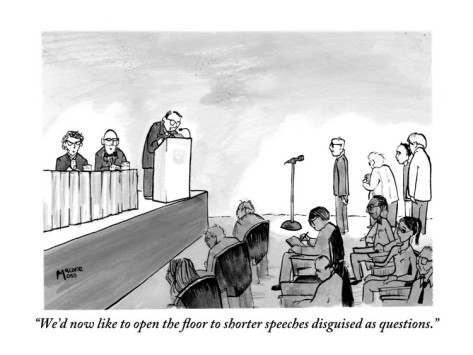
I have always been a fan of New Yorker cartoons, and this Steve Macone piece from 2010 seems to hit closer to home than most. Macone’s cartoon perfectly captures one of the several strange things that can happen during a conference Q&A.
In addition to the ‘shorter speeches disguised as questions’ there are also a number of other distinct flavours of questions–some good, some bad, but all of which we have seen before.
The Courtesy Question: There is always someone willing to fill the awkward silence when no one has a question to ask. The Courtesy Questions is flimsy at the best of times, and asked merely as a kindness to the presenter. Thank you and moving on.
The Tell-Us-What-You-Want-To-Tell-Us Question: This might be only one step above the Courtesy Question, but it is a question everyone is thrilled to receive. The Tell-Us-What-You-Want-To-Tell-Us Question is so broad that you can say whatever you want. It’s a great opportunity to recite the parts of your paper you hadn’t gotten to when the moderator called time.
The Factual Actual Question: There is no harm in wanting to know a bit more. Sometimes an audience member actually does genuinely want to know more about something you said: a particular source, a particular concept, a particular line of reasoning. These might sometimes look like Courtesy Questions, but when you see more than a handful of pens scribbling during your response, you know that you have probably just been hit with a Factual Actual Question.
The Tell-Me-What-Your-Paper-Was-About Question: This question might be disguised as a Factual Actual Question, but its ultimate goal is quite different: to get a summary of what you have just said. Usually this isn’t because someone wants you to do all the work for them. It’s more likely that, although your paper works fine when written, it is genuinely too challenging to follow when read. The lesson from this question is that reading and speaking are two very different things.
Looking over the roofs of Muswell Hill Place and Alexandra Gardens towards Springfield Avenue and the Alexandra Palace TV mast, from the viaduct at St James’s Lane. (Photo credit: Wikipedia)
British domestic architecture is largely made up of strange angles and peculiar proportions. Or, at least that was the case in the kinds of flats I lived in during most of my twenties, when I was, first, a student and, later, a young academic with precious little dosh for rent. One flat had soaring double-height ceilings, impossibly narrow hallways, and, in my bedroom in the back, an overly wide Georgian door that opened to show shelves 3 inches deep. Even my hairbrush didn’t fit. In a later flat in Muswell Hill in London, the most exciting feature was a tiny window, three-stories up, that opened onto a massive flat roof the size of the kitchen, bathroom, hallway, and bedroom below. It was covered in gravel, but I spent many evenings there looking up to Alexandra Palace in the distance.
Neither of these flats were being put to the use they were intended, and the proportions of living seemed charmingly off-kilter because of that. The former had been a Victorian boarding house in Leeds, before walls were shifted and latches were added to accommodate legions of Red-Brick students. The latter began life as a middle-class family home in a leafy suburb that was neither then nor now serviced by the Tube. But it has lately been carved up and made home to one middle-class family downstairs and several eager young career men upstairs, nearly doubling the original number of inhabitants. From slim crevices to capacious outdoor landings, every feature of these buildings was always too big or too small. Or, more regularly, both too big and too small at the same time.
This week I reminded my students that if they are serious about getting a good job in writing or communications then they need to get serious about their media consumption. That means: a daily newspaper with an international focus, a weekly news magazine, and two to three high-quality monthly magazines. ‘But that doesn’t require you to read everything cover-to-cover’, I assured 22 horrified faces. Rather, a good media consumption strategy gives you the framework to dip in and out of the most important events in the world, and allows you to feel connected to ideas bigger than yourself. During interviews for the jobs that students with an English Studies degree will go into–marketing, journalism, PR, publishing, teaching, to name merely a few–the question of ‘how do you consume your media?’ is becoming an increasingly common starting point. And the response needs to be a bit more developed than ‘oh, I read Heat every Tuesday.’
It is advice that I give to students every year, but with the recent announcement that later this summer Google will be dropping Google Reader–their pleasingly functional and well-connected RSS reading platform–I began to think once again about how I consume my media. I will be the first to admit that my methods of media consumption have been, until recently, what might be called… shady. I’m of the generation of Napster and torrents, after all. I’m part of the first generation of people who had computers in their bedrooms as children, paving the way for a bit of illegal downloading beginning with the era of Sugar Ray and Savage Garden and moving onward. When a good friend of mine introduced me to the world of illegal .epub files for my Kindle, I was hooked. But putting aside all the economic and moral arguments against illegal file sharing–and I do have a profound respect for musicians and writers, and believe they are owed fair compensation for their work–I have my own personal reasons for recently taking my media consumption more seriously. And by that, I mean, exchanging cold, hard (digital) cash for the pleasure of consuming.
Even the flurry of live tweeting from MLA 2013 has not been enough to distract the academic community from Susan Adams’ recent article in Forbes. In a largely tongue-in-cheek featurette with a veneer of statistical clout and some grand proclamations, Adams declared university professors to have ‘The Least Stressful Job of 2013’. The backlash was swift, with over 150 academics quickly pointing out precisely why and how the life of a university educator is surely not lacking in stress.
I have no other points to add these comments, but I can’t help but think of an almost identical article from August of last year. In her popular blog ‘A Don’s Life’, Professor Mary Beard lamented the absurd job postings for university comms and PR positions. As she sees it, the job listings were a mess of ridiculous collocations and nonsensical phraseology, a feature that she subtly suggests is indicative of confused and perhaps entirely unnecessary positions within the marketing department of the university. Professor Beard’s article is certainly worth a read. But in the context of the recent Forbes article, I want to reproduce here my own comment to Beard, which sparked some discussion of its own:
As a humanities academic who spent a year working in the brand/design/communications sector while writing a book on the topic, I read this post with interest. In the same way that most people will view academic job postings as completely meaningless (e.g. ‘the successful candidate will contribute to the department’s international profile for research and teaching….’), many academics lack an understanding of what it is that many professionals actually do on a day-to-day basis. It’s no one’s fault, but perhaps suggests that ideal of knowledge transfer, as an ‘activity’ rather than simply a matter of course, is still maintaining a certain uncomfortable distance between academics and those in ‘hard business’. A job listing for, let’s say, a Senior Lecturer in Art History will contain loads of discipline-specific jargon that doesn’t reveal what it actually is that the person will do with their time–instead, it gestures toward the force of personality required of the successful candidate. Precisely the same is true in the communications, PR, and brand worlds. The people who get these jobs at the OU will be undertaking challenges that not many academics could face, and to consider that the funding for these posts might be more profitably channeled toward research seems to undermine the very premise of the modern university: to begin breaking down the barriers between the ivory tower, public policy, and hard business. We as academics have heard many times the complaints that we work only a handful of weeks a year and do very little, all on a hugely inflated salary. Yet we recognize that people who make these complaints simply don’t understand what it is that we do. In turn, perhaps we should make an effort to understand what it is that other people do as well.
The comments to Adams’ Forbes article are precisely the type of response that I discussed: the academic community’s backlash against unfair portrayals of working conditions in higher education. Adams has since issued a gracious addendum to her article which takes these responses into account. But with the recent discussion surrounding her findings, it seems an ideal time to re-evaluate how academics view those in positions outside of academia.
I am sure that Beard’s certain distrust of professional roles in media and communications is not unique in the academy. Indeed, the many comments to her post show that there are an awful lot of academics who fear that a Barnum-esque American business lexicon has entered the British university system. But as my comments to Beard’s post maintain, it’s entirely unfair to take issue with charges leveled against our profession whilst still distrusting the business world to the point of repulsion. In the twenty first century it is essential for academics to speak freely with and work well alongside their business compatriots. And the inverse, of course, is true as well.
Does academia bring with it the sort of acute stress an account manager or marketing director might feel when faced with a project deadline, a slack team, and an impossible brief? Perhaps not. But academia certainly does bring stress of its own. There is, for example, the 8-15 year period of training and apprenticeship, during which pay is negligible and prospects are slim. There is the extraordinary student loan debt which must be addressed during this very same period of penury. After all of that, there are the 80-hour weeks and endless nights of marking. And there are, as a bonus, the publishing requirements that can leave even the most confident and productive writers blanching.
Of course it is unfair to call university professors the least stressed workers of 2013. Though perhaps it is also unfair to call tailors or hairdressers–two other finalists on the list–similarly free of stress. Every profession brings with it its own challenges, pleasures, and disappointments. Many academics value the unique privileges of their position, while never forgetting the stress that these pleasures bring. And in just the same way, more academics should seek to understand what it is, exactly, other professionals do that make them valuable and unique.
It’s easy to forget that philosophy was never meant to be a spectator sport. Long before it became something we studied, it was something people did. Philosophy began as a way of arranging a day, training attention, shaping character, and orienting oneself toward what mattered in life. It didn’t live in texts, but in habits: how one…
I’ve been thinking a lot lately about the word ‘equinamity’: what it really means, why we use it so infrequently, and how we can translate the inner stillness of equinamity into outer action. It’s an old question, of course. The contemplative traditions are full of cautions against mistaking withdrawal for wisdom, or serenity for disengagement.…
There is something about the craft of bookbinding. It re-educates the hands, and through them, the nervous system. It returns time to its proper scale. I’ve been thinking about this more since settling into my new flat, which—by a small but meaningful stroke of grace—includes a dedicated studio space. For the first time in years,…