
Following a blog post last week on using Kindle in teaching, I asked: “do you think location numbers (rather than page numbers) are an adequate form of citation?” I received many responses…
[View the story “Location Numbers in Research?” on Storify]
Following a blog post last week on using Kindle in teaching, I asked: “do you think location numbers (rather than page numbers) are an adequate form of citation?” I received many responses…
[View the story “Location Numbers in Research?” on Storify]

I have been using Evernote since the early days of my PhD (see how I get Kindle notes into Evernote for my teaching), so I was thrilled when they invited me to be their Higher Education Ambassador. Starting today I will get to do lots of cool stuff with them–a bit of traveling, a bit of writing, a bit of speaking. Awesome!
So, to mark the occasion, I have some great Evernote stuff to give away. Here’s how you can get it:
To enter, respond to the following question in the comments at the bottom of this post: ‘How do you organize your teaching, research, and writing? Paper, digital, post-its? File folders, shoe boxes, digital tablets?’ Everyone has their own system–what is yours?
This isn’t just for academics, but for anyone who writes, thinks, doodles, ponders, pilfers, or philosophizes. And there are some great prizes to be won…
Entries close at 11:59pm GMT on 12 December 2012 and winners will be chosen randomly from all entries on 13 December 2012. Make sure that you include your e-mail address when you comment so I can contact you.
Now that Kindles outnumber hard copies by a margin of nearly 2-1 in my classes, I have decided that the time really has come to think about ways to integrate Kindle into my teaching and research workflow.
In order to make this work, I needed a good way to get Kindle highlights and notes into Evernote, my note-taking software of choice. Because there is currently no way to directly link Kindle and Evernote, I set out to find a way to push Kindle content into Evernote with minimal effort. After a weekend of experimentation with unnecessarily complex workarounds, I found an elegant and simple solution:

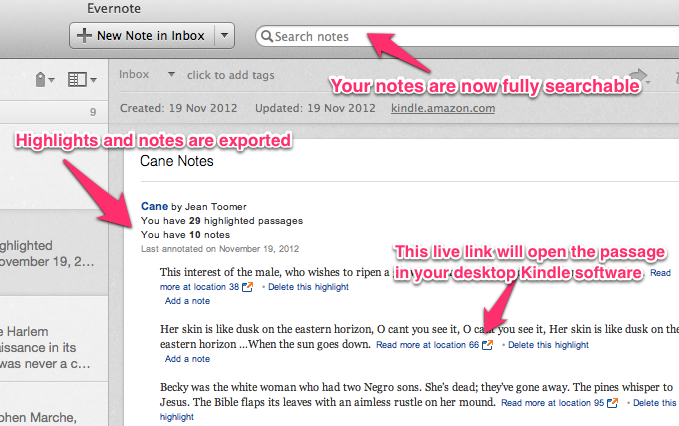
How are you integrating your Kindle into your teaching or research workflow? What other workarounds have you come up with for making the best use of e-readers?

The job of the humanities academic has always been to absorb large amounts of content, evaluate it, synthesize it, and portray the results in a way that will be relevant and engaging to an audience (whether that audience be students, peers, or the wider society). In the information age, we have a vast array of new tools to not only help us sort through this content, but also to shape it and share it.
I am a big fan of the ‘whole-person’ style of tweeting, with a mixture of general chatter (e.g. “it’s Thai for dinner!”) and valuable curated content (e.g. “great article at http://…”). A mixture of about 30% chatter and 70% content is seen as a golden standard by those in the brand and digital media world, and seems to suit academic tweeting down to a T. This blend of chatter and content situates the academic lifestyle in a very real and very human context, while also providing some helpful information to colleagues. Remember, sharing is caring!
But continually finding that 70% of curated content can be an onerous task, especially now, when desks are piled with unmarked essays and grant application deadlines are looming. To make sure that my Twitter feed is filled with links that the academic community may find interesting, I use a couple of helpful apps to make the process as easy for me as possible. I spend an hour every Sunday getting high-quality Twitter content ready for the coming week, which leaves me the rest of the week to tweet about the interesting new recipe I’ve made for dinner or the dance routines on Strictly.
My Twitter workflow for curated content is based on David Allen’s infamous GTD method, as is the flowchart that outlines it. It goes like this. Throughout the week I scan through the content that comes through to my RSS reader (I happen to use NewsRack). The content is a mixture of my main interests: academia, of course, but also fashion, design, media, culture, theatre, and architecture. If I can read the post in less than 2 minutes (that magical cutoff point for GTDers) then I have a read, and tweet it if I think it is worthwhile. But if it will take longer than 2 minutes, I send it straight to Pocket, a read-it-later app which links directly with NewsRack.
Continue reading “Using Twitter for Curated Academic Content”

Over the past several years I have experimented with experiential learning in my teaching: how it’s presented, how it’s managed, and how it’s evaluated. This semester I have rolled out a full-scale experiential learning component for my module on the Twentieth-Century British Novel–and this has only come after a great deal of trial and error. For this part of the module assessment, students are required to write an essay reflecting on one of the several experiential learning activities taking place over the course of the semester. In this essay they must first identify how they understood one specific aspect of a text we studied before the experiential learning activity, and then how their understanding of that aspect changed or was modified after the activity. This type of critical analysis demands a great deal of self-reflexivity from students, but I have been extremely pleased with how the work has gone so far. In previous years, students haven’t so easily taken to the challenges of self-reflexive thinking, but there have been five key lessons that I have learned along the way:
1) Explicitly introduce the goals of experiential learning
It is often students–rather than faculty boards or senior colleagues–who are most resistant to innovation in learning and teaching. Students generally begin university with a clear preconception of what learning will entail (e.g. read book, listen to lecture, discuss in seminar, write essay), and breaking from this anticipated course of learning can quickly create confusion or concern. This confusion is an issue that I address head-on. When introducing experiential learning assignments or activities, I very explicitly explain the goals and objectives. ‘We are working on recognizing that the literature we study doesn’t exist in a vacuum–it is still being molded and changed by our perceptions of the world around us. As we begin to recognize how our daily lives impact upon our understanding of literature, we not only become stronger readers of literature, but stronger readers of everything that surrounds us.’ This big-picture overview really does help students to understand how experiential learning fits into their programme as a whole, and what they might hope to get out of it.
Continue reading “Making the Most Out of Experiential Learning: 5 Things That Work for Me”