Refining Technique in Academic Writing

Typewriters


I wrote briefly last week about the importance of technique in academic writing.   Academic writing is, above all else, a specialised form of communication, which remains true whether we are teaching essay writing to first year students or working on a journal article addressing our research. Articles, essays, theses, and dissertations are all modes of communication that serve to share with readers how we have approached our topic and the conclusions to which we have come. And the success of this communication is dependent each writer’s display of technical mastery. This does not, of course, mean mindlessly following the model, although many writing teachers would agree that is preferable to write with good technique and be a bit monotonous than to write with no technique and lose the reader from the outset.

The aim of good technique is to create a fluid and organic microcosmic structure. What this means is, simply: 1) each paragraph is a self-contained unit, 2) which contributes to the argument of its individual section, 3) which contributes to the argument of its chapter, 4) which contributes to the argument of the work as a whole. No matter the length of the writing, these key building blocks will always stay the same, and should always help your reader to enter into your analysis with the tools to engage meaningfully with what you have to say.

Continue reading “Refining Technique in Academic Writing”

‘Technique’ and Academic Writing

Practitioners of the fine and performing arts are well acquainted with the notion of ‘technique’. One hears ‘technique’ spoken of regularly by commentators, adjudicators, and reviewers of the arts, who use term to characterise the success or failure of an artistic undertaking. The study of technique forms the core of advanced training in many disciplines, including dance, acting, music, voice, visual art, and design. For dancers, ‘technique’ entails an understanding of the lines a body casts in space, and an ability to manipulate and control these lines as required for various dance
styles. The ‘technique’ of singers involves the development and control of sound-producing resonators, and the ability to produce the desired sounds with as little strain and stress on the body as possible.

And in some instances, the technique has been extensively documented and codified. Most professional actors today have been trained in at least a derivative form of the technique promoted by Constantin Stanislavski and Lee Strasberg, and, even more exhaustive than that, Bharata Natyam—the national dance of India—has a wide vocabulary of specific expressive hand gestures that each dancer must learn and perfect. These gestures form one component of the ‘technique’ of Bharata Natyam, and serve not only as an elemental part of the dancer’s training, but also as a clear benchmark of the dancer’s successful or incomplete treatment of the style.  ‘Technique’ is the specialist code followed by practitioners in a particular discipline. ‘Technique’ comprises the rules that first must be learned fully before they can be bent, shaped, and reworked in order to produce the desired effect.

Continue reading “‘Technique’ and Academic Writing”

Alan Hollinghurst and Some Archeological Digging

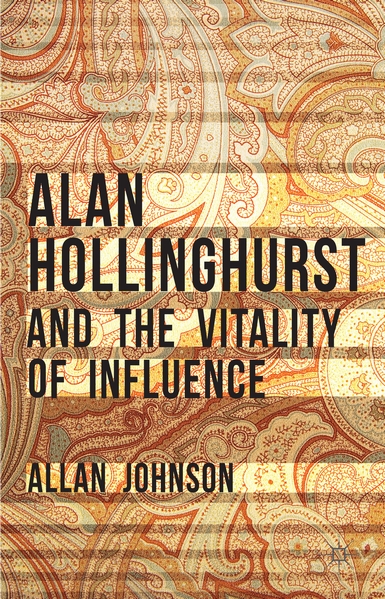
It’s not very often that my research requires me to get involved with something as interesting as archeology, but in tying up some last pieces for my new book The Vitality of Influence: Alan Hollinghurst and a History of Image (Palgrave Macmillan, early 2014) I have found myself tracking down archeological digs in some surprising places.

Skinner's Lane, the City of London

At the centre of Hollinghurst’s 1988 début The Swimming-Pool Library is the grand home of Lord Charles Nantwich, which is somewhat awkwardly hanging on in the City of London as the last reminder of a very different time.  One of the most fascinating features of Charles’s house is that it is covering the remains of a Roman bath, which serves as one of the points of reference for the novel’s paradoxical title.

Continue reading “Alan Hollinghurst and Some Archeological Digging”

The Questions Academics Ask: Conference Edition

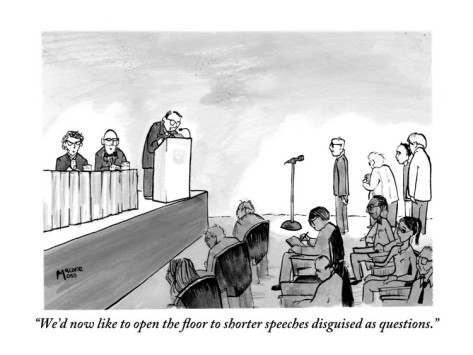
Steve Macone, The New YorkerI have always been a fan of New Yorker cartoons, and this Steve Macone piece from 2010 seems to hit closer to home than most.   Macone’s cartoon perfectly captures one of the several strange things that can happen during a conference Q&A.

In addition to the ‘shorter speeches disguised as questions’ there are also a number of other distinct flavours of questions–some good, some bad, but all of which we have seen before.

  • The Courtesy Question: There is always someone willing to fill the awkward silence when no one has a question to ask.  The Courtesy Questions is flimsy at the best of times, and asked merely as a kindness to the presenter.  Thank you and moving on.
  • The Tell-Us-What-You-Want-To-Tell-Us Question: This might be only one step above the Courtesy Question, but it is a question everyone is thrilled to receive.  The Tell-Us-What-You-Want-To-Tell-Us Question is so broad that you can say whatever you want.  It’s a great opportunity  to recite the parts of your paper you hadn’t gotten to when the moderator called time.
  • The Factual Actual Question: There is no harm in wanting to know a bit more.  Sometimes an audience member actually does genuinely want to know more about something you said: a particular source, a particular concept, a particular line of reasoning.  These might sometimes look like Courtesy Questions, but when you see more than a handful of pens scribbling during your response, you know that you have probably just been hit with a Factual Actual Question.
  • The Tell-Me-What-Your-Paper-Was-About Question: This question might be disguised as a Factual Actual Question, but its ultimate goal is quite different: to get a summary of what you have just said.  Usually this isn’t  because someone wants you to do all the work for them.  It’s more likely that, although your paper works fine when written, it is genuinely  too challenging to follow when read.  The lesson from this question is that reading and speaking are two very different things.

Continue reading “The Questions Academics Ask: Conference Edition”