Mastering 2024 with a Personal Annual Review

Review and reflection are an important part of the creative process, but one that is often underestimated or completely undervalued. Having those moments where we look at the work we’ve completed and realise how we’ve changed and grown as a result, and what new opportunities or challenges present themselves to us in the future, is part of the process of constant iteration and growth.

An annual reflection is an opportunity to reconnect with our purpose and find a greater sense of clarity, recognise growth, and ensure we’re aligned with our long-term goals. It’s also about being more accepting of change, recognising how we have grown over the year, but also that we want to continue to grow in the year ahead. 

Reflection encourages creative innovation, and it’s something I’ve been doing regularly in the last few weeks of December over the last few years. The tool I use to structure the questions of my annual review is what is called the PERMA Model, developed by positive psychologist Martin Seligman. This model provides a holistic framework for understanding and improving our wellbeing and focuses on five essential elements that contribute to a flourishing and truly fulfilling life. 

  • P stands for ‘Positive Emotion’ and emphasises the importance of feeling joy, gratitude and contentment. 
  • E is for ‘Engagement’ and encourages us to seek out activities that put us in a state of flow and immerse us deeply in the world around us. 
  • R stands for ‘Relationships’, recognising the important role of positive social relationships and communities in our overall wellbeing.
  • M refers to ‘Meaning’, encouraging us to find purpose and significance in our actions and behaviours. 
  • Finally, A represents ‘Achievement’ or ‘Accomplishment’, recognising the importance of engaging in and pursuing meaningful challenges to foster a sense of competence and growth within us. 

This model emphasises the interconnectedness of all these elements, asserting that a balance between positive emotions, engagement, relationships, meaning and achievement leads to a more robust and inclusive sense of wellbeing. 

The PERMA model is a practical guide to improving our overall life satisfaction and a tool to help us reflect on the past year and plan for the year ahead. It can serve as a framework for our personal annual review and provides a nuanced lens through which we can evaluate the different facets of our lives. 

The strength of the model is that it allows us to holistically assess our situation and our progress this year, so that the annual review goes beyond simply setting goals. Instead, this approach encourages us to explore our emotional wellbeing as part of our creative process. It encourages quality social relationships and the pursuit of activities that contribute to a greater sense of purpose as you move towards your personal goal. 

PERMA ensures that every element of a balanced life is brought into focus. Like any other annual review it incorporates a focus on achievements, but it doesn’t stop there, as it emphasises the importance of living in a way that aligns with with our personal values and which fosters a deep sense of purpose. Elements of personal growth such as engagement and purpose are placed centre stage and we’re asked to reflect on how we have developed and what we have learned. 

PERMA can transform our personal review from a mere checklist of achievements into a powerful journey of reflection. It invites us to explore emotions, evaluate commitment, cultivate meaningful relationships, find goals and celebrate successes, encouraging a continuous and adaptive approach to our self-improvement. 

To do your personal review, start by finding a comfortable, private space and take some time to make it really cosy and inviting for you. This could mean lighting a candle or pouring yourself a cup of tea or coffee, perhaps with some music playing in the background. And then sit down with a notebook and write down your answers to these PERMA questions. Trust your instincts and don’t overthink your response. 

Positive Emotions (P):

  • What were the most joyful moments you experienced throughout the past year?
  • Reflecting on challenging times, how did you cultivate positive emotions to navigate difficulties?
  • Did you engage in activities that brought you a sense of contentment and fulfilment?
  • How can you incorporate more activities that elicit positive emotions into the upcoming year?

Engagement (E):

  • Identify the activities or projects that made you feel completely absorbed and engaged.
  • Were there times when you experienced a state of flow, losing track of time while working on something meaningful?
  • Did you pursue hobbies or interests that brought a deep sense of satisfaction and engagement?
  • How can you structure your daily or weekly routine to include more activities that bring a sense of engagement?

Relationships (R):

  • Reflect on the quality of your relationships with friends, family, and colleagues.
  • Were there any conflicts or challenges in your relationships that need resolution or improvement?
  • What actions did you take to strengthen existing relationships or cultivate new meaningful connections?
  • How can you prioritise and nurture your relationships in the upcoming year?

Meaning (M):

  • Consider the goals and values that provided a sense of purpose in the past year.
  • Were there moments when you questioned or reaffirmed your sense of meaning and purpose?
  • Reflect on activities that aligned with your personal values and contributed to a greater sense of meaning.
  • What new goals or areas of focus can you explore to enhance the overall meaning in your life?

Accomplishment/Achievement (A):

  • List your significant achievements and accomplishments over the past year.
  • Reflect on goals you set for yourself and assess the progress you made toward achieving them.
  • Were there any setbacks or obstacles that impacted your sense of achievement, and how did you overcome them?
  • What new goals or challenges do you want to set for yourself in the coming year?

In The Path of Mindful Living: A 21-Day Mindfulness Companion, I lead you through a series of self-guided mindfulness exercises and show you how to bring mindfulness into your daily life. Readers of my blog can download the workbook and pullout charts for only £6.

Research Workflow for Academics: The Best of Digital and Analogue Working Together

research workflow


In his presentation at the ‘Humanities Computing: Formal Methods, Experimental Practice’ symposium at King’s College London in 2000, John Unsworth described the seven ‘scholarly primitives’, that is, the ‘basic functions common to scholarly activity across disciplines, over time, and independent of theoretical orientation’:

  • Discovering
  • Annotating
  • Comparing
  • Referring
  • Sampling
  • Illustrating
  • Representing

A similar taxonomy was described by Ernest Boyer in Scholarship Reconsidered: Priorities of the Professoriate.  Boyer’s model of scholarship refers to four interrelated areas of practice: ‘the scholarship of discovery; the scholarship of integration; the scholarship of application; and the scholarship of teaching.’  While the nature of scholarly work hasn’t changed much since Unsworth’s and Boyer’s observations, the way in which we go about it and the goals that we hope to meet by completing it certainly have.

The workflow that I use for my academic research draws upon Boyer’s model of scholarship and Unsworth’s scholarly primitives, and aims to both isolate the individual components of scholarly work while recognising the inherent relationship and necessary overlap between these components.  In order to meet these aims, I needed a workflow that fulfilled several requirements:

  1. Assign tasks to the platform best designed for that task.  Evernote is excellent for taking notes, for example, but doesn’t stand up well to PDF management.
  2. Integrate analogue components at suitable points. I love notebooks and pens so this is largely a personal preference, but considerable research shows longhand writing aids in memory and comprehension.
  3. Create a frictionless system that allows for collaboration. When working with collaborators or research assistants, the workflow can be opened up at strategic points, while still offering privacy.
  4. Exist in the cloud. My academic writing takes place in my office, at home, and on the road; it happens on computers, iPads, and iPhones. I need to be able to reach everything securely in the cloud and across multiple platforms.
  5. Look visually appealing, and capture content in a visually appealing way. This isn’t just about aesthetics.  Visual appeal is a significant aspect of the success of digital spaces.

As it turns out, these five objectives are often at odds with one another.  Creating a frictionless system (#3) is easiest if only one programme is used, but then there will likely be tasks that are not suited to that programme (#1) (this is often the issue when all aspects of research and writing live exclusively in Scrivener or Evernote).  If the workflow exists securely in the cloud (#4), then it seems counterintuitive to involve analogue components (#2).

The workflow that I use takes the best of digital and analogue research and puts it into an adaptable, frictionless, and appealing system.  I begin by uploading articles to Papers and cleaning up metadata.  As I read the article in Papers, I highlight important passages, but keep my written notes and commentary separately in longhand form in my notebook.  With a clever shortcut in Papers (⌃⇧C), I can copy the full citation, all highlighted text, and associated page numbers of these highlights.  This is then pasted into a new Evernote note along with the link to the article in Papers (Edit > Copy As > Papers Link).  In both Papers and Evernote I rely on the same tagging conventions.

The outputs of this workflow are important: 1) PDFs continue to livein  Papers where they can be organised, tagged, and read in the most efficient way, 2) notes live in Evernote where they add to a growing commonplace book of research, and 3) commentary and ideas for future research live in a notebook where I can reflect upon them at a later point.  Of course, any workflow should stay flexible–already I am considering moving from Word to Scrivener for drafting, and from Papers to Mendeley for PDF management–but no matter how this workflow continues to evolve, it will always accept the distinctiveness of each component of scholarly work while acknowledging the necessary overlapping between these components.

15 Flags: How I Create Habits for Writing

I am constantly searching for ways to better integrate my digital life into the world of paper, pens, and printed materials that I still love (here, here, and here).  Although there are countless apps available to help create and track new habits–many of which gamify the traditional 21-days rule of habit formation with some very fun results–I have found the best way for me to track my habits is with a stack of sticky flags and my Moleskine.

Continue reading “15 Flags: How I Create Habits for Writing”

4 Tags That Make Sense of It All: Best Practice for Tagging Academic Notes

tags

2013 is already looking like a busy year for me, not least because of an exciting move from the University of London to City University of Hong Kong.  That means new courses, new students, new administrative systems, and a lot of new projects.  Since I have set some time aside this week to take stock and review my plans for the coming year, I wanted to share one of the things that keeps my note-taking organized and ultimately helps to support my work as an academic: a clear, consistent tagging system that I use everywhere I can.

The academic life is a chaotic mixture of teaching, research, service, knowledge transfer, partnerships, publicity, and planning, so it has been important for me to find a way to seamlessly blend these strands.  To this end, every piece of information that I put into Evernote or Things immediately gets these types of tags (I use the hashtag to denote a type of tag–these don’t actually form part of the tag itself):

Context > #Output > #Topic > #X-Ref

Because I use this same tagging system in both my task manager and my note taking software, it is incredibly easy to cross-reference details or to find the information that I need.  Before I explain how these tags function within Evernote and Things, here’s a quick summary of each:

Continue reading “4 Tags That Make Sense of It All: Best Practice for Tagging Academic Notes”

Tutorial: Getting Kindle into Evernote

Now that Kindles outnumber hard copies by a margin of nearly 2-1 in my classes,  I have decided that the time really has come to think about ways to integrate Kindle into my teaching and research workflow.

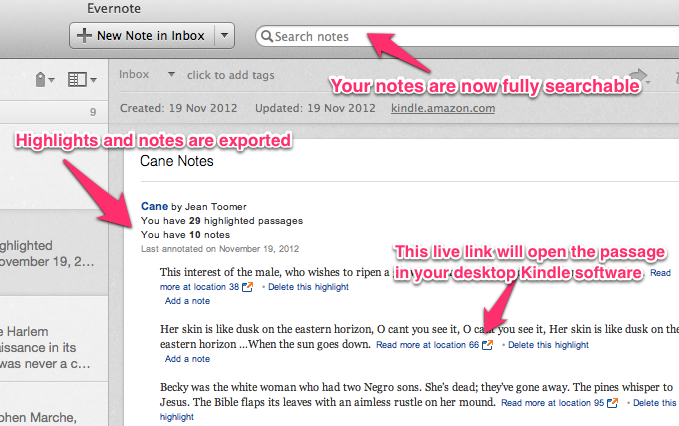
In order to make this work, I needed a good way to get Kindle highlights and notes into Evernote, my note-taking software of choice.  Because there is currently no way to directly link Kindle and Evernote, I set out to find a way to push Kindle content into Evernote with minimal effort.  After a weekend of experimentation with unnecessarily complex workarounds, I found an elegant and simple solution:

  1. Login to your Kindle at https://kindle.amazon.com/ and click on ‘Your Highlights’
  2. Use the Evernote Web Clipper (free: Firefox) to ‘Clip Article’ (this will select only the book notes/highlights for clipping, and not the full webpage).  Relevant metadata can be added at this stage.
  3. Both the notes and the highlights from your Kindle will now be in Evernote, beautifully organized and fully searchable.  The best part is that clicking on any of the ‘Read more at location…’ links will open that passage in your desktop Kindle app for further review.

How are you integrating your Kindle into your teaching or research workflow?  What other workarounds have you come up with for making the best use of e-readers?