Embracing Craft in Academia: Reflections on Sabbatical

Academia, for all its bureaucratic scaffolding and metricisation (neither of which, in spite of what many would have us believe, is newly arrived on the scene), has always seemed to me less an outcome and more a craft. The language we use is linear and progressive—impact, output, key performance indicators—but the experience is slower and quieter. What looks from the outside like a trajectory of advancement often feels, from the inside, like the painstaking rhythms of practice: revisiting texts, refining an argument, shaping a paragraph until it carries its own weight.

Beginning a period of sabbatical this month has sharpened this distinction for me. Having the time to work on my next book, on liberal theology in early-20th-century America, is an extraordinary privilege, of course, but also a perturbing reminder that the rhythms of academic life are neither fixed nor inevitable. After a six-year term as an associate dean, when my diary wasn’t my own and a truly uninterrupted hour for writing was out of the question, I now find myself in a space where mornings are less prescribed, afternoons more open, and evenings less weighed down by the day’s unanswered emails.

This shift has interrupted the treadmill to which I had grown accustomed: no more weekly meetings or administrative reports, fewer obligations to the tempo of the institution. The contrast is striking. Career logic dictates constant forward motion, progression, and visibility. Sabbatical interrupts that, slowing time to the pace of craft: immersion, attention, revision. After years of deliberately (and at times aggressively) climbing a ladder, it feels now like I am stepping back into the workshop of what I have actually been trained to do: pore over the historical record to better understand what modernist literature means, and, in doing so, cultivate my own scholarly sensibilities in order to train students to do the same.

The language of career encourages us to think in terms of advancement, but the language of craft invites us to think in terms of depth. Career implies a vertical climb: promotion, recognition, and external markers of success. Craft, by contrast, is iterative and circular: you return to the same problems with new tools, you revisit the same materials with a slightly steadier hand. In my ways, this sabbatical is feeling like an unmistakable return, and whether or not my hand is indeed steadier, it is at the very least different to when I began my career.

Pierre Bourdieu’s account of ‘academic capital’ in Homo Academicus explains much about why universities are structured to reward careerist accumulation: advancement depends on how well one plays the game, converting intellectual labour into recognisable forms of capital. But Richard Sennett’s celebration of craft in The Craftsman reminds us that the deeper meaning of scholarly work is found elsewhere: in the long hours of slow reading, the shaping of sentences, the iterative labour of interpretation. Bourdieu undoubtedly shows us the internal logic of the field, but to treat scholarship as craft is to resist the abstraction of labour into capital and to remain grounded in the work itself, the feel of words under the hand, the quiet satisfaction of making something well.

Craft is built not through dramatic leaps but through the slow accumulation of skill over time. Looking back, I see this clearly in my own trajectory. As an undergraduate, I was awkward but diligent; I once arrived late to an exam with an analogue alarm clock whose battery had died, holding it up as evidence. From those unpolished beginnings to my current role as teacher and writer, what has mattered is not sudden transformation but steady honing.

This accumulation resists the logic of outputs. Like any craft, academic practice is tethered to the materiality of tools, spaces, and habits. The scholar’s equivalents of the potter’s wheel or carpenter’s chisel are the library, the notebook, and the annotated text (I’ve also grown accustomed to my ReMarkable tablet but still feel uneasy when I see my disused notebooks glaring back at me from the shelf). 

My own sabbatical days so far have been marked by relocating books and rediscovering notes I had once scribbled in margins, while rearranging my desk into something that feels more like a workshop than an office. Bruno Latour reminds us in Reassembling the Social that tools are never neutral; they co-constitute practice. Academic work, though often presented as disembodied thought (the ‘output’, the ‘paper’, the ‘impact’), is always materially situated. The desk, the chair, the pen, the screen: they are part of the making.

The pressures of modern academia can make it dangerously easy to forget the craft beneath the career, but the dangers of modern academia can make it just as tempting to ignore the career beneath the craft, an evasion that only feeds the very thing we hoped to resist.

I know this from experience. Six years in middle leadership brought tremendous satisfaction but also a creeping drift away from the hands-on craft of my own research. Strategy and oversight are necessary, but they can displace the intimate contact with sources and sentences that drew me to academia in the first place. Sabbatical is, in that sense, a time to retool: to remember the making at the heart of the work. As Stefan Collini asked in What Are Universities For?, what are we serving if we forget the scholarly craft that justifies the institution itself?

My hope for this sabbatical is to deepen the craft. A book will come out of it, but as a tool rather than a product. I want to give myself permission to linger in primary texts, to sketch ideas without rushing to publication, to think slowly. Projects on attachment and literature, and on contemplative approaches to pedagogy beckon, but I want to approach them less as tasks to be completed than as materials to be worked with patiently.

To see scholarship as craft is to reclaim its artistry from the machinery of career. Universities will continue to speak the language of metrics, rankings, and progression, an essential role, because it is this machinery that maintains the workshop in which scholarship can take place. But we don’t have to speak in the same register. To resist or even repudiate the machine is not to undermine the institution but to create the very conditions in which scholarship can breathe: the space for slow thought, patient practice, and the kind of intellectual labour that no metric can capture.

The machinery of career will always hum in the background, but we needn’t let its clatter drown out the quieter sound of practice itself. If these reflections resonate, I explore them further in The Art of Academic Practice on Substack, a space for thinking together about how scholarship might remain both sustainable and alive.

What is a Course in Miracles?

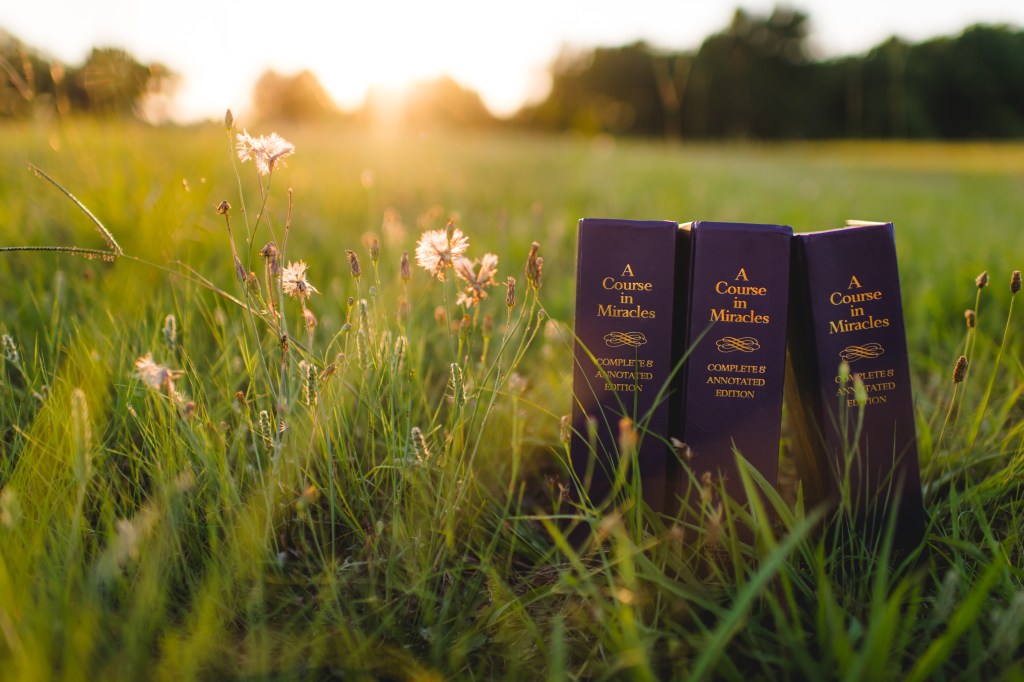
If you were to glance at the cover of A Course in Miracles, you might find it a little intimidating.

Gold-embossed title. No back cover blurb. Dense text. Three volumes.

It doesn’t exactly scream “approachable.”

Add to that a name like A Course in Miracles—and it’s understandable why many people assume it’s either ultra-religious, uncomfortably mystical, or some obscure New Age self-help project from the 1970s.

But here’s the truth, and it might surprise you: The Course is none of those things.

It’s not a religion. It’s not a belief system. And it’s not trying to sell you a new worldview.

At its heart, A Course in Miracles is a method of mental and emotional clarity. A structured way of exploring your perceptions, undoing habitual fear-based thinking, and reclaiming the peace that’s already available beneath the noise of the mind.


So What Is It, Then?

Let’s step back a moment.

The Course was written in the late 1960s and early 70s by Helen Schucman, a clinical psychologist at Columbia University. She described it as a form of inner dictation—words that came to her during a time of personal and professional strain, in response to a growing desire to find “a better way” of relating to the world.

Regardless of how we frame its origin, the Course is remarkable in one key respect: it speaks in symbolic, poetic language, but offers psychologically rigorous insights into how perception works—and how often we are the source of our own suffering without realising it.

It doesn’t ask you to believe in anything. Not in the traditional sense. In fact, one of its opening lines is:

“This is a course in miracles. It is a required course. Only the time you take it is voluntary.”

It’s not referring to belief or theology. It’s referring to a kind of deep inner retraining—a shift in how you meet your thoughts, how you interpret experience, and how you move through relationships, conflict, and uncertainty.


A Practice of Undoing, Not Adding More

Most spiritual systems (and most self-help programs) are about adding more.

More positive habits. More affirmations. More rituals. More goals. More ideas.

The Course is different. It’s not additive—it’s subtractive.

It says, essentially: you don’t need to become better, you need to remember who you already are beneath fear. And the way to remember is by undoing the thoughts that block your natural capacity for peace.

This includes thoughts like:

  • “I need to control this situation to be okay.”
  • “If I don’t prove my worth, I’ll be rejected.”
  • “Other people’s approval determines my value.”
  • “I can’t be happy until X happens.”

Rather than challenging those thoughts intellectually, the Course invites you to bring them into awareness and notice what they cost you. Not in moral terms, but in energy, clarity, and presence.

And then it offers an alternative—a quieter, more honest perception. One that doesn’t come from striving, but from stillness.


So, No Dogma? Really?

There’s a common misunderstanding that A Course in Miracles is part of a larger religious or spiritual institution. But it isn’t. There’s no church. No hierarchy. No initiations. y. And no penalties for disagreement.

The Course explicitly says:

“A universal theology is impossible, but a universal experience is not only possible but necessary.”

That experience, for the Course, is peace.

But not peace as a vague ideal. Peace as a felt experience of spaciousness. Of groundedness. Of being free from the constant effort to defend yourself against life.

Robert Holden, a longtime student and teacher of the Course, often describes it as “spiritual psychotherapy.” He calls it a practical, heartfelt path that clears away the false self—not by condemning it, but by recognising it was never needed in the first place.


What Happens in the Study Group?

This is why the Course is best approached with others.

Not because we need to believe the same thing—but because this kind of inner exploration thrives in gentle company. Somewhere between a book club, a reflection circle, and a slow-burn inner workout, our Sunday evening study group provides a regular space to unpack and embody the Course’s core ideas.

We meet weekly (Sundays 7.30–9.00 pm UK time) and work through the Text in small, digestible sections. There’s no pressure to speak, and no prior knowledge needed. The readings are thoughtfully paced to allow insight to land and ripple in your daily life.

Each session is rooted in quiet attention—not performance. You can reflect aloud, or simply listen and take in what resonates.

Over the course of 18 months, we’ll move through the entire Text—the foundation of the Course—together.

When you sign up, you’ll receive the full reading schedule so you always know what we’re covering.


A Language of Peace, Not Preaching

Because the Course uses words like “miracle” and sometimes borrows spiritual terms from Christian mysticism, some readers initially worry that it’s trying to impose a worldview. But the language is symbolic, not doctrinal.

If a word doesn’t resonate with you, you’re encouraged to reinterpret it in a way that does. The Course doesn’t ask for obedience—it asks for honesty. And it reminds us that truth doesn’t need to be defended; it simply needs to be experienced.

I often tell people: don’t let the language throw you. The Course isn’t asking you to believe in anything “supernatural.” It’s inviting you to recognise how many of your perceptions are distorted by fear—and how peace becomes available when those distortions dissolve.

It’s less “join us” and more “come and see.”


This Is a Practice of Clarity

And clarity, for many of us, is in short supply.

We’re overloaded with information, overwhelmed by choice, and often undernourished when it comes to stillness. What the Course offers is not a shortcut—but a framework. A rhythm. A return.

It’s not for everyone. But if you’re someone who’s felt that traditional paths don’t quite fit… or who’s looking for something deeper than the usual spiritual gloss… you may find in the Course a friend you didn’t know you were waiting for.


🌀 Want to explore with us?
Join the weekly group here → https://www.meetup.com/meetup-group-vjcggkfq/
You’ll receive the full reading schedule upon registration.

What If You Could Train Your Mind for Peace?

We live in a time when personal development is everywhere. Books, podcasts, apps, retreats—offering promises of clarity, balance, transformation. Yet for all the tools we now have at our fingertips, many of us still feel stuck in cycles of stress, comparison, anxiety, and low-level unease. We meditate, journal, affirm—but underneath, a quieter question lingers:

Why do I keep thinking in ways that don’t serve me?

A Course in Miracles doesn’t answer that question in the way most programs or teachings do. It doesn’t try to fix your life. It doesn’t teach you how to manifest your dream job, or how to wake up feeling inspired every morning. It doesn’t even really give advice.

Instead, it offers something far more radical: a training in how to undo fear at the level of thought. Not by fighting it. Not by spiritually bypassing it. But by recognising how much of what we call “reality” is coloured by unconscious habits of mind—and learning, very gently, to choose a different lens.

The Course tells us: “Nothing real can be threatened. Nothing unreal exists. Herein lies the peace of God.”

That sounds mystical, and it is. But it’s also incredibly practical. It points to a profound principle: most of what we spend our time defending, controlling, resisting, or avoiding… isn’t actually real. It’s based on thoughts we’ve inherited, stories we’ve absorbed, and fear patterns we mistake for wisdom.

And yet—there is another way of seeing. And we can learn it. That’s what A Course in Miracles invites us to do.


Not a Religion, But a Mindset Shift

For many people, the word “Course” suggests a study program, while “Miracles” sounds like something out of a spiritual fantasy novel. It’s no wonder people hesitate to pick it up. But behind the slightly intimidating title is something remarkably down-to-earth: a process.

The Course is made up of three parts:

  1. Text that lays out the underlying framework for how we perceive the world, and how we might begin to shift our perception.
  2. Workbook, offering a lesson for every day of the year, each designed to undo a particular block to awareness.
  3. A brief Manual for Teachers, which clarifies how to embody and share the Course’s core principles.

What’s unique about the Course is that it doesn’t ask us to adopt new beliefs. It doesn’t claim to be the only way. In fact, it repeatedly says it’s just one path among many. But it is precise. And if you feel drawn to it, it works deeply.

The Course teaches that the world we see is shaped by the thoughts we think. But unlike most positive psychology, it doesn’t suggest we simply replace negative thoughts with nicer ones. Instead, it asks us to recognise the root of our misperception—fear, judgment, separation—and to bring those habits into awareness, where they can be gently released.

This is not about willpower. It’s not about becoming a better version of yourself. It’s about becoming aware of the part of your mind that thinks it has to struggle for worth, and learning how to soften its grip.


A Path Practised by Many (Even If You Don’t Know It)

You may have encountered the Course without realising it.

Marianne Williamson’s A Return to Love—a breakout spiritual classic in the 1990s—was drawn directly from her experience as a Course student. Oprah, who championed the book, has spoken about how the Course shaped her understanding of forgiveness and emotional responsibility. Gabrielle Bernstein built much of her early work around making Course ideas more accessible to a younger generation.

And yet for all this quiet influence, the Course remains relatively underground—a word-of-mouth path. That’s partly because it’s not easy to summarise. It’s not designed for social media snippets. It asks for attention, and offers clarity in return.


Why Study the Course in a Group?

Like many spiritual texts, A Course in Miracles is best read slowly, with space to reflect, question, and apply. It isn’t something you power through. In fact, many people return to it again and again over years—each time discovering something they didn’t see before.

That’s why I’ve created an 18-month study group, meeting weekly on Sunday evenings from 7.30 to 9.00pm UK time.

We take the Text section by section—reading together, reflecting aloud or in silence, noticing how these teachings meet our real lives. There’s no pressure to contribute, no expectations of previous study. Just an invitation to explore what happens when we train the mind for peace rather than protection.

Once you register, you’ll receive the full reading schedule. You can join each week or come when you can. The rhythm is slow, sustainable, and designed to create space for integration rather than overwhelm.

Some people come with a long-standing interest in the Course. Others are completely new. Some are therapists, teachers, or coaches looking to deepen their personal practice. Others are simply seeking an anchor—something intelligent and transformative that doesn’t ask them to leave their critical thinking behind.


Miracles, Redefined

In the Course, a miracle isn’t a supernatural event. It’s a shift in perception—from fear to love, from control to trust, from attack to understanding. These are the quiet revolutions that can change a life from the inside out.

And they happen, not because we force them, but because we create the conditions for them to arise.

In a world that often feels fast, fragmented, and fraught with uncertainty, the Course offers something rare: a path of steady, unhurried insight—one that helps us see ourselves and others more clearly, and respond from a place of genuine freedom.


You’re Invited

If something in you feels curious, even if you’re unsure what to make of the Course, you’re warmly invited to join us. There’s nothing to prove. No need to sign up to a belief system. Just a willingness to explore what happens when we start training our minds not to panic, but to listen.

🌀 Ready to begin? Join the study group here

What If Pain Isn’t Here to Break You?: Post-Traumatic Growth, Stoicism, and the Alchemy of Suffering

There are moments in life that split us open.

They arrive quietly or crash down like thunder. A diagnosis. A betrayal. An ending we didn’t choose. These ruptures don’t come with warnings or exit strategies. One moment we’re on the path we thought was ours—and the next, we’re somewhere else entirely. In the space left behind, there is pain. Sometimes profound, sometimes quiet. And there is uncertainty.

What now?

Our culture doesn’t always offer satisfying answers. Instead, it tends to give us two dominant narratives: either we bounce back, stronger and shinier than before—optimized by adversity—or we break. Disintegrate. And carry the trauma like a scar we learn to hide or over-intellectualize.

But what if there’s a third story?

A gentler, more soul-honest possibility.

What if suffering isn’t always a sign that something has gone wrong—but an invitation to deepen? Not in a performative, “turn your pain into power” kind of way. Not a heroic tale where you conquer your demons and emerge with a gleaming smile. I mean something quieter. Something alchemical. Something like… transmutation.

A way of sitting with what hurts, deeply and patiently, until something shifts.

This is what I want to explore today: a third way of meeting pain. One shaped by Stoic wisdom, modern psychology, and contemplative insight. A path that doesn’t bypass grief but lets it speak—and even guide us, if we’re willing to listen.


A Personal Threshold

Some years ago, I hit a threshold. It wasn’t a neat turning point or a poetic unraveling. It was chaotic, disorienting, and utterly real. Everything—externally and internally—began to fray. Plans fell apart. Identity fractured. No amount of productivity tools or project management could rescue me from what was happening.

I was forced inward.

And in that inward turning, I began to revisit old teachers. Old books. Old practices that once steadied me. The Stoics were among them—those austere, misunderstood philosophers from a couple thousand years ago who have, in recent years, made an odd comeback in the worlds of tech, business, and self-help. But unlike the modern caricature of Stoicism—cold logic, emotional detachment, a stiff upper lip—what I encountered was something else entirely.

Spiritual steadiness. Fierce gentleness. An unflinching honesty about pain.

Marcus Aurelius, who had long been a companion in my intellectual life, began speaking to me differently. More intimately. One line in particular lodged itself in my psyche:


“The impediment to action advances action. What stands in the way becomes the way.”

At first, it sounded like something from a TED talk. But as I sat with it—really sat with it—I began to understand. What I most wanted to avoid might be what I most needed to face. The blockages weren’t detours from the path. They were the path.


The Alchemy of Suffering

To use the language of alchemy might feel out of place in a post-empirical world, but I think it has its uses—especially when we’re talking about transformation. The Stoics didn’t talk about “post-traumatic growth” in the way we do today, but their ideas revolve around the same principle: that adversity reveals character, and character reveals truth.

Not truth in a doctrinal or ideological sense. But truth in the soul-deep, meaning-making sense. The sense that something in us is trying to become more real.

When we go through something that breaks our ordinary world—be it loss, betrayal, burnout, illness—we’re often tempted to seek shortcuts. We look for ways to “get over it.” To return to baseline. But baseline no longer exists. The ground has shifted. The person we were before is not the person who must now move forward.

So what do we do?

This is where the idea of post-traumatic growth becomes relevant—not as a prescription, but as a possibility.


Post-Traumatic Growth: The Research

In the late 1990s, psychologists Richard Tedeschi and Lawrence Calhoun began studying people who had undergone severe trauma—bereavement, serious illness, violent assault—and noticed a curious pattern. Many didn’t just survive their experiences. They grew. Not in every case, and not in a linear, upward fashion. But in a measurable, meaningful way.

They identified five dimensions of what they called post-traumatic growth:

  1. Greater appreciation of life
  2. Deeper relationships
  3. New possibilities in life
  4. Increased personal strength
  5. Spiritual or existential development

These are not “silver linings” or cheap reframings. They are hard-won realignments. And crucially, growth does notnegate suffering. People who grow after trauma still carry pain. But that pain has become a doorway to something else—something that wouldn’t have emerged otherwise.

In other words, what stands in the way becomes the way.


Three Tools for Transmutation

Let’s look more closely at how one might practice this path—not as a tidy formula, but as an orientation toward life.

1. Stoic Framing

The Stoics teach us to distinguish between what is in our control and what is not. Illness, heartbreak, loss—these are often outside our sphere of influence. But how we meet them? That is where our freedom begins.

This isn’t about suppression. It’s about perspective. Seneca wrote,
“A setback has often cleared the way for greater things.”

When we learn to frame suffering as material—not obstacle—it shifts our orientation. We move from resistance to participation. From avoidance to inquiry.

Ask yourself: What is this moment asking of me? What capacity is it calling forth?

2. Contemplative Practice

Stillness matters. When the world turns upside down, we need anchors. Breath. Awareness. A place to witness the storm without collapsing into it.

Whether it’s mindfulness, centering prayer, or simply sitting in silence each morning—contemplative practice builds the inner spaciousness needed for transmutation. It doesn’t erase pain. It makes us capable of holding it.

And over time, we start to feel something unexpected: a quiet intimacy with our own suffering. Not self-pity. Not indulgence. Just presence.

3. Inner Narrative Work

The stories we tell about our pain matter. Are we a victim of cruel randomness? A cautionary tale? Or are we a pilgrim—still walking, still learning, still becoming?

Psychologists have found that the ability to integrate trauma into a coherent narrative is one of the strongest predictors of healing. This doesn’t mean rushing to make meaning. It means allowing meaning to unfold, slowly and honestly.

Sometimes, the most powerful narrative isn’t one of triumph—but of tenderness. A story where you didn’t conquer the mountain, but you learned how to rest halfway up.


Gentle Awakening

I don’t believe in quick fixes. I don’t believe that every hardship hides a gift. And I don’t believe that pain makes us better people by default.

But I do believe—fiercely—in our capacity to meet life deeply. I believe that suffering, when approached with courage, patience, and honesty, can become a site of transformation. Not because pain is inherently good, but because we are inherently creative.

And so: if you’re in a season of rupture, if the story you were writing has been torn open, let me offer this as a small encouragement:

There is no shame in grief. There is no weakness in disorientation. And there is no rush.

What hurts may also be what heals.

And healing, in this deeper sense, is less about fixing and more about becoming. Becoming more truthful. More rooted. More available to the life that is still yours.


Subscribe to my free newsletter for more tools, guided meditations, and productivity insights.

If you want to start putting these ideas into action, you can sign up for Integrative Meditation (Level 1). This course represents the culmination of years of learning, practice, and personal growth. Integrative Meditation is a comprehensive framework designed to enhance your mental and emotional well-being. It draws on Mindfulness-Based Cognitive Therapy (MBCT), positive psychology, neuroscience, Acceptance and Commitment Therapy (ACT), journaling, and breathwork to support you in reducing stress, enhancing focus, building emotional resilience, and discovering your true self.

Do You Need a Teacher to Learn How to Meditate?

Do you need a teacher to learn how to meditate, or can you do it entirely yourself? The answer is a complex one.

When we begin thinking about meditation, we recognise that we’re not discussing some sort of endpoint or final destination. Meditation doesn’t have an ultimate goal we are striving toward. Instead, what we encounter through the development of a sustained meditation practice is the ability to connect more fully and regularly with our own inner teacher—our intuitive, present awareness.

Now, while we can reach that stage by ourselves by cultivating communication with our inner teacher, having a real-world teacher, whether through courses, face-to-face sessions, or even apps, can significantly accelerate the process. I’ll come back to that point in a moment, but first, let’s talk a bit more about the nature of the inner teacher that we cultivate through meditation.

Our inner teacher isn’t an external guru. It’s our own capacity to listen really deeply to ourselves. Meditation builds our self-awareness, clarity, and intuition. And here’s where a fascinating paradox emerges: even though meditation is self-directed, solitary, silent, and quiet, without structure, we can easily drift or plateau.

That’s where real-world teachers come in: helping prevent us from drifting or stagnating, and ultimately speeding up a process that we could, left to our own devices, still achieve just much more slowly.

When I talk about a “real-world teacher,” I mean many different things. It could be face-to-face meditation teachers at retreats, courses, group sessions at yoga studios, gyms, community centres, or church halls. It could also be free online courses, guided meditations, or structured programs you find online.

Ultimately, what we’re aiming for is self-discipline in our busy, tech-saturated lives: the discipline to maintain a daily meditation practice. That’s what’s key. Thousands of years ago, meditation practitioners didn’t have apps, YouTube videos, or timers to track how many minutes they’d meditated. They relied on real, face-to-face teachers in their communities.

Today, in a tech-driven society, I think what we’re moving toward is a hybrid approach—a blend of self-guided daily practice and teacher-led guidance.

However, if we only meditate alone, or only use the same app or the same recording every day, we won’t continue to deepen and develop more nuanced phases of our meditation.

That’s where live teachers come in:

  • Attending weekly or monthly meditation classes.
  • Working with a mindfulness-based coach online.
  • Going to your local yoga studio.
  • Participating in regular retreats.

Developing an in-person student–teacher relationship is what will truly accelerate our meditation journey. In the same way that just sitting alone at home won’t lead to rapid growth, attending only the occasional class or retreat isn’t enough either.

hybrid approach—a daily, self-directed practice supported by regular real-world teaching—is what provides the richest environment for growth. This approach helps us better understand and navigate the many unique, subjective experiences that arise in meditation.

So in answer to the question:
Do we need a teacher to meditate?
Yes, we do.
But the nature of a “teacher” in the 21st century looks very different from what it did thousands of years ago, and will often be supplemented by digital tools and must always be supplement by our own personal meditation practice.

Rather than resisting digital tools and apps, we can use them to support our daily practice.
And rather than relying only on weekly classes or quarterly retreats, we can integrate those as vital touchstones for learning, sharing, and connecting with others. Let’s use everything we have to develop our own unique meditation journeys—because that’s what they truly are: individual, unfolding, and lifelong.

Subscribe to my free newsletter for more tools, guided meditations, and productivity insights.

If you want to start putting these ideas into action, you can sign up for Integrative Meditation (Level 1). This course represents the culmination of years of learning, practice, and personal growth. Integrative Meditation is a comprehensive framework designed to enhance your mental and emotional well-being. It draws on Mindfulness-Based Cognitive Therapy (MBCT), positive psychology, neuroscience, Acceptance and Commitment Therapy (ACT), journaling, and breathwork to support you in reducing stress, enhancing focus, building emotional resilience, and discovering your true self.