I left a tarot workshop yesterday with an insight that was startlingly clear: I spend a great deal of time living in the future. Card after card suggested anticipation, projection, preparation, movement toward what comes next.
The irony was not lost on me. Present-moment awareness — mindfulness, contemplative attention, the cultivation of presence — sits at the centre of my teaching and much of my writing. I talk frequently about inhabiting experience rather than managing it, about learning to notice rather than constantly optimise. And yet, as anyone who works in this space knows, the practical reality of such work involves a surprising amount of future-thinking: planning programmes, designing workshops, mapping trajectories, building structures that do not yet exist.
At the moment my notebooks are full of precisely this energy: outlines for new offerings, teaching plans, lists of ideas, and preparations for the opening this Spring of my new online community space, Innerworks (more on this very soon). All meaningful, all exciting — and all subtly orienting attention toward what is not yet here.
The cards were not criticising ambition or creativity. They were pointing to something more delicate: the ease with which we begin to live ahead of ourselves.
Psychologists sometimes describe this as time orientation — the habitual direction in which our attention leans. In The Time Paradox, Philip Zimbardo and John Boyd argue that individuals tend toward past-, present-, or future-oriented modes of living, each with advantages and distortions. Future orientation, often celebrated in productivity culture, enables planning, discipline, and achievement. But pushed too far, it produces a life experienced primarily as preparation.
Philosophers have long recognised this tendency. Martin Heidegger described modern existence as characterised by projection — the self constantly thrown forward into possibilities. Henri Bergson distinguished between measurable clock time and lived duration, reminding us that real experience unfolds qualitatively, not as a sequence of tasks awaiting completion.
There is a peculiar paradox when presence becomes one’s professional field. Teaching mindfulness, creativity, or contemplative practice requires organisation. Workshops must be scheduled. Communities must be built. Emails must be sent. Ideas must become structures.
The work of helping others arrive in the present inevitably involves calendars. Over the past months, as I’ve been developing new programmes and thinking carefully about how to support creative and reflective communities more deeply, I’ve noticed how easily meaningful planning slides into subtle deferral. The mind begins narrating life as a sequence of upcoming thresholds:
Once this launches.
Once this settles.
Once this next phase begins.
The tarot workshop simply named what I already half knew: I had begun relating to the present primarily as a staging area. And the strange thing is that the more meaningful the work becomes, the easier this trap is to fall into. Purpose intensifies projection.
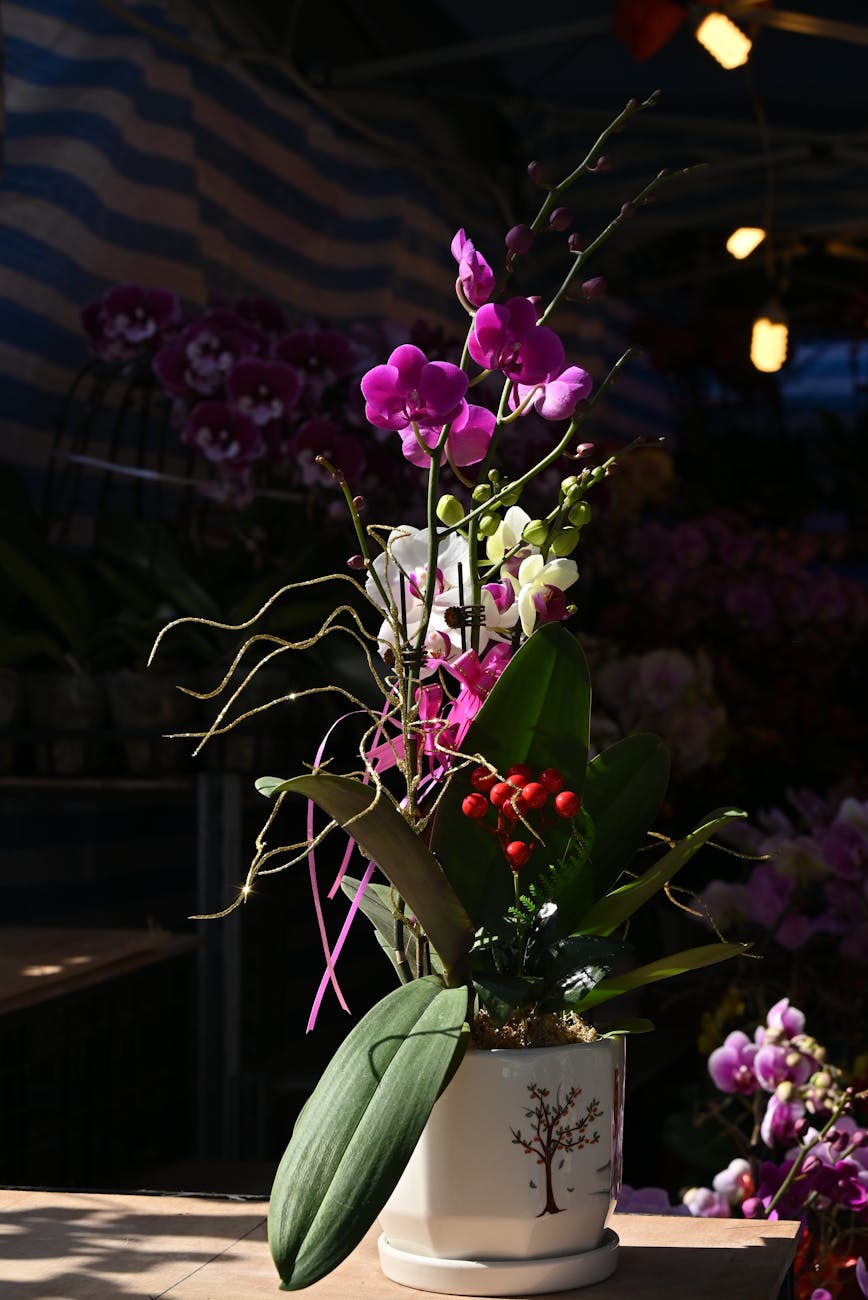
This weekend my partner and I visited the Orchid Festival at Kew Gardens — its 30th anniversary this year, and something that has become part of our late-winter rhythm. It is, objectively speaking, an exercise in logistical patience. Timed tickets, queues, dense crowds moving slowly through glasshouses thick with humidity and colour.
And yet something happens once you are inside. Orchids have an almost unreasonable beauty. Shapes that seem designed rather than grown. Colours that look improbable even while directly in front of you. People shuffle forward, phones lifted, conversations softening. Despite the press of bodies, time loosens.
Standing there — surrounded by impossible blooms and sharing the experience with someone I love — I noticed a rare stillness. Nothing needed to happen next. The present moment was sufficient.
The trap of living elsewhere is subtle because it disguises itself as responsibility. We believe we are being diligent, visionary, prepared. And often we are. The future matters. Planning matters. But presence is not opposed to planning; it is what prevents planning from becoming exile. The challenge, then, is not abandoning future-thinking but returning, repeatedly, to lived immediacy.
This insight has shaped how I’m approaching my upcoming workshops. Increasingly, I see creativity itself as a form of time practice — a way of restoring balance between imagination and presence.
Creative work asks us to plan and to surrender, to envision and to attend. Writing, especially, teaches patience with unfolding. You cannot inhabit a sentence that you are already trying to finish.
That’s partly why I’m so excited about the programmes beginning this March. They are designed not simply as skill-building spaces but as environments where people can rediscover a different relationship to time that supports both aspiration and groundedness.
If this reflection resonates, you might consider joining:
5 Days of Creative Abundance
9–13 March | 7.30–8.00 PM GMT | £29
A short, gentle immersion designed to reset creative momentum and reconnect with possibility through small daily practices.
Register here:
https://www.meetup.com/the-art-of-creative-practice/events/313206797/
The Writer’s Flow Circle: A 12-Week Group Coaching Circle
Beginning Monday 23 March | 7.30–9.00 PM UK time | £180
A sustained space for writers seeking structure, accountability, and deeper alignment with their creative rhythms.
Register here:
https://www.meetup.com/the-art-of-creative-practice/events/313207235/
Both, in different ways, are invitations to stop postponing creative life until conditions feel perfect.
The lesson from yesterday’s tarot spread was not that I should stop imagining the future. It was simply a reminder to visit the present more often — to stop treating it as a corridor leading elsewhere. Presence is not a permanent achievement. It is a practice of return. And perhaps that is why moments like the Orchid Festival linger: they reveal that life is not waiting for us at the end of our plans. It appears briefly, vividly, whenever attention and experience coincide.
The future will arrive soon enough. In the meantime, there is always this moment.
Discover more from Allan Johnson, PhD
Subscribe to get the latest posts sent to your email.
