
The Emperor’s Notebook: Stoic Leadership Today

Picture this: You wake in a marble palace. You are the most powerful person in the world. The emperors before you drowned in their own indulgence, in greed, or fear. Outside, the crowd calls your name.

But you don’t begin your day with a performance. You don’t summon generals or scribes. You sit with a notebook. And you write—not to boast, not to issue decrees, but to remind yourself to be kind. To remind yourself that today you will meet resistance. And that this resistance is not your enemy. It is your path.

This happened. We still have the notebook.

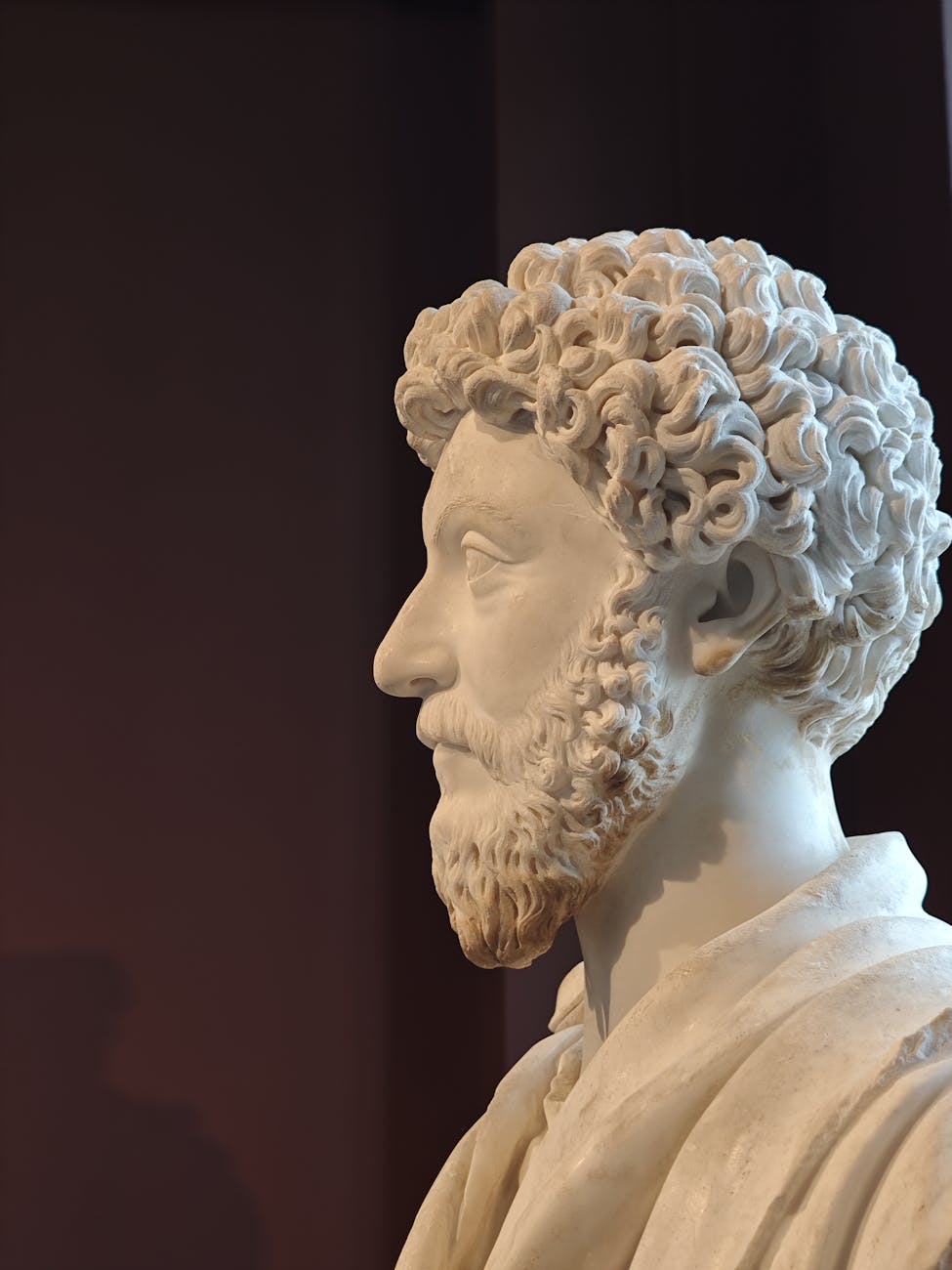
It belonged to Marcus Aurelius, emperor of Rome and one of the most profound Stoic philosophers. His Meditations are not a book written for others. They are personal reminders. Field notes from the front lines of his own mind.

And if that sounds like the opposite of modern leadership—where visibility is everything, where charisma sells and speed is mistaken for insight—that’s precisely why Marcus matters.


Too often today, stoicism is reduced to mere aesthetics. Ice baths. Cold showers. Grit, hustle, and rejection of feeling. We romanticise resilience as if it means silencing the soul.

But stoicism, properly understood, is less about hardening and more about softening into clarity. It’s not the rejection of emotion—it’s the training of emotion. Not the renunciation of the world—but a recalibration of one’s place within it.

Marcus Aurelius didn’t write the Meditations to impress. He wrote them to endure. To remember what he believed in when the palace and the politics threatened to make him forget. This wasn’t a performance. It was a quiet transformation.

And it invites us to our own.


During my time in leadership, I’ve learned that the heaviest burden is not decision-making. It’s visibility.

When we are visible, we are misunderstood. When we are misunderstood, we are attacked. And the work of leadership becomes not just a matter of making good choices, but of remaining whole while those around us cast fragments of who they think we are.

That’s what Marcus teaches us: that leadership is not a performance. It is presence. It is the quiet art of being with our responsibilities without collapsing into them. Of taking pressure and transmuting it into clarity.

And this is not reserved for emperors. Leadership takes many forms. Raising a family. Building a team. Guiding a creative project. Holding space for a friend. Or simply—no less meaningfully—learning to lead oneself.


Marcus didn’t dominate a room. He attended to it. And that attention—to self, to others, to the rhythm of nature and the seasonality of emotion—is what made him powerful.

He reminds us: You will meet frustrating people today. And your task is not to change them. Not even to fix them. But to notice them—and not let them disturb the integrity of your own mind.

This, in many ways, is the true work of self-leadership: not pretending the world is different than it is, but accepting what is and holding to what matters.


If we strip away the glamour from leadership, what remains is not emptiness—but depth.

Because what stands in the way becomes the way.

This is Marcus’s central teaching. And it’s a reminder we need more than ever in a world of spectacle. Where it’s easy to think we’re only as good as our last presentation, our last post, our last win.

But real strength doesn’t come from spectacle. It comes from silence. From beginning the day not with declarations, but with a return. A return to what we believe. A return to who we choose to be.


If you know the weight of being the person who holds it all together—at work, in your family, in your inner world—I’ve created an online course integrating these Stoic principles into daily practice. It’s not about quick wins. It’s about sustainable clarity. You’ll find a link below if that’s of interest.

And wherever you are on your path—remember this:

You don’t need to dominate the room to lead.

You just need to meet the day with presence.

Even, and especially, when marble palaces crumble and the crowd calls your name.


Unlock your potential with mindfulness! Discover how a few mindful moments can help spark breakthrough, overcome blocks, and transform your personal and professional journey. Subscribe to my blog today for more on the art of being present.

What If Pain Isn’t Here to Break You?: Post-Traumatic Growth, Stoicism, and the Alchemy of Suffering

There are moments in life that split us open.

They arrive quietly or crash down like thunder. A diagnosis. A betrayal. An ending we didn’t choose. These ruptures don’t come with warnings or exit strategies. One moment we’re on the path we thought was ours—and the next, we’re somewhere else entirely. In the space left behind, there is pain. Sometimes profound, sometimes quiet. And there is uncertainty.

What now?

Our culture doesn’t always offer satisfying answers. Instead, it tends to give us two dominant narratives: either we bounce back, stronger and shinier than before—optimized by adversity—or we break. Disintegrate. And carry the trauma like a scar we learn to hide or over-intellectualize.

But what if there’s a third story?

A gentler, more soul-honest possibility.

What if suffering isn’t always a sign that something has gone wrong—but an invitation to deepen? Not in a performative, “turn your pain into power” kind of way. Not a heroic tale where you conquer your demons and emerge with a gleaming smile. I mean something quieter. Something alchemical. Something like… transmutation.

A way of sitting with what hurts, deeply and patiently, until something shifts.

This is what I want to explore today: a third way of meeting pain. One shaped by Stoic wisdom, modern psychology, and contemplative insight. A path that doesn’t bypass grief but lets it speak—and even guide us, if we’re willing to listen.


A Personal Threshold

Some years ago, I hit a threshold. It wasn’t a neat turning point or a poetic unraveling. It was chaotic, disorienting, and utterly real. Everything—externally and internally—began to fray. Plans fell apart. Identity fractured. No amount of productivity tools or project management could rescue me from what was happening.

I was forced inward.

And in that inward turning, I began to revisit old teachers. Old books. Old practices that once steadied me. The Stoics were among them—those austere, misunderstood philosophers from a couple thousand years ago who have, in recent years, made an odd comeback in the worlds of tech, business, and self-help. But unlike the modern caricature of Stoicism—cold logic, emotional detachment, a stiff upper lip—what I encountered was something else entirely.

Spiritual steadiness. Fierce gentleness. An unflinching honesty about pain.

Marcus Aurelius, who had long been a companion in my intellectual life, began speaking to me differently. More intimately. One line in particular lodged itself in my psyche:


“The impediment to action advances action. What stands in the way becomes the way.”

At first, it sounded like something from a TED talk. But as I sat with it—really sat with it—I began to understand. What I most wanted to avoid might be what I most needed to face. The blockages weren’t detours from the path. They were the path.


The Alchemy of Suffering

To use the language of alchemy might feel out of place in a post-empirical world, but I think it has its uses—especially when we’re talking about transformation. The Stoics didn’t talk about “post-traumatic growth” in the way we do today, but their ideas revolve around the same principle: that adversity reveals character, and character reveals truth.

Not truth in a doctrinal or ideological sense. But truth in the soul-deep, meaning-making sense. The sense that something in us is trying to become more real.

When we go through something that breaks our ordinary world—be it loss, betrayal, burnout, illness—we’re often tempted to seek shortcuts. We look for ways to “get over it.” To return to baseline. But baseline no longer exists. The ground has shifted. The person we were before is not the person who must now move forward.

So what do we do?

This is where the idea of post-traumatic growth becomes relevant—not as a prescription, but as a possibility.


Post-Traumatic Growth: The Research

In the late 1990s, psychologists Richard Tedeschi and Lawrence Calhoun began studying people who had undergone severe trauma—bereavement, serious illness, violent assault—and noticed a curious pattern. Many didn’t just survive their experiences. They grew. Not in every case, and not in a linear, upward fashion. But in a measurable, meaningful way.

They identified five dimensions of what they called post-traumatic growth:

  1. Greater appreciation of life
  2. Deeper relationships
  3. New possibilities in life
  4. Increased personal strength
  5. Spiritual or existential development

These are not “silver linings” or cheap reframings. They are hard-won realignments. And crucially, growth does notnegate suffering. People who grow after trauma still carry pain. But that pain has become a doorway to something else—something that wouldn’t have emerged otherwise.

In other words, what stands in the way becomes the way.


Three Tools for Transmutation

Let’s look more closely at how one might practice this path—not as a tidy formula, but as an orientation toward life.

1. Stoic Framing

The Stoics teach us to distinguish between what is in our control and what is not. Illness, heartbreak, loss—these are often outside our sphere of influence. But how we meet them? That is where our freedom begins.

This isn’t about suppression. It’s about perspective. Seneca wrote,
“A setback has often cleared the way for greater things.”

When we learn to frame suffering as material—not obstacle—it shifts our orientation. We move from resistance to participation. From avoidance to inquiry.

Ask yourself: What is this moment asking of me? What capacity is it calling forth?

2. Contemplative Practice

Stillness matters. When the world turns upside down, we need anchors. Breath. Awareness. A place to witness the storm without collapsing into it.

Whether it’s mindfulness, centering prayer, or simply sitting in silence each morning—contemplative practice builds the inner spaciousness needed for transmutation. It doesn’t erase pain. It makes us capable of holding it.

And over time, we start to feel something unexpected: a quiet intimacy with our own suffering. Not self-pity. Not indulgence. Just presence.

3. Inner Narrative Work

The stories we tell about our pain matter. Are we a victim of cruel randomness? A cautionary tale? Or are we a pilgrim—still walking, still learning, still becoming?

Psychologists have found that the ability to integrate trauma into a coherent narrative is one of the strongest predictors of healing. This doesn’t mean rushing to make meaning. It means allowing meaning to unfold, slowly and honestly.

Sometimes, the most powerful narrative isn’t one of triumph—but of tenderness. A story where you didn’t conquer the mountain, but you learned how to rest halfway up.


Gentle Awakening

I don’t believe in quick fixes. I don’t believe that every hardship hides a gift. And I don’t believe that pain makes us better people by default.

But I do believe—fiercely—in our capacity to meet life deeply. I believe that suffering, when approached with courage, patience, and honesty, can become a site of transformation. Not because pain is inherently good, but because we are inherently creative.

And so: if you’re in a season of rupture, if the story you were writing has been torn open, let me offer this as a small encouragement:

There is no shame in grief. There is no weakness in disorientation. And there is no rush.

What hurts may also be what heals.

And healing, in this deeper sense, is less about fixing and more about becoming. Becoming more truthful. More rooted. More available to the life that is still yours.


Subscribe to my free newsletter for more tools, guided meditations, and productivity insights.

If you want to start putting these ideas into action, you can sign up for Integrative Meditation (Level 1). This course represents the culmination of years of learning, practice, and personal growth. Integrative Meditation is a comprehensive framework designed to enhance your mental and emotional well-being. It draws on Mindfulness-Based Cognitive Therapy (MBCT), positive psychology, neuroscience, Acceptance and Commitment Therapy (ACT), journaling, and breathwork to support you in reducing stress, enhancing focus, building emotional resilience, and discovering your true self.

Do You Need a Teacher to Learn How to Meditate?

Do you need a teacher to learn how to meditate, or can you do it entirely yourself? The answer is a complex one.

When we begin thinking about meditation, we recognise that we’re not discussing some sort of endpoint or final destination. Meditation doesn’t have an ultimate goal we are striving toward. Instead, what we encounter through the development of a sustained meditation practice is the ability to connect more fully and regularly with our own inner teacher—our intuitive, present awareness.

Now, while we can reach that stage by ourselves by cultivating communication with our inner teacher, having a real-world teacher, whether through courses, face-to-face sessions, or even apps, can significantly accelerate the process. I’ll come back to that point in a moment, but first, let’s talk a bit more about the nature of the inner teacher that we cultivate through meditation.

Our inner teacher isn’t an external guru. It’s our own capacity to listen really deeply to ourselves. Meditation builds our self-awareness, clarity, and intuition. And here’s where a fascinating paradox emerges: even though meditation is self-directed, solitary, silent, and quiet, without structure, we can easily drift or plateau.

That’s where real-world teachers come in: helping prevent us from drifting or stagnating, and ultimately speeding up a process that we could, left to our own devices, still achieve just much more slowly.

When I talk about a “real-world teacher,” I mean many different things. It could be face-to-face meditation teachers at retreats, courses, group sessions at yoga studios, gyms, community centres, or church halls. It could also be free online courses, guided meditations, or structured programs you find online.

Ultimately, what we’re aiming for is self-discipline in our busy, tech-saturated lives: the discipline to maintain a daily meditation practice. That’s what’s key. Thousands of years ago, meditation practitioners didn’t have apps, YouTube videos, or timers to track how many minutes they’d meditated. They relied on real, face-to-face teachers in their communities.

Today, in a tech-driven society, I think what we’re moving toward is a hybrid approach—a blend of self-guided daily practice and teacher-led guidance.

However, if we only meditate alone, or only use the same app or the same recording every day, we won’t continue to deepen and develop more nuanced phases of our meditation.

That’s where live teachers come in:

  • Attending weekly or monthly meditation classes.
  • Working with a mindfulness-based coach online.
  • Going to your local yoga studio.
  • Participating in regular retreats.

Developing an in-person student–teacher relationship is what will truly accelerate our meditation journey. In the same way that just sitting alone at home won’t lead to rapid growth, attending only the occasional class or retreat isn’t enough either.

hybrid approach—a daily, self-directed practice supported by regular real-world teaching—is what provides the richest environment for growth. This approach helps us better understand and navigate the many unique, subjective experiences that arise in meditation.

So in answer to the question:
Do we need a teacher to meditate?
Yes, we do.
But the nature of a “teacher” in the 21st century looks very different from what it did thousands of years ago, and will often be supplemented by digital tools and must always be supplement by our own personal meditation practice.

Rather than resisting digital tools and apps, we can use them to support our daily practice.
And rather than relying only on weekly classes or quarterly retreats, we can integrate those as vital touchstones for learning, sharing, and connecting with others. Let’s use everything we have to develop our own unique meditation journeys—because that’s what they truly are: individual, unfolding, and lifelong.

Subscribe to my free newsletter for more tools, guided meditations, and productivity insights.

If you want to start putting these ideas into action, you can sign up for Integrative Meditation (Level 1). This course represents the culmination of years of learning, practice, and personal growth. Integrative Meditation is a comprehensive framework designed to enhance your mental and emotional well-being. It draws on Mindfulness-Based Cognitive Therapy (MBCT), positive psychology, neuroscience, Acceptance and Commitment Therapy (ACT), journaling, and breathwork to support you in reducing stress, enhancing focus, building emotional resilience, and discovering your true self.

Navigating Change in Higher Education: A Mindful Approach for Academics

Change in higher education is no longer episodic. It is perpetual, structural, atmospheric. It arrives in policy revisions and leadership reshuffles, in curriculum redesigns and shifting student demographics, in technological expectations and spreadsheet logic. Most of all, it arrives in the body — in that silent bracing of the shoulders during a Teams meeting, the unnameable unease in a Monday morning inbox, the quiet dread that the next institutional strategy document will require yet another translation of one’s real work into metrics that cannot hold its meaning.

In such a climate, mindfulness may seem like a footnote — a luxury, even — when there are frameworks to draft, students to support, REF narratives to align, and budgets to cut. But it is precisely in these conditions that a mindful approach becomes not peripheral but foundational. Not because it offers escape, but because it restores clarity, orientation, and above all, sovereignty. Amidst structures that shift faster than our capacity to adapt, mindfulness can return us to an inner ground not defined by performance, but by presence.

To work in higher education today is to live with paradox. We are tasked with fostering curiosity while meeting key performance indicators. We speak of critical thinking but must constantly justify our existence in market terms. The university is both a sanctuary and a machine. We are both scholars and service providers. Amidst these conflicting roles, it is easy to lose the thread of meaning — to forget, even temporarily, why we entered this vocation at all. Mindfulness does not resolve these tensions, but it allows us to hold them without being torn apart.

A mindful academic is not one who detaches from institutional life, but one who sees it clearly. Who feels the anxiety in the department corridor and does not immediately try to fix it. Who senses the slow burn of cynicism and greets it not with shame, but with inquiry. Who can pause — even for ten seconds — before responding to an email designed to provoke defensiveness. These small acts of awareness are not insignificant. They are the quiet acts of resistance that keep the inner life intact.

Too often, change is experienced as assault: something done to us, without context, without conversation, without care. And this is not a fiction. Many of the recent reforms in higher education have been rolled out in ways that ignore the deep ecology of academic labour — the tacit, the affective, the relational, the slow. But mindfulness shifts the question from “How do I survive this?” to “How am I relating to this?” That shift, though subtle, is liberating. It does not pretend we are in control. But it reminds us that we are not powerless.

The mindful stance begins not with technique, but with intention. Intention to remain human in systems that reward efficiency over empathy. Intention to listen to our own rhythms, even as deadlines crowd the calendar. Intention to keep the heart involved — not as sentimentality, but as epistemology. Because what we know best, we know not only with our minds, but with our bodies, our histories, our breath. Mindfulness reclaims this wider field of knowledge. It reminds us that awareness is not passive. It is participatory.

There are, of course, practices that can support this reorientation. But they must be approached not as productivity hacks, but as subtle forms of remembrance. A minute of breath awareness before opening Outlook. A quiet noticing of where tension gathers during a faculty meeting. A walk between classes without headphones. These are not grand interventions. But they are portals. They invite us back into the moment — not as an end in itself, but as the only real site of agency.

One of the most transformative insights mindfulness offers is that thoughts are not facts. This is especially important for academics, whose professional currency is thought. We are trained to critique, to problematise, to map the terrain of argument. But when the voice of critique turns inward — “I’m not keeping up,” “I’m not doing enough,” “They’re doing it better” — we often fail to notice that we’ve mistaken a mental habit for a truth. Mindfulness interrupts that identification. It lets us witness our thoughts without becoming their echo.

This witnessing is not neutral. It is infused with compassion. And here, the academic temperament often balks. Compassion sounds soft, indulgent, uncritical. But in fact, it is fiercely intelligent. It sees clearly the pressures we face and refuses to compound them with self-punishment. It recognises that behind every unfinished chapter, every late reply, every missed funding bid, there is a human being doing their best. Compassion is not about lowering standards. It is about recognising that the standards are often inhuman.

In times of institutional change, one of the most disorienting losses is continuity — of roles, of relationships, of the unspoken rituals that once grounded our days. The colleague who retired early. The leadership team reshuffle. The erasure of departmental histories in the name of agility. Mindfulness helps us grieve these losses. Not as obstacles to progress, but as meaningful ruptures that deserve acknowledgment. In a system that moves on quickly, a mindful approach says: pause. Remember. Honour what is passing. Then continue.

This approach also helps us work with the emotional aftershocks of change: resentment, fatigue, numbness, resistance. These states are not signs of failure. They are signals of care. We feel angry because something matters. We feel exhausted because we have been trying. We feel resistant because something in us still hopes for authenticity. Mindfulness does not silence these reactions. It makes space for them. It lets us feel the texture of our own responses without becoming stuck in them.

Importantly, mindfulness also allows us to identify the places where our energy is leaking. In academia, overextension is a status symbol. The performative exhaustion, the boast of back-to-back meetings, the quiet competition over who is more overwhelmed. But this way of being is unsustainable — not only for the individual, but for the system. A mindful academic notices the cost of this mode. Begins to ask different questions. Not “What more can I take on?” but “What can I offer fully?” Not “How do I keep up?” but “What pace honours the depth of my work?”

There is also the matter of hope. Change can corrode hope if we feel it is always top-down, always reactive, always beyond our influence. But mindfulness offers a different kind of hope — not rooted in outcomes, but in presence. The hope that comes from showing up fully. From refusing to be numbed. From choosing integrity, even in constrained circumstances. This is not naïve optimism. It is clear-eyed commitment. A belief that how we show up — in teaching, in supervision, in conversation — still matters. That meaning is made not only in policy but in presence.

Over time, mindfulness begins to reshape our sense of time itself. The academic calendar is relentless — term to term, year to year, punctuated by reports, reviews, and rankings. But beneath this calendar is another rhythm: the rhythm of thought, of growth, of maturation. A research idea may gestate for years before it finds form. A student’s confidence may bloom long after graduation. A team dynamic may shift only through months of quiet effort. Mindfulness tunes us to this subtler tempo. It reminds us that real change is not always visible — but it is always unfolding.

The mindful academic, then, is not simply calm. They are attentive. Responsive. Able to hold complexity without collapse. Able to lead without dominance, to follow without resentment, to rest without guilt. They do not escape the pressures of higher education. But they move through them differently. With more breath. More choice. More humanity.

And perhaps that is the most radical gesture of all — to remain human in a system increasingly governed by algorithms, audits, and abstractions. To remember that behind every module code is a learner. Behind every spreadsheet, a colleague. Behind every institutional statement, a set of lives trying to do something worthwhile. Mindfulness restores this remembrance. It makes us better educators, better thinkers, better companions in the work of change.

So the next time change arrives — and it will — try pausing. Try noticing what rises. Try letting the breath anchor you for a moment before the next decision, the next document, the next demand. You are not a machine. You are a mind, a body, a history. A presence in a changing world. That presence matters more than you know.


Unlock your potential with mindfulness! Discover how a few mindful moments can help spark breakthrough, overcome blocks, and transform your personal and professional journey. Subscribe to my blog today for more on the art of being present.


If you want to start putting these ideas into action, you can sign up for Integrative Meditation (Level 1). This course represents the culmination of years of learning, practice, and personal growth. Integrative Meditation is a comprehensive framework designed to enhance your mental and emotional well-being. It draws on Mindfulness-Based Cognitive Therapy (MBCT), positive psychology, neuroscience, Acceptance and Commitment Therapy (ACT), journaling, and breathwork to support you in reducing stress, enhancing focus, building emotional resilience, and discovering your true self.

Ignite Your Imagination: Essential Mindfulness Practices for Creatives

Imagination does not always come galloping through the mind like a wild horse across open ground. More often, it creeps in — hesitant, flickering, partial — like light beneath a half-closed door. For the creative spirit, this can be both a torment and a gift. We long for the fullness of vision, the burning clarity, the intoxicating moment when idea and form lock together and the world briefly makes sense. But more often, we are in the waiting room: alert, uncertain, rehearsing fragments and false starts, hoping for a signal. It is in this threshold space — this in-between — that mindfulness becomes not only helpful but transformative.

Creativity has long been romanticised as divine madness, a burst of genius, a possession. And while there may be truth in that mythology, it is not the whole truth. The more interesting question is not what inspiration is, but how we prepare for it. Not how we command the imagination, but how we create conditions in which it might choose to speak. Mindfulness, in this light, is not a set of breathing techniques or an escape from the demands of artistic work. It is an ethos of attention. A way of being that sharpens the contours of perception and makes the self available to wonder.

To live mindfully as a creative is not to disengage from the world, but to engage it more fully. It is to notice, in radical detail, the colour of morning light on the floorboards, the twitch in a friend’s voice, the quiet violence of a passing thought. This kind of noticing is not simply decorative. It is the material of art. All creative acts begin with attention — not just to what is seen, but to how it is seen. Mindfulness cultivates that how. It refines the inner lens. And with that, the imagination becomes less a distant realm and more a neighbour — elusive, yes, but not unreachable.

The challenge is that modern life trains us out of this kind of perception. We scroll, skim, switch tasks mid-thought. Our nervous systems are fragmented, our minds colonised by speed. In such a climate, the imagination withers — not because it lacks ideas, but because it cannot find stillness. Mindfulness returns us to a slower rhythm, one more akin to the pace at which creative insight naturally moves. The imagination does not shout. It whispers. It offers symbols and sensations before it offers structure. To receive those fragments requires a kind of inner spaciousness that mindfulness can restore.

It is important to say that mindfulness is not a cure for creative block. It is not a pill or a shortcut. It is, in many ways, a deepening of the block. A way of entering it with presence rather than panic. When the artist is blocked, they are often not lacking ideas — they are overfull. Jammed with expectations, self-comparisons, imagined critics, and internalised metrics of worth. The block is often a symptom of too much noise, not too little content. Mindfulness teaches us to sit quietly in that noise until it begins to part. It does not dissolve resistance, but it changes our relationship to it.

At its heart, mindfulness invites us to meet the moment as it is — not as we wish it to be. This is perhaps the most radical act for a creative. Because we are often trained to work from an ideal: the perfect performance, the future masterpiece, the imagined audience who will finally understand. But the work does not emerge from the ideal. It emerges from the real. From the slight tremor in the hand. From the smell of the paper. From the deep breath taken before the brushstroke or the chord or the sentence. When we attend to the real, we begin to loosen our grip on perfection and make space for play — and play is where the imagination feels safest.

There are practices that support this shift — not as formulas, but as invitations. One of the most powerful is the simple act of arriving. Before beginning your creative work, pause. Close your eyes. Feel your feet on the ground. Sense the breath in your body. Let yourself come into presence, not as an act of performance, but as a gesture of receptivity. In doing so, you are not asking the imagination to perform. You are letting it know that you are listening. This small ritual can become an anchor — a way to mark the space between ordinary time and creative time.

Another practice is mindful observation. Take an object — a leaf, a stone, a photograph — and study it without naming it. Let yourself be absorbed by its texture, its edges, the way light moves across it. Notice your mind’s habits — how it wants to interpret, to comment, to categorise. Gently return to the act of seeing. This seemingly simple exercise reawakens the raw materials of creativity: detail, pattern, form, and most of all, wonder. It is wonder, not novelty, that fuels true imagination. And mindfulness is a training in wonder.

Body awareness is equally vital. Creative work is not only intellectual — it is visceral. The body speaks in tone and rhythm and colour, often before the mind knows what it means. Writers sense a sentence’s weight. Dancers feel a phrase in the spine. Painters move through gesture. Musicians enter trance. Mindfulness reconnects us to these signals. A body scan — gently bringing attention to each part of the body — allows us to hear the somatic wisdom beneath the surface. Often, an idea is stuck not in the mind but in the jaw, the shoulders, the chest. When we release these holding patterns, the imagination begins to flow again.

Mindfulness also teaches us how to recover from the inevitable crash after a creative high. Every artist knows the pattern: the flush of energy, the intoxication of vision — followed by doubt, fatigue, the sense that none of it is working. This cycle is not a flaw. It is the natural rhythm of the creative process. Mindfulness helps us ride it without drowning in it. It teaches us to greet the high with gratitude and the low with compassion. Not to cling to either, but to keep returning to the work, with steadiness, even when inspiration recedes.

In a deeper sense, mindfulness reminds us that the imagination is not a separate realm to be accessed, but a mode of being to be remembered. Children live in this mode. They animate the world with story and symbol. They know, without being told, that the line between what is and what could be is porous. Adults, trained in control and outcome, often lose this porousness. But it can be recovered. And mindfulness is one way to trace the path back. It allows us to unhook from habitual thinking and return to what is called “beginner’s mind” — a mind not emptied, but freshly open.

Beginner’s mind is a paradoxical place. It requires discipline to enter, but surrender to remain. For the creative, this is the site of pure potential. It is where the known world dissolves just enough to let the new world appear. But it does not come through force. It comes through presence — through the willingness to stay close to the edge of unknowing, to sketch with the left hand, to listen without deciding. This is not the absence of technique. It is technique softened by trust.

And trust is perhaps the most essential ingredient in creative life. Trust in the process. Trust in the self. Trust that something worthwhile can emerge even from a messy first draft, a broken melody, an unfinished canvas. Mindfulness strengthens this trust, not by feeding confidence, but by cultivating stability. When the mind is steadied, we are less thrown by failure, less addicted to success. We become more willing to explore. And the imagination — that sensitive, skittish creature — comes closer when it senses safety.

Of course, not every moment of creativity will feel mindful. We will still have days when the mind races, when the work feels brittle, when nothing seems to cohere. This is human. Mindfulness does not erase difficulty. It simply offers us a way to meet it without collapsing. To meet it with a little more breath. A little more kindness. A little more space. Over time, this changes not just how we work, but who we become through our work. It reshapes the creative life from a series of outcomes to a deepening relationship — with form, with feeling, with the mystery of making itself.

So light the candle. Take the breath. Touch the clay. Return to the sentence. Let your attention lean in. The imagination is not a bolt of lightning. It is a door. And mindfulness is the key that helps you hear when the latch lifts.


Unlock your potential with mindfulness! Discover how a few mindful moments can help spark breakthrough, overcome blocks, and transform your personal and professional journey. Subscribe to my blog today for more on the art of being present.


If you want to start putting these ideas into action, you can sign up for Integrative Meditation (Level 1). This course represents the culmination of years of learning, practice, and personal growth. Integrative Meditation is a comprehensive framework designed to enhance your mental and emotional well-being. It draws on Mindfulness-Based Cognitive Therapy (MBCT), positive psychology, neuroscience, Acceptance and Commitment Therapy (ACT), journaling, and breathwork to support you in reducing stress, enhancing focus, building emotional resilience, and discovering your true self.