More or Less? The Paradox of the Zero-Sum Game

It’s a commonly held saying in academia that a good journal article will eventually be published in the right journal. The infamous publish-or-perish culture has led to a world of relentless hustle in which academics — particularly those precariously balanced at the base of the long, shaky ladder to professorship — compete to publish more and better work. Academic publishing has exploded as the quest for validation has intensified, so that most published academic journal articles are never read.

Yet despite this massive growth in academic publishing, it is still a competitive game, and one that early career scholars are trained to navigate and understand. The dictum that ‘a good journal article will eventually find its right journal’ is, in some ways, a limp platitude conveyed through the encouragement of supervisors to help the researcher keep the faith. If the article is ‘good’ — and the unexamined assumption is that every article by a researcher is ‘good’ — then it is only a matter of time before the ‘right journal’ is found. In this context, ‘right journal’ usually means ‘less impactful and prestigous journal’, one with less rigorous editorial standards, higher acceptance rates and ultimately a smaller readership.

In many ways, it’s a good strategy to not give up and keep submitting to journal after journal, even if rejections keep coming, especially considering that a vibrant market of dubious, if not downright predatory, publishers has emerged to scoop up the articles that didn’t make it into quality publications. There’s a certain stoicism to it all: sticking to what you believe in, accepting that you can’t control whether an article is accepted or not, and hoping for a better and more positive outcome in the future.

But what about the articles that are never published in the end? What about the scientists who end up going under rather than publishing? What do we do with these cases that do not correspond to the reality represented by the bromide theory that a good article will always find its place?

In many academic fields, particularly in the arts and humanities, the number of recent PhD graduates is far higher than the number of permanent academic positions available, and the chances of finding a position are vanishingly small. In these cases, can we still assume that all good applicants will find the right job? Again, it’s about encouraging someone to storm. You just have to hang in there a bit longer, but we know that statistically that’s not going to be the case for everyone, and in academia that’s true in all walks of life. There are some people who don’t get a journal article accepted, who don’t get an academic job, things that they were told over and over again will happen if they just wait.

I am thinking of an episode of a BBC nature programme, maybe Planet Earth, but definitely voiced by David Attenborough, where a community of walruses banish some of the male walruses to the edge of the community, they will not meet, they will get just enough food to survive as long as they are content to live on an ice floe on the edge of the community. This is an example of how this particular animal community functions and deals with limited resources, and therefore may not translate directly to the human experience, but it is one of many examples of zero-sum games that surround us everywhere.

Positive psychology tells us that there are no zero-sum games, that one person’s success does not mean that another person cannot also be successful. The advice given to young academics is that if you can just weather the storm, you will achieve your goal. But there is something of a paradox when it comes to our understanding of these so-called zero-sum games.

In the business world, companies compete for market share. There are a few factors at the company’s disposal to try to increase their market share, but they will, sooner or later, come up against the hard wall of mathematical certainty that will require something to be created out of thin air. Let’s see how this works through a thought experiment. Imagine two people are selling an identical product in a completely isolated community of exactly 100 people (let’s say a village with a total population of 102, including the two entrepreneurs).

They might agree that 50 customers is enough for each of them, and that by splitting the customer base evenly they can generate the necessary income. However, it is very likely that sooner or later the light bulb of ambition will come on for one or both of the entrepreneurs and they will think: ‘I can make more money if I have 55 customers, or 75 customers, or 95 customers.’ What doesn’t change is the total number of potential customers available. So if the more ambitious entrepreneur wants to increase their market share, they need to focus on differentiation and make their product seem like the more attractive option. Remember that the two products are absolutely identical, so the differentiation has to be done in a different way. Perhaps the entrepreneur has discovered that if he has 75 customers but charges them a lower price, he still makes more money than before by lowering the price and increasing the volume — the variable at play here is cost. Or the entrepreneur may turn to intangible factors such as persuasion and influence to make his product seem like the more desirable option. Or perhaps the entrepreneur engages in shady practises by lying about his or his competitor’s product, threatening the competition or forcing customers to choose his product over the other.

What this thought experiment doesn’t allow for is the expansion of the market beyond 100 potential customers, and there’s a reason for that: relentless expansion is exactly how humans have tried to overcome zero-sum games since the industrial revolution, Ponzi schemes of growth that feed back into systems that then require further exponential growth to be sustained in the future.

In the past, people have used various strategies to expand markets and create new opportunities. Technological advances, new scientific discoveries, and economic paradigm shifts have repeatedly moved societies forward and enabled them to break free from the constraints of the zero-sum game, creating new and more opportunities for growth. The industrial revolution of the nineteenth century marked a turning point where innovations in manufacturing, transport, and communication dramatically expanded the scope of economic opportunity.

However, this relentless pursuit of growth has led to some very serious problems. Growth has become a prerequisite for maintaining the stability of the system, and economic structures have become designed to require constant expansion in order to sustain themselves, leading to resource depletion, environmental degradation, and increased inequality. As these systems become larger and more interconnected, they are required to expand faster and faster to avoid collapse, leading to some of the biggest challenges facing our world today: overconsumption, environmental degradation, and increasing economic inequality.

In the context of our thought experiment, expanding the market beyond 100 potential customers (e.g. by finding a new community of potential customers that the entrepreneurs were previously unaware of) could be a temporary solution, but it also raises the question of the long-term sustainability of such a strategy — what happens when there are no new undiscovered neighbouring villages with potential new customers? Can the market continuously expand to accommodate more potential customers for our two entrepreneurs, or will it reach a saturation point at some point?

And this thought experiment hasn’t even considered the countless other factors that motivate both the entrepreneurs and the potential customers to act within the system in ways that may seem irrational, but from their personal human perspective are absolutely rational in trying to secure the greatest personal good for themselves while reducing the chances of negative repercussions or pain.

Relentless expansion is a hallmark of human progress and has been used to disguise or deny many forms of zero-sum games where one person must lose in order for another person to gain. Economic inequality is the most obvious and pressing example, but this also applies to opportunities in the labour market, where one applicant’s success means a missed opportunity for another, to healthcare, where allocation of resources in one place can mean a lack of resources in another, and for land use and housing, where gentrification and rising property values may benefit some residents but displace others, leading to an increasing expansion of urban and suburban centres and fewer opportunities for younger people to own property than was the case in their parents’ generation.

One of the reasons this problem is so complex to illustrate is that it involves large numbers and patterns of human behaviour rather than individual transactions. In the area of employment, job opportunities are finite until the market expands, but then the market must continually expand to create job opportunities for the new generation of job seekers that were initially created to expand the market.

Fordism, named after the American industrialist Henry Ford, is a socio-economic system characterised by mass production in which the workers who make the product earn so much money that they can afford the product themselves, thanks to the assembly line method that reduces costs and increases productivity. This concept — that you can afford a car, a hat, or a table if you work in a factory that makes cars, hats or tables — while commonplace today, was a groundbreaking departure from prevailing economic practises until the early twentieth century. Modern society enabled the division of labour, where workers specialised in specific tasks, which ultimately contributed to a huge increase in efficiency and output, and therefore a reduction in costs.

But this apparent success of Fordism is another example of a self-reproducing zero-sum system. Mass production required mass consumption to sustain itself, and the relentless expansion associated with Fordism perpetuated the idea that continued economic growth was not only desirable, but necessary for the well-being of society. In this system, labour became increasingly specialised in repetitive tasks, leading to a sense of alienation and dissatisfaction, and although the economic and social situation of many people improved after the industrial revolution, this came at an invisible cost.

Although the economic and social situation of many people improved after the industrial revolution and the advent of Fordism, these gains were not equally distributed. The zero-sum nature of the system meant that progress for some came at the expense of others, and as we have seen in our own time, the pursuit of continuous economic growth was fuelled by a collective mentality that prioritised material accumulation as a sign of social progress. This relentless pursuit of growth sometimes overshadowed the importance of other essential elements of wellbeing, such as work-life balance and social cohesion.

Unlike economic systems, personal relationships involve a range of observable but fiendishly complex and often invisible factors, making them a complex and highly nuanced area of experience. In many ways, however, the reality of human relationships is even more complex. Human relationships are influenced by a variety of factors, including personal values, interests and life circumstances.

Unlike economic transactions, relationships are not tied to finite resources, and the possibilities for meaningful relationships are seemingly limitless. However, this complexity also makes relationships susceptible to the nuances of individual personalities, societal expectations and cultural influences. In the context of relationships, the concept of the zero-sum game takes on a different dimension. The idea that finding a life partner is a competition in which one person’s happiness comes at the expense of another’s happiness is overly simplistic. While it is true that not every connection leads to a lifelong partnership, the richness of human experience allows for diverse and meaningful connections that contribute to personal growth and fulfilment.

The invisible costs associated with personal relationships can manifest in the form of emotional challenges, misunderstandings or unfulfilled expectations. However, much like the complexities of economic systems, the intricacies of human relationships also hold the potential for growth, learning and shared experiences that contribute to the richness of life. It is important to recognise that, similar to economic systems, societal narratives and cultural expectations shape our ideas of what constitutes an ideal relationship.

The pursuit of continuous growth and progress, whether in economic development or personal relationships, can sometimes overshadow the importance of other essential elements of wellbeing.

In the realm of relationships, as in the broader social context, balance and appreciation for the multidimensionality of human experience is critical. The pursuit of happiness and fulfilment should not be seen as a zero-sum game, but rather as an exploration of the myriad opportunities for connection, understanding and shared joy that enrich our lives. Just as economic models must evolve for sustainable progress, our view of relationships can benefit from a holistic understanding that embraces the diverse and intricate human relationships.

The dictum that a good journal article will eventually find its right journal is reassuring, but sometimes leads to settling for lower impact journals, perpetuating a zero-sum game in the pursuit of academic success. Similarly, economic systems and the relentless pursuit of growth epitomised by Fordism have often obscured or denied the zero-sum games within them.

The invisible costs of economic progress, such as environmental degradation, resource depletion, and increasing inequality, highlight the complexity and challenges associated with constant expansion. The parallels also extend to personal relationships, where the pursuit of happiness and fulfilment is often portrayed as a competition, eclipsing the diverse and meaningful relationships that contribute to the richness of human experience.

Recognising this zero-sum dynamic leads to a call for a more balanced and holistic approach. As we navigate the complexities of science, business and personal relationships, a nuanced understanding of success and fulfilment is critical. Just as the pursuit of perpetual growth in economic systems can lead to undesirable consequences, an overemphasis on competition and scarcity in personal relationships can obscure the true potential for connection, understanding and shared joy. Finding a balance that prioritises wellbeing, sustainability and inclusivity is key to fostering a future where success is achieved not at the expense of others, but in harmony with the interconnected fabric of our shared human experience.


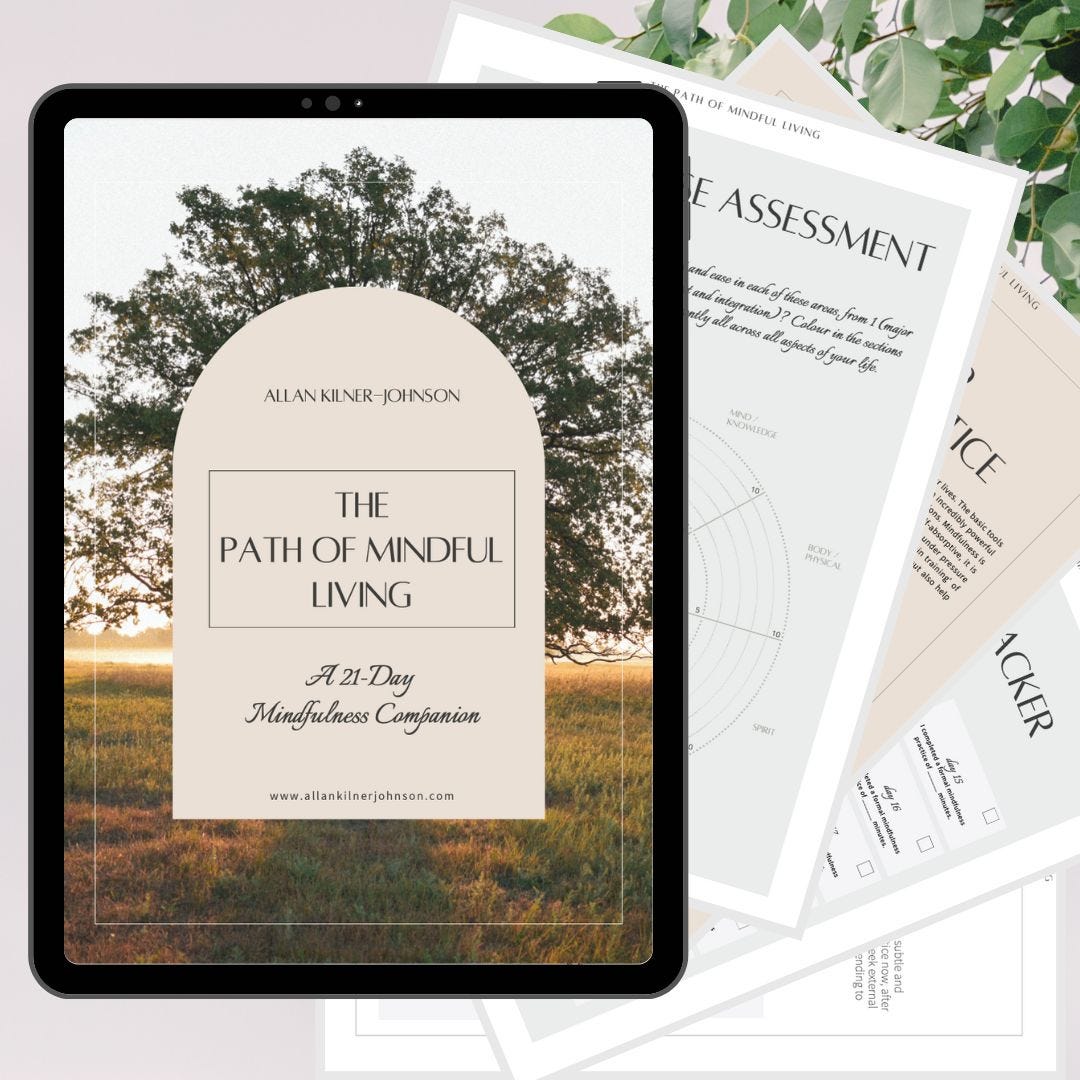
In The Path of Mindful Living: A 21-Day Mindfulness Companion, I lead you through a series of self-guided mindfulness exercises and show you how to bring mindfulness into your daily life. Readers of my blog can download the workbook and pullout charts for only £6.

Discovering the Language That Speaks to Your Soul

Once, many years ago, at a dinner with some distant friends I didn’t know very well, the question of what ‘good poetry’ was came up. ‘Poetry doesn’t really speak to me,’ I confessed ashamedly at the table. Although literature was then, as now, one of my greatest passions, I didn’t feel as connected to poetry as I did to fiction and drama, and I was embarrassed to admit this at the table. One of my dinner neighbours looked at me to gauge my reaction. ‘That’s a very poetic way of putting it,’ she replied dryly, with a touch of humour in her eyes.

In the years that followed, I began working on my PhD on twentieth-century English literature, and during this time the initial love of literature I had as a child began to fade. During my PhD, literature became something that couldn’t be enjoyed naturally, and the idea of reading for pleasure became an alien concept. Literature outside my narrowly defined area of interest became increasingly distant and unremarkable. The pages of novels were no longer turned with the same sense of wonder and anticipation; instead, each word seemed to carry the weight of analysis, critical scrutiny and the relentless pursuit of scholarly precision. The works that had once held my imagination were now scrutinised through the lens of theory and methodology, often overshadowing the fascination and magic that had originally drawn me to it.

The question of my appreciation of poetry (or lack thereof) came up again a few years later during an interview for the academic position I hold today. The stakes were high. As part of the process, I had to submit a sample syllabus for a module in modernism, my specialism, and present these plans to the committee. The module I presented was, as one might expect: Virginia Woolf, James Joyce, D.H. Lawrence, etc. The presentation began with a discussion of the themes, historical context, and analytical approaches that formed the core of my academic expertise. After my presentation, I was asked by one of the panellists about the lack of poetry in the module. Where was Ezra Pound? Where was T.S. Eliot? Where was H.D.?

Being the brash young academic that I was at the time, I said, ‘Well, I specialise in the novel form, so someone else who specialises in poetry might teach the module differently to me.’ The panellist knew as well as I did that the story of modernist literature could be told in different ways. The story that persisted for much of the twentieth century was that the radical innovations of literary modernism represented a form of masculine heroism characterised by the bold poetic experiments of T.S. Eliot, Ezra Pound, and W.B. Yeats. The panellist’s question therefore touched on a deeper truth — the diversity of voices in modernist literature and the complex interplay of gender dynamics that shaped their perception. But it is also true that the heroic saga of modernist innovation as it is usually told tends to overshadow the contributions of women poets like H.D., Marianne Moore, and others who have played a key role in reshaping poetic expression.

More recently, modernist studies, in which I was trained in the early years of the 21st century, centred on a multifaceted modernism characterised by fiction, with James Joyce, Virginia Woolf and D.H. Lawrence being among the main voices contributing to the period and style we now call modernism. This focus on the novel as the primary medium for the expression of modernist ideas was not without merit. The narrative innovations and exploration of subjective experience in these novels provided rich terrain for scholarly analysis and interpretation.

In the years following that fateful interview in which I was asked what place poetry had in my curriculum, something known as ‘new modernist studies’ has emerged, which addresses the question of what we mean by several different modernisms that include many different voices beyond the Western male voices of the ‘men of 1914’ history of modernism. This contemporary approach removes the limitations imposed by a Eurocentric, male-centred view and leads to a more comprehensive examination of the multiplicity of modernist expressions. The paradigm of ‘new modernist studies’ actively seeks out the voices that were previously excluded — voices beyond the Western male canon that dominated early discussions of the movement. This inclusive perspective recognises that modernity is not a monolithic entity, but a dynamic and heterogeneous phenomenon shaped by a spectrum of cultural, geographical and gendered influences.

The module I presented at the interview could have been about poetry, but also about the development of modernist fiction, about the ways in which the shifting centres of consciousness, alienation, and unease of modernism contributed to a new experimental way of capturing the unconscious in modernist prose. I wanted to explain how these thematic elements contributed to a pioneering, experimental approach to capturing the complexity of the unconscious in modernist prose. But when I was asked about my apparent lack of expertise in poetry during the interview, I recalled a similar question at a dinner a few years earlier and once again felt that there was something wrong with me because poetry wasn’t inherently appealing to me. It was an unsettling moment, a subtle reminder that my fondness for fiction might be perceived as a lack, casting a shadow over my confidence and expertise in the wider field of literary studies.

Why was I not drawn to and moved by poetry, as so many others seemed to be, and, more worryingly, why was poetry not for me, an academic of English literature, something that shaped and broadened my view of the world? Poetry has traditionally been held in high esteem in the ivory towers of literary scholarship, seen as a vessel for the most profound expression and a key to conveying the human experience. This raised the question of whether my academic journey was incomplete without a deep engagement with the poetic form.

I still read poetry, and I still look forward to the lecture I give each year to students on T.S. Eliot’s masterful 1922 poem The Waste Land. But the history of English that I know how to tell is the story of fiction. And that’s just as well, because there are other academics around me telling the parts of the story that I don’t know or speak naturally. Each academic holds onto a part of the history of English literature that they have embodied and can render spontaneously and authentically. While we must continually challenge ourselves and question the limits and judgements of our understanding of this small part of our shared cultural history, we can also surrender to the certainty that we don’t need to know everything. Like a piece of a mosaic, each scholar contributes a unique perspective that embodies and expresses the nuances of a particular literary period or genre. This collective endeavour ensures that the narrative is comprehensive, multi-faceted, and, most importantly, collectively understood.

That is true of life in general. We’re all in search of a language that we naturally speak, the language of our youthful interests and obsessions. Our early childhood obsessions give us an early indication of the things we care about most, but as we grow up, we tend to detach ourselves from these early interests and lose sight of what was once really important to us. Often it’s these childhood interests that point us in the direction of how we want to see the world and how we want the world to speak to us. These formative passions, which point like compass needles to our genuine concerns and authentic desires, are the key to understanding what is truly important to us. In these early years, we connect to the world by establishing an initial dialogue with the aspects that capture our imagination and awaken our genuine curiosity.

As we go through our formal education and then enter adulthood, we seem to drift further and further away from the unique language that communicates to us. Whether it’s poetry, sports, art, cars, horses, the creation of beautiful spaces or beautiful conversations, there is something we’re naturally drawn to. Sometimes we feel that it’s not what we should be drawn to, we feel ashamed of the language we naturally speak, and we feel that we should be drawn to a different way of expressing our innermost selves. In the fabric of our evolving lives, there is a constant beacon — a resonance that calls to us and guides us towards something we’re naturally drawn to. The language we naturally speak, the unique dialect of our passions and interests, is an integral part of who we’re. It’s a symphony of our individuality, a melody that carries the echo of our genuine self-expression.

Academic disciplines are concerned with a language that is authentic to the object of study. This applies to all interpretive humanities, from art history to game studies and English literature to theology. The primary and often only difference between these disciplines is the object of study itself, not the goals and intentions. The difference lies first and foremost in the specific object of study, be it the brushstrokes of a painting, the dynamics of a game, the nuances of narrative form or the theological foundations of belief systems. The respective ways of thinking, thought patterns, and techniques are not particularly different. Scholars in all of these disciplines conduct critical research using different lenses to peel back the layers of meaning and significance in their respective objects of study.

In all these disciplines, we have an object in front of us, an artefact that we analyse and understand. We come together in a shared interpretive community to build on the interpretations of others and construct a shared and commonly accepted understanding of meaning in the present. Whether we are writing about Eliot’s Waste Land or Dungeons and Dragons, when we write about an artefact, we share with others what it means to us at this particular moment so that other critics in our own time and in the future can understand what that work meant in our own time.

In this collaborative endeavour, we build on the interpretations of our predecessors, creating a continuous chain of insights that contributes to the construction of shared meaning. The interpretations offered by scholars are not isolated acts, but rather building blocks in an ongoing dialogue that spans time and disciplinary boundaries. By sharing individual perspectives and insights, scholars contribute to a collective understanding of the meaning of an artefact in the present. This not only captures the essence of the artefact itself, but also reflects the cultural, social and intellectual milieu of the time. In essence, academic interpretations become capsules of meaning that encapsulate the zeitgeist in which they are formulated.

In recent decades, the academic field of Western esotericism has revitalised serious academic interest in magic, mysticism, and the occult, subjects that had long been relegated to the dustbin of history by ‘serious’ scholars. As the field of Western esotericism began to develop, a new language emerged, a system of conventions for reading, discussing, and critically understanding the vast cultural heritage of esoteric thought forms. This does not presuppose that one believes in astrology or trance possession, but it does presuppose that one believes that these practises were and are a significant cultural moment worthy of attention in this regard.

I now teach Western esotericism at university level, and students are sometimes surprised to realise that they do not have to believe in the transmigration of souls or the teachings of the Theosophical Society. Some students may also be followers of these practises, but all that is required from the conventions of the subject is a belief that these forms of thought were important to many people and that by studying them we can better understand what magical ways of thinking meant to society in the past, present, and probably into future.

In many ways, this is similar to my own apprehension that I am not naturally inclined to poetry. I understand and appreciate the value and importance of poetry, but at the same time accept that the intense study of poetry is something that can be pursued by others who more instinctively speak this language. This diversity of interest and passion enriches the collective understanding of literature and allows for a multi-faceted exploration of the myriad ways in which poetry affects the individual.

Ultimately, we all strive to connect what is inside us with what is outside us. We are all born with an innate language that speaks to us. This quest for connection is based on the realisation that we are born with an innate language — an intricate system of expression that uniquely resonates with our individual being.We first understand this language through our childhood passions and obsessions, but this language is often trained out from us in early adulthood.

To return to the language we naturally speak, we need to re-engage with what inspired us as a child, perhaps things that we were later told were not to be taken seriously, were shameful, or would not get us a job in the long run. Our relationship to these themes and ideas will have changed in the intervening years or decades, but the value that has remained is that they meant something to us when we were young, and that something inside us was trying to find an outward expression, a way to find form and meaning in a way that could be shared and understood by others. We are all just one piece of a huge social jigsaw puzzle, carrying a part of the story that others will join us in adding to and completing.

Rediscovering the language we naturally speak requires a courageous journey back to the sources of inspiration from our childhood. It involves re-engaging with the passions and pursuits that once piqued our curiosity. What was once perceived as frivolous or trivial may now be viewed through the lens of experience, wisdom, and maturity. However, the essence remains the same — these inspirations meant something to us in the formative years of our lives. They represented an authentic part of our identity, a yearning for outward expression and a search for form and meaning that sought a connection to others.

The things that ignited our passion were essentially attempts to communicate something profound from within us. They were not mere whims, but serious expressions of our authentic selves in an attempt to find resonance and understanding in the outside world. The value of these expressions lies not in their conformity to social expectations, but in their sincerity and the genuine connection they made to our innermost selves.


In The Path of Mindful Living: A 21-Day Mindfulness Companion, I lead you through a series of self-guided mindfulness exercises and show you how to bring mindfulness into your daily life. Readers of my blog can download the workbook and pullout charts for only £6.

A New Approach to New Year’s Resolutions

The new year marks the start of a new chapter and, with it, the tradition of setting resolutions. For many of us, resolutions such as exercising more, getting rid of bad habits, journaling, or learning to meditate become important goals for the year ahead. But most New Year’s resolutions don’t seem to be as effective as we would like to believe. On average, we stick to our New Year’s resolutions for around four and a half months. For more than one in five of us, these resolutions last less than 30 days, and only 6% of us manage to stick to them for the whole year. 

To ensure we set ourselves the best possible plans 2024, instead of a taking a conventional approach to goal setting, let’s explore a transformative perspective on how to make lasting change in our lives.

The traditional method of crafting New Year’s resolutions usually involves pinpointing aspects of ourselves that we perceive as shortcomings and then finding ways to ‘fix’ them. Often these resolutions seem daunting, almost insurmountable, which perhaps explains why we often hear little about them after January, and more often than not we resolve to do things because we think that we should rather than considering how the resolutions can contribute to our bigger plans for personal growth. 

Instead, let’s consider a subtle paradigm shift: what if we saw them not as distant goals that can make us better in the future, but as invigorating challenges that are part of a longer journey of growth and change? By changing our mindset, we move from merely striving to achieve resolutions to striving for personal growth. Challenges act as a catalyst for adaptability, equipping us with the resilience needed to overcome unforeseen obstacles. They facilitate continuous personal growth by emphasising a journey of constant development rather than fixating on a predetermined end point. This subtle but crucial shift can cultivate a mindset of greater resilience and adaptability, fostering a more positive and constructive approach to self-improvement.

Embracing challenges over resolutions is a powerful catalyst for the development of grit, self-confidence, and discipline. Grit is resilience in the face of adversity, and we cultivate it when we view challenges not as hurdles to be overcome, but as opportunities for growth. The consistent effort required to face these challenges fosters a tenacity that is the foundation of grit. By navigating the varied terrain of our chosen challenges, we learn to trust our ability to adapt and persevere in the face of uncertainty.

In overcoming any challenge, be it small or large, we gather evidence of our abilities and strengths. If we regularly don’t meet the targets that we set for ourselves we quickly come to believe that we don’t have the ability to achieve. However if we make continual progress toward conquering a challenge we build the self-confidence muscles needed to keep us going. This tangible evidence forms the basis for true confidence. Challenges can push us beyond our comfort zone and enable us to tackle future challenges with greater certainty.

Discipline is honed by the constant commitment required to overcome challenges. It is about dedicating ourselves daily to our chosen challenges to create a sense of structure and routine and the discipline we develop in this process can be transferred to different aspects of our lives. It enables us to persevere through the inevitable ups and downs and leads us to sustained success in our personal and professional endeavours.

Fear of failure often leads us to unconsciously undermine our own longer term plans. We may give up sooner than necessary and succumb to the belief, whether consciously or unconsciously, that success is unattainable. This defeatist attitude calls into question the intrinsic value of trying. For example, if we have set ourselves the challenge to wake up at 5am in 2024 and realise that we’ve hit snooze and it’s now 5.02, we might tell ourselves that we have already missed the target and consider it a failure. In such cases, it’s important to change our perspective: a resolution is something that is achieved or not; a challenge is something that we are continually working on within our selves. 

Another major hurdle that often arises is the lack of motivation. It’s easy to get carried away by the enthusiasm with which you make ambitious New Year’s resolutions, such as meditating for two hours a day or running a 5k during our lunch break. As we tackle our 2024 challenges, it’s imperative that we look at the why behind each commitment. By asking ourselves questions like, ‘how will I change after completing this challenge?’ and, more importantly, ‘why is this change meaningful to me?’ we can anchor our motivation in personal relevance.

Unrealistic expectations are a common challenge, often due to underestimating what we can achieve in a year while overestimating our daily capacity. Rather than setting an unrealistic goal, such as running a 5k every day during our lunch break if we are new to running, we should change our approach. Instead, we can aim to run 5k by the end of 2024 and break this goal down into manageable daily or weekly habits and systems. This way, what seemed unattainable on 2 January 2024 becomes an extremely realistic expectation for 31 January 2024.

Perfectionism is another significant obstacle to achieving our goals, a challenge that many of us will face in 2024. Many people who set goals struggle with perfectionism, as these two factors are often intertwined and create a sense of winning or losing. In contrast, challenges provide a path for continuous growth and development. Much like Frodo’s journey to Mordor, there are inevitably ups and downs, victories and setbacks along the way. Our path to overcoming challenges is anything but a flat, linear path; it has its own ups and downs. It doesn’t have to be flawless— it’s enough to keep the challenge in sight.

As we stand on the threshold of a new year, let’s revolutionise our approach to the usual resolutions. Instead of fixating on rigid goals, we should set ourselves challenges. This shift in perspective encourages a mindset characterised by continuous growth, resilience, and adaptability.


In The Path of Mindful Living: A 21-Day Mindfulness Companion, I lead you through a series of self-guided mindfulness exercises and show you how to bring mindfulness into your daily life. Readers of my blog can download the workbook and pullout charts for only £6.

How I’m Reading 100 Books in 2024

Reading has always been more than just a pastime for me — it’s my passion and my whole world. To misquote Barbie‘s Ken: my job is books. But perhaps somewhat surprisingly, in the hustle and bustle of my day job as an English literature academic, the sheer joy of reading for pleasure has fallen by the wayside. In order to get back to the joys of simply reading for pleasure I have set myself a challenge to read 100 books in 2024.

I read a lot as it is, but as there is so much more out there that I want to consume and enjoy I am challenging myself to read a lot this year. Nearly twice as much as I read last year. And, just to be clear, the 100 books are those that I am reading for pleasure–not the many more books that I will also be reading just for work.

I’m feeling pretty confident that I can meet this challenge because I already have a lot of strategies that have always helped me read a huge amount for my job. While these tips and tricks have been helpful to me as an English academic over the years, this year I am repurposing them for my own benefit to make sure that I am reading the stuff that I want to read for pleasure this year.

Here are some tips on how you can read 100 books (or 52, or 25, or 12, or whatever!) in 2024:

  • Keeping a TBR List: In order to navigate all the fantastic books that you have in store for you, keeping track of your To-Be-Read (TBR) list is paramount. My strategy is to use Goodreads as a comprehensive tool to keep track of the books I want to read, am currently immersed in, and have completed. This not only simplifies the reading process, but also provides a rewarding visualisation of progress and turns the literary journey into a tangible adventure.
  • Multitasking the reading experience: The key to an enriching reading experience lies in variety and having several books on the go at once ensures flexibility: if I don’t like one book, there’s another waiting for me. As I take a cross-platform approach, I juggle between a printed book, a Kindle and an audiobook. This ensures that, whatever the mood or situation, I always have a literary companion at hand to transport me to other worlds.
  • Notes as a ritual of immersion: For a devoted bibliophile, reading goes beyond the act itself. It becomes an immersive ritual where you internalise the essence of each book. My simple note-taking system consists of underlining or highlighting key passages and then summarising the book in my Goodreads reviews to create a tangible connection with the material. It’s a practise that goes beyond just finishing a book; it’s about creating a record of what you’ve completed
  • Giving up the unappealing: One of the liberating facets of my reading challenge is that I allow myself the freedom to give up on a book after the first 50 pages if it doesn’t captivate me. Life is too short to force yourself through something that you don’t vibe with. This ensures that each book contributes to the pleasure of reading rather than becoming a chore.
  • Visibility and accountability: When you resolve to read a hundred books in a year, visibility becomes a powerful accountability tool. Platforms like Goodreads are no longer just personal logbooks, but become public statements of commitment. This visibility acts as a subtle motivator, a gentle reminder that the literary journey is shared and that milestones should be celebrated together.

For me the challenge of reading 100 books in one year is not just about sheer quantity, but about rediscovering the joy of reading for pleasure. You can track my progress and share your own reading adventures on Goodreads — a virtual place where fellow literature lovers come together to celebrate the magic of books!


In The Path of Mindful Living: A 21-Day Mindfulness Companion, I lead you through a series of self-guided mindfulness exercises and show you how to bring mindfulness into your daily life. Readers of my blog can download the workbook and pullout charts for only £6.
Mastering 2024 with a Personal Annual Review

Review and reflection are an important part of the creative process, but one that is often underestimated or completely undervalued. Having those moments where we look at the work we’ve completed and realise how we’ve changed and grown as a result, and what new opportunities or challenges present themselves to us in the future, is part of the process of constant iteration and growth.

An annual reflection is an opportunity to reconnect with our purpose and find a greater sense of clarity, recognise growth, and ensure we’re aligned with our long-term goals. It’s also about being more accepting of change, recognising how we have grown over the year, but also that we want to continue to grow in the year ahead. 

Reflection encourages creative innovation, and it’s something I’ve been doing regularly in the last few weeks of December over the last few years. The tool I use to structure the questions of my annual review is what is called the PERMA Model, developed by positive psychologist Martin Seligman. This model provides a holistic framework for understanding and improving our wellbeing and focuses on five essential elements that contribute to a flourishing and truly fulfilling life. 

  • P stands for ‘Positive Emotion’ and emphasises the importance of feeling joy, gratitude and contentment. 
  • E is for ‘Engagement’ and encourages us to seek out activities that put us in a state of flow and immerse us deeply in the world around us. 
  • R stands for ‘Relationships’, recognising the important role of positive social relationships and communities in our overall wellbeing.
  • M refers to ‘Meaning’, encouraging us to find purpose and significance in our actions and behaviours. 
  • Finally, A represents ‘Achievement’ or ‘Accomplishment’, recognising the importance of engaging in and pursuing meaningful challenges to foster a sense of competence and growth within us. 

This model emphasises the interconnectedness of all these elements, asserting that a balance between positive emotions, engagement, relationships, meaning and achievement leads to a more robust and inclusive sense of wellbeing. 

The PERMA model is a practical guide to improving our overall life satisfaction and a tool to help us reflect on the past year and plan for the year ahead. It can serve as a framework for our personal annual review and provides a nuanced lens through which we can evaluate the different facets of our lives. 

The strength of the model is that it allows us to holistically assess our situation and our progress this year, so that the annual review goes beyond simply setting goals. Instead, this approach encourages us to explore our emotional wellbeing as part of our creative process. It encourages quality social relationships and the pursuit of activities that contribute to a greater sense of purpose as you move towards your personal goal. 

PERMA ensures that every element of a balanced life is brought into focus. Like any other annual review it incorporates a focus on achievements, but it doesn’t stop there, as it emphasises the importance of living in a way that aligns with with our personal values and which fosters a deep sense of purpose. Elements of personal growth such as engagement and purpose are placed centre stage and we’re asked to reflect on how we have developed and what we have learned. 

PERMA can transform our personal review from a mere checklist of achievements into a powerful journey of reflection. It invites us to explore emotions, evaluate commitment, cultivate meaningful relationships, find goals and celebrate successes, encouraging a continuous and adaptive approach to our self-improvement. 

To do your personal review, start by finding a comfortable, private space and take some time to make it really cosy and inviting for you. This could mean lighting a candle or pouring yourself a cup of tea or coffee, perhaps with some music playing in the background. And then sit down with a notebook and write down your answers to these PERMA questions. Trust your instincts and don’t overthink your response. 

Positive Emotions (P):

  • What were the most joyful moments you experienced throughout the past year?
  • Reflecting on challenging times, how did you cultivate positive emotions to navigate difficulties?
  • Did you engage in activities that brought you a sense of contentment and fulfilment?
  • How can you incorporate more activities that elicit positive emotions into the upcoming year?

Engagement (E):

  • Identify the activities or projects that made you feel completely absorbed and engaged.
  • Were there times when you experienced a state of flow, losing track of time while working on something meaningful?
  • Did you pursue hobbies or interests that brought a deep sense of satisfaction and engagement?
  • How can you structure your daily or weekly routine to include more activities that bring a sense of engagement?

Relationships (R):

  • Reflect on the quality of your relationships with friends, family, and colleagues.
  • Were there any conflicts or challenges in your relationships that need resolution or improvement?
  • What actions did you take to strengthen existing relationships or cultivate new meaningful connections?
  • How can you prioritise and nurture your relationships in the upcoming year?

Meaning (M):

  • Consider the goals and values that provided a sense of purpose in the past year.
  • Were there moments when you questioned or reaffirmed your sense of meaning and purpose?
  • Reflect on activities that aligned with your personal values and contributed to a greater sense of meaning.
  • What new goals or areas of focus can you explore to enhance the overall meaning in your life?

Accomplishment/Achievement (A):

  • List your significant achievements and accomplishments over the past year.
  • Reflect on goals you set for yourself and assess the progress you made toward achieving them.
  • Were there any setbacks or obstacles that impacted your sense of achievement, and how did you overcome them?
  • What new goals or challenges do you want to set for yourself in the coming year?

In The Path of Mindful Living: A 21-Day Mindfulness Companion, I lead you through a series of self-guided mindfulness exercises and show you how to bring mindfulness into your daily life. Readers of my blog can download the workbook and pullout charts for only £6.