In all of us there lies an inherent innocence — trust in the process, faith in the goodness of others, and a genuine curiosity that drives us forward. This innocence is the foundation for growth and learning, but it is also the beginning of a transformative journey full of challenges and revelations. This part of ourselves taps into an archetype known as The Innocent, which presents challenges but also offers deep wisdom to us as we explore what innocence means within us and within the complexities of our lives.
The Innocent archetype is characterised by a fundamental trust in life and in others, and fosters a sense of belonging to a larger community. It embodies qualities such as purity, simplicity, and optimism, and guides the individual towards a hopeful perspective and a genuine love of learning. At the core of the Innocent archetype lies a deep trust — in oneself, in others and in the inherent goodness of life. This trust serves as a source of strength and resilience and enables individuals to face challenges with a sense of optimism and hope. It fosters a belief in the potential for growth and transformation, even in the face of adversity.
However, this unwavering trust can also lead to a sense of naivety and vulnerability. The Innocent can be overly trusting of others and overlook potential dangers and risks. This can make them vulnerable to manipulation and exploitation as they struggle to recognise the darker side of human nature.
Being comfortable with discomfort is a lesson and challenge for the Innocent.
The Innocent archetype is also characterised by a sense of simplicity and purity. People who embody this archetype often see the world through a lens of innocence and perceive it as a place of wonder and beauty. This simplicity allows them to appreciate life’s small pleasures and find meaning in everyday moments. But, this simplicity and purity can also be a source of limitation, as the innocent have difficulty grappling with the complexities and ambiguities of life. They may shy away from difficult truths and uncomfortable realities, preferring to live in a world of innocence and naivety.
One of the greatest strengths of the Innocent archetype is its inherent sense of optimism. People who embody this archetype approach life with a sense of hope and positivity and believe in the potential for a better future. This optimism serves as a source of motivation and inspiration and drives their efforts to bring about positive change in the world. This optimism can also lead to feelings of disillusionment and disappointment when reality does not meet their expectations. The Innocent may struggle to reconcile their idealistic vision of the world with the harsh realities of life, leading to feelings of frustration and despair.
Despite these challenges, the Innocent archetype brings with it a sense of curiosity and wonder. People who embody this archetype have a genuine love of learning and exploration and are eager to seek out new experiences and knowledge. This curiosity fuels their creativity and imagination and enables them to approach life with a sense of wonder and awe. If left unchecked, this curiosity can also lead to a sense of restlessness and dissatisfaction as the Innocent is constantly in search of new experiences and adventures. They may find it difficult to be content in the present moment as they are always longing for something more or something different.
In the journey of The Innocent archetype, individuals must learn to balance their confidence and optimism with a healthy dose of scepticism and discernment. They must cultivate a sense of resilience and adaptability and learn to navigate the complexity and uncertainty of life with grace and wisdom. By embracing the challenges and opportunities that come with embodying this archetype, they can unlock their full potential and discover the deep wisdom that lies within.
Resources of The Innocent Archetype:
Optimism and hope: The Innocent embodies a sense of unwavering optimism and hope that enables individuals to face life’s challenges with resilience and positivity. This inherent optimism serves as a source of motivation and inspiration, fuelling their efforts to create positive change in the world. Curiosity and wonder: People who embody the Innocent archetype possess a genuine love of learning and exploration and are eager to seek out new experiences and knowledge. This curiosity fuels their creativity and imagination and enables them to approach life with a sense of wonder and awe. Trust and faith: At the core of The Innocent archetype lies a deep trust — in themselves, in others and in the inherent goodness of life. This trust is a source of strength and resilience that enables the individual to face challenges with confidence and grace. Simplicity and Purity: The Innocent sees the world through a lens of simplicity and purity, perceiving it as a place of wonder and beauty. This simplicity allows them to appreciate life’s small pleasures and find meaning in everyday moments, fostering a sense of contentment and fulfilment. Belonging to a community: The Innocent fosters a sense of belonging to a larger community and creates connections with others based on trust, empathy and shared values. This sense of belonging provides support and encouragement, helping individuals to navigate life’s challenges with resilience and grace.
Challenges of The Innocent Archetype:
Naivety and vulnerability: The Innocent’s unwavering trust and optimism can sometimes lead to a sense of naivety and vulnerability, making the individual susceptible to manipulation and exploitation. They can find it difficult to recognise the darker side of human nature and overlook potential dangers and risks. Idealism and disillusionment: The Innocent often approaches life with a sense of idealism and optimism, believing in the possibility of a better future. However, this idealism can lead to feelings of disillusionment and disappointment when reality does not meet their expectations. They may find it difficult to reconcile their idealistic view of the world with the harsh realities of life. Simplicity and limitation: The simplicity and purity of the Innocent archetype can be a source of strength, but also a limitation. People can have difficulty dealing with the complexities and ambiguities of life, preferring to live in a world of innocence and naivety. They may shy away from difficult truths and uncomfortable realities, hindering their personal growth and development. Restlessness and dissatisfaction: The curiosity and wonder of The Innocent can sometimes lead to a sense of restlessness and dissatisfaction. Individuals may constantly seek out new experiences and adventures and struggle to be content in the present moment. They may feel a constant longing for more or something different, which prevents them from fully appreciating the beauty of life as it unfolds. Absolutist thinking: The Innocent tends to think in absolutist terms, seeing things in black and white rather than appreciating the complexities and nuances of life. They may find it difficult to acknowledge shades of grey and cling to simplistic solutions and rigid beliefs. This can lead to narrow-mindedness and a lack of flexibility, affecting their ability to adapt to changing circumstances and perspectives.
We have all fallen into the trap of longing for the perfect car, the dream house, or the ideal partner and believing that these external factors will bring us lasting joy and satisfaction. The truth, however, is much more nuanced. What we’re really looking for isn’t the tangible object itself, but the inner state and the feelings we associate with it. This realisation can really have a big impact on our pursuit of happiness.
According to psychologist Daniel Gilbert, our expectations of how certain possessions or achievements will make us feel often lead to a psychological phenomenon known as ‘impact bias’. This bias causes us to overestimate the emotional impact of future events, including the acquisition of material possessions.
Our emotional reactions to external stimuli are often short-lived. The initial excitement of a new car or a bigger house gradually fades, and we look for the next purchase to fill the void.
Why is this important? In a world where we are bombarded by advertising and societal norms that equate success with material wealth, it’s important to re-evaluate our desires and challenge the narrative that possessions alone can ensure our happiness. This shift in perspective invites us to explore the profound impact of inner states and mindsets on our overall wellbeing.
When we obsess over external objects, we inadvertently overlook the impermanence of the joy they bring us. The point isn’t to deny the value of material comfort, but to recognise that possessions alone cannot sustain our inner happiness.
Think of a time when you acquired something you longed for — perhaps a new gadget or an expensive pair of shoes. Initially, the excitement and joy may have been very real, but over time these feelings have probably diminished. This phenomenon isn’t uncommon; it’s a common experience that highlights the transience of external pleasure.
Imagine someone who worked tirelessly to afford their fantasy house. The day the keys are handed over is a moment of unrivalled bliss. But as the months go by, the novelty of the house wears off and the initial euphoria gives way to the realisation that the external object of the house was no guarantee of lasting happiness.
This realisation isn’t to diminish the importance of achievements or possessions, but to emphasise that they should be seen as a complement to our inner state and not a substitute for it. By understanding this, we can recalibrate our approach to desires and create a foundation for a more lasting sense of contentment.
The pursuit of possessions for lasting happiness is an illusion. While external achievements can bring temporary joy, it’s important to recognise their transience and seek a more sustainable source of contentment within.
Positive psychology studies emphasise the link between emotional well-being and life satisfaction. The pursuit of positive emotions, meaningful relationships and a sense of purpose is consistently associated with higher overall levels of happiness. This isn’t to dismiss the role of external achievements, but to emphasise that they’re most fulfilling when they align with our inner state.
Imagine someone who has shifted their focus from the acquisition of material goods to activities that bring them joy and a sense of fulfilment. Meaningful relationships, gratitude and personal growth became the guiding principles of their life. Over time, this shift in focus led to a more sustainable and deeper sense of satisfaction. They begin to see challenges as opportunities for growth, setbacks as lessons and every moment as a chance to feel gratitude. This shift in perspective not only improves their general wellbeing, but also influences the way they coped with life’s ups and downs.
This shift isn’t about giving up on external goals, but understanding that striving for an ideal future should include both tangible achievements and cultivating a positive inner state. By recognising the intricate relationship between these elements, we lay the foundation for a more balanced and fulfilling life.
Prioritising inner states and emotional wellbeing is not about rejecting external achievements, but recognising their synergy with our overall happiness. Building a life based on positive emotions and meaningful connections contributes to a more fulfilling and lasting sense of satisfaction.
Why should we consider a shift in mindset as the cornerstone of our pursuit of happiness? The answer lies in the transformative power of our perspectives and beliefs in shaping our reality.
Adopting a growth mindset, where challenges are seen as learning and development opportunities, is associated with greater resilience and life satisfaction. This shift in mindset is an active choice that can be cultivated through mindfulness, self-reflection and deliberate practises.
Changing our mindset is not a passive reaction to circumstances, but an active choice that shapes our experience of happiness. By adopting a positive and growth-orientated perspective, we empower ourselves to navigate life with resilience and satisfaction.
Our journey to understanding the true nature of our desires debunks the illusion of lasting happiness through possessions. By prioritising inner states and emotional wellbeing and adopting a shift in mindset, we pave the way for lasting fulfilment. The ideal future is not a mere collection of objects, but a harmonious blend of outer achievements and a rich inner landscape. So as we head for life’s goals, let us not lose sight of the profound impact our inner state and mindset can have on shaping a life that goes beyond the fleeting pleasure of possessions.
What makes a great novel? Is it, as we generally assume, something about the novel itself, that it has been expertly crafted, that the language is transcendent, that the spirit of the characters seems to touch a deep human soul level?
Or, a possibility that we speak of less often, is the novel great because of the greatness of the reader? Does the reader bring a sense of greatness to the work and therefore does it take a great reader to ultimately create a great novel?
While reviews in the Sunday papers and the proliferation of literary criticism suggests we believe the former, I don’t think we need to completely discredit the significance of the latter, that is, the role that the quality of readership plays in shaping a novel.
We often talk about how the greatest novels pay dividends and give the reader more and more depth and insight each time they revisit them. What’s important to recognise here is that the novel isn’t hasn’t changed. It’s very rare that the text of a novel is actually changed after first publication, and these emendations are usually quite small and usually take place during the author’s lifetime. When we return to a novel, the only thing that has actually changed is the reader and what that reader brings with them.
There is an old Zen saying that you can never step into the same river twice. We often assume this is the case because the river is always flowing. The water which makes up the river is in constant motion and without water there would be no river. And of course, over longer periods of time, the path of river itself moves in different ways, carving new troughs through the land, finding new plains, valleys, and gradients as it sculpts its way through the world around it.
What is much less often recognised in this Zen anecdote is that, like the river, we too are constantly changing. We can never step into the same river twice, not only because the water in the river is different, but because we’re different from the last time we stepped into the river.
We therefore also never read the same novel twice. Not because the novel itself has changed in any way. But because the reader has changed their frame of reference, their understanding of human expression and feeling, the particular interests and passions they’re confronted with at that moment. All of this will have changed and evolved since the last time the novel was read.
So we can certainly talk about the greatness of a novel, and we also talk about how we cultivate the greatness of readership, the sensibility with which we approach a particular novel and find a cinematic and transcendent experience in it.
Consider for a moment the world of wine. By tacit social agreement, we have turned something as simple as fermented grape juice into an art form worthy of connoisseurship. But it’s widely known that there are studies that show that even professional wine critics are unable to distinguish between good wines and cheap supermarket wines in blind tastings. A language of its own has developed around wine, focusing on the texture, flavour, and tannins that make each individual wine a unique treat for the palate — at least that’s what the professional wine critics tell us.
But of course, blind tastings show that much of this is a socially constructed meaning. We want to believe in the artistry and craft of winemaking. For those closest to it, it’s clearly a vocation, a passion. It provides countless jobs, from the producers to the salespeople to the sommeliers and the restaurants who advise on which bottle will go best with your meal.
But we also want to believe in the language of wine, because it elevates something commonplace. We recognise the unique way in which alcohol can change our memory for better or worse, if we acknowledge that this is something special. Over the centuries, this has developed into something of an art form. Not only does it rationalise the process of intoxication, but it also helps us to explain intoxication and turn it into an art.
This is a great example of the negotiation of social meaning. We give meaning to everything that surrounds us.
When we look into the room in which we now find ourselves, we have given meaning to this pen, this chair, this bookshelf. This is not just our own unexamined meaning, of course, but also the negotiation of meaning with others at a particular point in our growth and development. We have been told what a pen is and what a pen does, and we have stuck to that. So when we see an object that we think is a pen, we name it as such.
We are constantly giving meaning to everything around us. We negotiate and agree meanings with others, and therein lies much of the value and importance of social exchange.
For many philosophers and thinkers, Plato in particular, this realisation led to the belief that there must be some kind of celestial ideal of the pen. There must be a point of origin for what this pen is if we are to negotiate it socially with others.
Like clockwork, the online debate pops up every Christmas about whether Die Hard is a Christmas film. Each year there are countless memes and messages in which people forensically examine all mentions of Christmas, all holiday allusions, the narrative arch. There’s something fun and light about these conversations, and there’s no denying that many people enjoy the Christmas tradition of watching Die Hard. But in many ways, we are asking the wrong question here.
It’s not about whether Die Hard is a Christmas film; it’s about what constitutes a Christmas film in the first place. If a Christmas film is just a film set on or around Christmas then Die Hard is certainly such a film. If a Christmas film is a film set around Christmas that has a redemptive narrative of love and charity and hope and family, and maybe Die Hard is not one.
In this vast network of social negotiation of meaning, we often lose sight of the a priori questions that we take for granted. Things that probably need to be explored first.
This is one of the reasons that the standard curriculum for Mindfulness-Based Stress Reduction (MBSR) begins with what is popularly referred to as the raisin exercise. Students are given a raisin and instructed to observe it intently, pay attention to the colour and texture, feel the size and weight, and only then, after paying attention to the external qualities for some time, put it in their mouths and make the same slow, methodical assessment of its taste, texture, and sensations in the mouth. When we move inwardly towards the external object.
The purpose of this mindfulness exercise is twofold. Firstly, it trains us to slow down and notice that we are letting go of the automatic thought patterns that can very often shape and control our sense of reality and the world around us. But even more subtly, and something MBSR teachers talk about less often, is that it offers an early invitation to examine the quintessence of an object, something we rarely think about.
We have the socially constructed meaning of ‘raisin’ as a tasty but not entirely interesting, vaguely healthy but not very satisfying snack, but where does this meaning come from? And do we need to continue ascribing this socially agreed upon meaning to it? During the raisin exercise, students often find a new joy and appreciation for the raisin rather than mindlessly eating a handful of the wrinkly little morsels. We appreciate the flavour, the rich caramelly bite that is the meaning of the raisin exercise to develop the ability to make such an exploration of consciousness in other realms.
We can unthinkingly call a novel great or terrible, a wine delicious or despicable, Die Hard a Christmas film or an action fest.
But we forget that there is a level of meaning-making that exists before all of these assessments, that they exist in a spectrum of negotiation of meaning of which we are a part, and that we continue to contribute to every time we agree that this Côtes du Rhône was worth £50, and that Die Hard is the film for Christmas Eve.
There’s nothing wrong with that, but when we realise how unsettling that realisation can be for us, we realise how significant it might actually be.
In a world dominated by touchscreens and keyboards, the reason why writing by hand is still important seems to be increasingly forgotten. The physical act of putting pen to paper has a profound impact on our creativity and unleashes untapped potential in our minds.
This year, I have gone back to writing my Morning Pages by hand and it’s made a huge difference to me.
Many famous thinkers and writers throughout history have emphasised the benefits of writing by hand—and, indeed, Julia Cameron herself made it very clear that Morning Pages should be handwritten, even if I forgot about that for a while. The act of handwriting activates various cognitive processes and creates a unique connection between the brain and the hand. The tactile experience of writing seems to anchor the information deeper in our memory, promoting a deeper understanding of the material.
In a world where information overload is the norm, it becomes a valuable skill to retain and truly understand what we encounter. Handwriting provides a pathway to better learning as it allows us to grasp concepts more effectively and subsequently stimulates our creativity.
J.K. Rowling wrote the first drafts of Harry Potter by hand. This way of writing allowed her to give free rein to her creativity without the constraints of a blinking cursor. Rowling herself has spoken about the liberating experience of writing by hand, explaining that it allowed her to explore creative tangents and unexpected plot twists.
The cognitive processes triggered by the physicality of handwriting have the potential to fuel our creative minds and push us beyond the boundaries of conventional thinking. Handwriting improves memory, fosters deep understanding and unleashes creative potential. This practise can be a powerful tool to manage the complexity of our information-driven world.
Part of the problem I struggled with is that in the digital age, speed often takes precedence over thought. Clicking buttons can feel like a race against time, where our thoughts have to keep up with the incessant flow of information. However, when we focus on the deliberate pace of handwriting, a profound shift occurs.
Writing by hand encourages a slower, more contemplative approach to thinking. It makes us savour every word, every sentence as we put our ideas down on paper. The physical effort required to form letters and words engages our senses in a way that typing does not. This deliberate rhythm can be a balm for an overstimulated mind and provides a sanctuary for deep thinking in a world where speed is often more important than substance.
Take the example of Virginia Woolf, who filled countless notebooks with her handwritten thoughts. Her methodical approach to writing allowed her to immerse herself in the nuances of her characters and narratives, creating literary works that stand the test of time. This is in stark contrast to the speed of digital communication, where brevity often trumps depth.
Writing my Morning Pages by hand has taught me to trust the pace at which ideas flow. When I used to type them, my mind would race ahead and I’d find myself faced with pages of pretty nonsensical stream of consciousness. By gently slowing down with handwritten pages, my ideas have more time to take shape before flowing onto the page.
I have realised that the deliberate pace of handwriting creates a connection between mind and paper that is difficult to achieve in the digital world. By slowing down the pace, we give our thoughts the space they need to develop and mature.
In a society that celebrates constant productivity, the value of well thought-out, well-developed concepts cannot be overestimated. The deliberate pace of handwriting encourages deep thinking and provides a counterbalance to the hectic pace of digital communication.
I see the sensory experience of handwriting as a rebellion against the sterility of digital tools. The feel of paper under our fingertips, the scratch of the pen on the page — these sensations engage our senses in a way that a keyboard and a screen cannot.
Sure, I love technology as much as the next person, but I’m learning to connect more with a form of digital minimalism, where I rely on the best of digital and the best of analogue without assuming that a digital version of something is always preferable.
Why is this tactile experience of the analogue so important? When we write by hand, we activate not only the visual sense, but also the tactile and kinaesthetic senses. This multi-sensory engagement leaves a deeper and more lasting impression on our memory.
In addition, the tactile experience of writing by hand also has therapeutic benefits. It can be a mindful exercise that anchors us in the present moment and offers a break from the constant digital deluge. In a world full of distractions, the act of writing by hand becomes a meditative exercise that allows us to switch off from the chaos and reconnect with our thoughts.
Digital minimalism is a subtle rebellion against a world that tells us that digital is the only way forward.
The practise of writing by hand is not a relic of the past, but a key to unlocking creativity in the present. From improving memory and fostering deep understanding to promoting conscious thinking and engaging multiple senses, handwriting offers a multitude of benefits.
In a world increasingly dominated by digital technologies, rediscovering the power of writing on paper can be a revolutionary act, freeing our minds to explore unexplored realms of imagination. So, in the midst of the digital rush, take a moment to savour the simplicity and richness of writing by hand — your creativity will thank you.
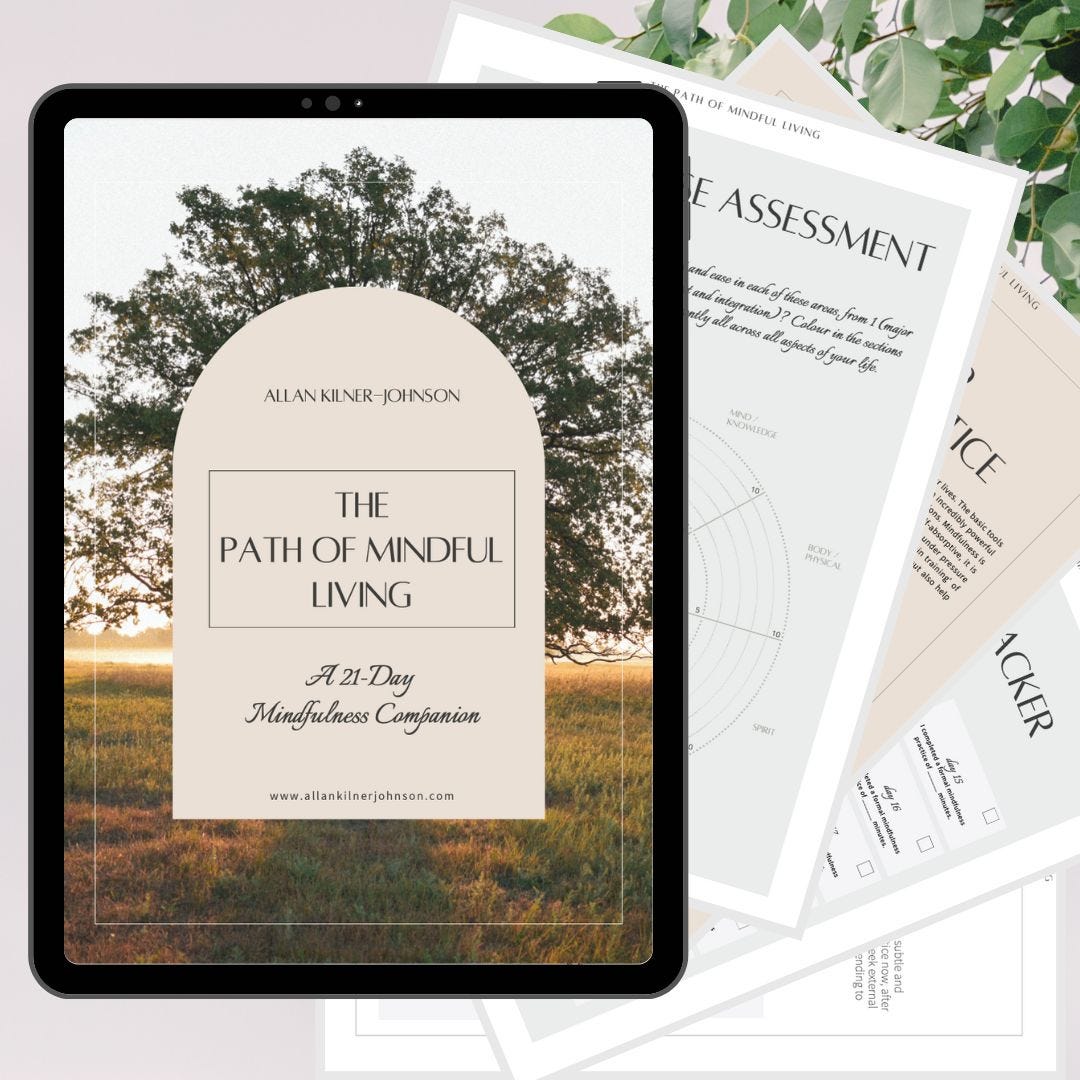
In The Path of Mindful Living: A 21-Day Mindfulness Companion, I lead you through a series of self-guided mindfulness exercises and show you how to bring mindfulness into your daily life. Readers of my blogcan download the workbook and pullout charts for only £6.
It’s a commonly held saying in academia that a good journal article will eventually be published in the right journal. The infamous publish-or-perish culture has led to a world of relentless hustle in which academics — particularly those precariously balanced at the base of the long, shaky ladder to professorship — compete to publish more and better work. Academic publishing has exploded as the quest for validation has intensified, so that most published academic journal articles are never read.
Yet despite this massive growth in academic publishing, it is still a competitive game, and one that early career scholars are trained to navigate and understand. The dictum that ‘a good journal article will eventually find its right journal’ is, in some ways, a limp platitude conveyed through the encouragement of supervisors to help the researcher keep the faith. If the article is ‘good’ — and the unexamined assumption is that every article by a researcher is ‘good’ — then it is only a matter of time before the ‘right journal’ is found. In this context, ‘right journal’ usually means ‘less impactful and prestigous journal’, one with less rigorous editorial standards, higher acceptance rates and ultimately a smaller readership.
In many ways, it’s a good strategy to not give up and keep submitting to journal after journal, even if rejections keep coming, especially considering that a vibrant market of dubious, if not downright predatory, publishers has emerged to scoop up the articles that didn’t make it into quality publications. There’s a certain stoicism to it all: sticking to what you believe in, accepting that you can’t control whether an article is accepted or not, and hoping for a better and more positive outcome in the future.
But what about the articles that are never published in the end? What about the scientists who end up going under rather than publishing? What do we do with these cases that do not correspond to the reality represented by the bromide theory that a good article will always find its place?
In many academic fields, particularly in the arts and humanities, the number of recent PhD graduates is far higher than the number of permanent academic positions available, and the chances of finding a position are vanishingly small. In these cases, can we still assume that all good applicants will find the right job? Again, it’s about encouraging someone to storm. You just have to hang in there a bit longer, but we know that statistically that’s not going to be the case for everyone, and in academia that’s true in all walks of life. There are some people who don’t get a journal article accepted, who don’t get an academic job, things that they were told over and over again will happen if they just wait.
I am thinking of an episode of a BBC nature programme, maybe Planet Earth, but definitely voiced by David Attenborough, where a community of walruses banish some of the male walruses to the edge of the community, they will not meet, they will get just enough food to survive as long as they are content to live on an ice floe on the edge of the community. This is an example of how this particular animal community functions and deals with limited resources, and therefore may not translate directly to the human experience, but it is one of many examples of zero-sum games that surround us everywhere.
Positive psychology tells us that there are no zero-sum games, that one person’s success does not mean that another person cannot also be successful. The advice given to young academics is that if you can just weather the storm, you will achieve your goal. But there is something of a paradox when it comes to our understanding of these so-called zero-sum games.
In the business world, companies compete for market share. There are a few factors at the company’s disposal to try to increase their market share, but they will, sooner or later, come up against the hard wall of mathematical certainty that will require something to be created out of thin air. Let’s see how this works through a thought experiment. Imagine two people are selling an identical product in a completely isolated community of exactly 100 people (let’s say a village with a total population of 102, including the two entrepreneurs).
They might agree that 50 customers is enough for each of them, and that by splitting the customer base evenly they can generate the necessary income. However, it is very likely that sooner or later the light bulb of ambition will come on for one or both of the entrepreneurs and they will think: ‘I can make more money if I have 55 customers, or 75 customers, or 95 customers.’ What doesn’t change is the total number of potential customers available. So if the more ambitious entrepreneur wants to increase their market share, they need to focus on differentiation and make their product seem like the more attractive option. Remember that the two products are absolutely identical, so the differentiation has to be done in a different way. Perhaps the entrepreneur has discovered that if he has 75 customers but charges them a lower price, he still makes more money than before by lowering the price and increasing the volume — the variable at play here is cost. Or the entrepreneur may turn to intangible factors such as persuasion and influence to make his product seem like the more desirable option. Or perhaps the entrepreneur engages in shady practises by lying about his or his competitor’s product, threatening the competition or forcing customers to choose his product over the other.
What this thought experiment doesn’t allow for is the expansion of the market beyond 100 potential customers, and there’s a reason for that: relentless expansion is exactly how humans have tried to overcome zero-sum games since the industrial revolution, Ponzi schemes of growth that feed back into systems that then require further exponential growth to be sustained in the future.
In the past, people have used various strategies to expand markets and create new opportunities. Technological advances, new scientific discoveries, and economic paradigm shifts have repeatedly moved societies forward and enabled them to break free from the constraints of the zero-sum game, creating new and more opportunities for growth. The industrial revolution of the nineteenth century marked a turning point where innovations in manufacturing, transport, and communication dramatically expanded the scope of economic opportunity.
However, this relentless pursuit of growth has led to some very serious problems. Growth has become a prerequisite for maintaining the stability of the system, and economic structures have become designed to require constant expansion in order to sustain themselves, leading to resource depletion, environmental degradation, and increased inequality. As these systems become larger and more interconnected, they are required to expand faster and faster to avoid collapse, leading to some of the biggest challenges facing our world today: overconsumption, environmental degradation, and increasing economic inequality.
In the context of our thought experiment, expanding the market beyond 100 potential customers (e.g. by finding a new community of potential customers that the entrepreneurs were previously unaware of) could be a temporary solution, but it also raises the question of the long-term sustainability of such a strategy — what happens when there are no new undiscovered neighbouring villages with potential new customers? Can the market continuously expand to accommodate more potential customers for our two entrepreneurs, or will it reach a saturation point at some point?
And this thought experiment hasn’t even considered the countless other factors that motivate both the entrepreneurs and the potential customers to act within the system in ways that may seem irrational, but from their personal human perspective are absolutely rational in trying to secure the greatest personal good for themselves while reducing the chances of negative repercussions or pain.
Relentless expansion is a hallmark of human progress and has been used to disguise or deny many forms of zero-sum games where one person must lose in order for another person to gain. Economic inequality is the most obvious and pressing example, but this also applies to opportunities in the labour market, where one applicant’s success means a missed opportunity for another, to healthcare, where allocation of resources in one place can mean a lack of resources in another, and for land use and housing, where gentrification and rising property values may benefit some residents but displace others, leading to an increasing expansion of urban and suburban centres and fewer opportunities for younger people to own property than was the case in their parents’ generation.
One of the reasons this problem is so complex to illustrate is that it involves large numbers and patterns of human behaviour rather than individual transactions. In the area of employment, job opportunities are finite until the market expands, but then the market must continually expand to create job opportunities for the new generation of job seekers that were initially created to expand the market.
Fordism, named after the American industrialist Henry Ford, is a socio-economic system characterised by mass production in which the workers who make the product earn so much money that they can afford the product themselves, thanks to the assembly line method that reduces costs and increases productivity. This concept — that you can afford a car, a hat, or a table if you work in a factory that makes cars, hats or tables — while commonplace today, was a groundbreaking departure from prevailing economic practises until the early twentieth century. Modern society enabled the division of labour, where workers specialised in specific tasks, which ultimately contributed to a huge increase in efficiency and output, and therefore a reduction in costs.
But this apparent success of Fordism is another example of a self-reproducing zero-sum system. Mass production required mass consumption to sustain itself, and the relentless expansion associated with Fordism perpetuated the idea that continued economic growth was not only desirable, but necessary for the well-being of society. In this system, labour became increasingly specialised in repetitive tasks, leading to a sense of alienation and dissatisfaction, and although the economic and social situation of many people improved after the industrial revolution, this came at an invisible cost.
Although the economic and social situation of many people improved after the industrial revolution and the advent of Fordism, these gains were not equally distributed. The zero-sum nature of the system meant that progress for some came at the expense of others, and as we have seen in our own time, the pursuit of continuous economic growth was fuelled by a collective mentality that prioritised material accumulation as a sign of social progress. This relentless pursuit of growth sometimes overshadowed the importance of other essential elements of wellbeing, such as work-life balance and social cohesion.
Unlike economic systems, personal relationships involve a range of observable but fiendishly complex and often invisible factors, making them a complex and highly nuanced area of experience. In many ways, however, the reality of human relationships is even more complex. Human relationships are influenced by a variety of factors, including personal values, interests and life circumstances.
Unlike economic transactions, relationships are not tied to finite resources, and the possibilities for meaningful relationships are seemingly limitless. However, this complexity also makes relationships susceptible to the nuances of individual personalities, societal expectations and cultural influences. In the context of relationships, the concept of the zero-sum game takes on a different dimension. The idea that finding a life partner is a competition in which one person’s happiness comes at the expense of another’s happiness is overly simplistic. While it is true that not every connection leads to a lifelong partnership, the richness of human experience allows for diverse and meaningful connections that contribute to personal growth and fulfilment.
The invisible costs associated with personal relationships can manifest in the form of emotional challenges, misunderstandings or unfulfilled expectations. However, much like the complexities of economic systems, the intricacies of human relationships also hold the potential for growth, learning and shared experiences that contribute to the richness of life. It is important to recognise that, similar to economic systems, societal narratives and cultural expectations shape our ideas of what constitutes an ideal relationship.
The pursuit of continuous growth and progress, whether in economic development or personal relationships, can sometimes overshadow the importance of other essential elements of wellbeing.
In the realm of relationships, as in the broader social context, balance and appreciation for the multidimensionality of human experience is critical. The pursuit of happiness and fulfilment should not be seen as a zero-sum game, but rather as an exploration of the myriad opportunities for connection, understanding and shared joy that enrich our lives. Just as economic models must evolve for sustainable progress, our view of relationships can benefit from a holistic understanding that embraces the diverse and intricate human relationships.
The dictum that a good journal article will eventually find its right journal is reassuring, but sometimes leads to settling for lower impact journals, perpetuating a zero-sum game in the pursuit of academic success. Similarly, economic systems and the relentless pursuit of growth epitomised by Fordism have often obscured or denied the zero-sum games within them.
The invisible costs of economic progress, such as environmental degradation, resource depletion, and increasing inequality, highlight the complexity and challenges associated with constant expansion. The parallels also extend to personal relationships, where the pursuit of happiness and fulfilment is often portrayed as a competition, eclipsing the diverse and meaningful relationships that contribute to the richness of human experience.
Recognising this zero-sum dynamic leads to a call for a more balanced and holistic approach. As we navigate the complexities of science, business and personal relationships, a nuanced understanding of success and fulfilment is critical. Just as the pursuit of perpetual growth in economic systems can lead to undesirable consequences, an overemphasis on competition and scarcity in personal relationships can obscure the true potential for connection, understanding and shared joy. Finding a balance that prioritises wellbeing, sustainability and inclusivity is key to fostering a future where success is achieved not at the expense of others, but in harmony with the interconnected fabric of our shared human experience.
In The Path of Mindful Living: A 21-Day Mindfulness Companion, I lead you through a series of self-guided mindfulness exercises and show you how to bring mindfulness into your daily life. Readers of my blogcan download the workbook and pullout charts for only £6.