Stress-Free Creativity: Mindfulness Strategies for Creative Entrepreneurs

The modern creative entrepreneur, far from being a whimsical dreamer, now finds themselves managing a personal brand, curating an online presence, navigating intellectual property law, and staying responsive to trends in everything from digital tools to collective taste. The imaginative life has been annexed by the logistical. And so, the very space in which new ideas used to emerge—unbidden, unforced—is now encroached upon by the relentless logic of hustle. There’s little room left for drift, daydream, or depth.

Yet this is precisely the contradiction that mindfulness helps us resolve—not by cancelling out ambition, or opposing the practical necessities of making a living through one’s art, but by returning us to the inner posture from which true creative agency arises. That posture is presence. And presence, for all its simplicity, is one of the most difficult things to cultivate in a world that monetises our distraction. For the creative entrepreneur—who must both think expansively and deliver reliably—mindfulness is not so much a wellness add-on as it is a method for living in the gap between inspiration and obligation without being torn apart.

One does not need to be a Zen master or an early riser with an incense habit to practice mindfulness. Nor does it require you to withdraw from ambition or complexity. It does, however, ask you to make a subtle shift: from acting under compulsion to acting with awareness. From speeding up when anxious to slowing down when it matters most. From using your work to prove your worth to allowing your work to emerge from a place that does not require proof. And in this sense, mindfulness is not merely a way to be calmer. It is a way to reclaim sovereignty over the rhythms of your own mind.

Creativity, at its heart, is about pattern-breaking. It is about letting the familiar become strange and the strange become familiar. Yet when our attention is colonised by metrics and our energy distributed across half a dozen platforms, this capacity to reimagine, to reorient, is diminished. We default to pattern-repeating: producing what has worked before, ticking off tasks, chasing that elusive sense of “having caught up.” The real danger for creative entrepreneurs is not laziness but a frenzied kind of competence that leaves no space for the unknown to speak.

Mindfulness does not immediately solve this, but it creates the preconditions for solving it. When we slow down enough to notice our breath, to locate the body in space, to sit in the quiet hum beneath our thoughts, we begin to disentangle ourselves from the mesh of urgency and enter something closer to the timeless. From here, the creative act reasserts itself—not as an effortful exertion of will, but as a natural consequence of being attentive. One of the deepest misunderstandings about mindfulness is that it’s about doing less. In truth, it’s about being more available—to sensation, to intuition, to nuance.

I often think of the creative process as a long conversation with silence. The problem is that we rarely give silence a chance to respond. We fill it with podcasts, email replies, algorithmic nudges, and guilt. But silence has its own grammar, its own cadence. Mindfulness trains us to listen—not just to our ideas, but to the conditions from which those ideas might arise. A writer, for example, does not invent a book out of thin air. They receive it, piecemeal, by staying close to the texture of their own mind. The same applies to the designer who begins with no image in mind, or the coach who senses what a client isn’t saying. All real creativity is relational. And mindfulness is the practice of showing up for that relationship with fidelity.

It is tempting, of course, to think of mindfulness as another task to master, another skill to add to the entrepreneurial toolkit. But it is better thought of as a stance—an ethical and perceptual orientation that refuses to treat attention as merely a means to an end. It changes the very shape of productivity, from something linear and extractive to something rhythmic and regenerative. And this matters because creative energy does not operate like fossil fuel. It cannot be extracted and stockpiled. It is more like breath: it comes and goes. It renews itself only if given space.

One of the most useful insights mindfulness offers the creative entrepreneur is that stress is not the enemy. The idea that we can (or should) eliminate stress in order to be more creative is both misguided and subtly violent. It sets up an opposition between clarity and challenge, as though we must be permanently soothed in order to think well. But creativity often emerges from the tension between competing impulses. What mindfulness helps us do is inhabit that tension without collapsing into panic or paralysis.

When we are present with our discomfort—naming it, breathing into it, noticing how it lives in the body—we begin to relate to it differently. It ceases to be a verdict and becomes a signal. A deadline that once felt suffocating might, through the lens of mindfulness, be reframed as a crucible: a necessary pressure that sharpens our attention and clarifies our intention. The inner critic, which so often masquerades as the voice of reason, can be recognised as a pattern of inherited fear, not a reliable narrator. And the feeling of being stuck can be honoured not as failure but as fertile stillness: a place where new insight incubates.

None of this is instantaneous. But over time, mindfulness begins to carve out a kind of internal spaciousness. You learn to pause before responding. You recognise that urgency is not the same as importance. You notice when your drive to be seen starts to eclipse your capacity to see. And in these micro-moments of awareness, something remarkable happens: you begin to recover the freedom that drew you to creative work in the first place.

What does this look like in practice? It might be as simple as beginning your day with five minutes of breath awareness before opening your laptop. It might mean taking a walk with no phone and no agenda, letting your mind roam like a child in a field. It might involve bringing a quality of deliberate slowness to a task you usually rush—writing an email, editing a photo, setting up your workspace. These are not acts of indulgence. They are acts of reclamation.

One especially powerful practice for creative entrepreneurs is what I call “mindful transitions.” Most of us move between tasks without any sense of arrival or departure. We check our messages while uploading files, plan tomorrow’s pitch while replying to today’s invoice. But creativity thrives on clear thresholds. Try this: when moving from one project to another, pause. Close your eyes. Feel your feet. Take one conscious breath. Let go of what you were just doing. Then begin. It’s astonishing how different the same task can feel when approached with fresh awareness rather than cognitive residue.

Another practice I recommend is “compassionate closing.” At the end of the day, before numbing out with streaming or scrolling, take a moment to acknowledge what you did manage to do. Not just the completed tasks, but the inner efforts—staying kind to yourself during a difficult call, resisting the urge to compare your work to someone else’s. Offer yourself a kind word. Then release the day. Creativity cannot thrive under the weight of perpetual self-judgment. Mindfulness helps you draw a boundary between being driven and being self-harming.

Above all, what mindfulness offers the creative entrepreneur is the courage to remain porous. In a world that rewards certainty, clarity, and control, the creative act is always an act of vulnerability. To write, design, launch, or teach something from the depths of your own sensibility is to risk misunderstanding and indifference. But mindfulness reminds us that we are not reducible to how our work is received. It roots us in the present moment, where our value is not conditional on our output.

To be a mindful creative is not to be perfectly balanced or endlessly serene. It is to be radically honest about your experience, moment by moment. It is to resist the cultural equation of speed with worth. It is to remember that your attention—when not siphoned away by algorithms or scarcity thinking—is one of the most powerful instruments of transformation you possess. Let this be your starting point: not perfection, but presence. Not productivity, but permission. Not constant motion, but creative stillness. The work will come. The audience will come. But the relationship you have with your own attention? That’s the foundation on which everything else rests.

In the end, what we call a creative career is really a sequence of small choices—where to focus, how to respond, whether to trust the inner voice or override it. Mindfulness does not eliminate uncertainty. It simply gives you the inner resources to navigate it without losing yourself. And in that space, stress begins to lose its grip. Creativity, no longer beholden to panic or pressure, can take its true shape: not as a sprint to the finish, but as a lifelong conversation with what is deepest in us, waiting always to be heard.


Unlock your potential with mindfulness! Discover how a few mindful moments can help spark breakthrough, overcome blocks, and transform your personal and professional journey. Subscribe to my blog today for more on the art of being present.


If you want to start putting these ideas into action, you can sign up for Integrative Meditation (Level 1). This course represents the culmination of years of learning, practice, and personal growth. Integrative Meditation is a comprehensive framework designed to enhance your mental and emotional well-being. It draws on Mindfulness-Based Cognitive Therapy (MBCT), positive psychology, neuroscience, Acceptance and Commitment Therapy (ACT), journaling, and breathwork to support you in reducing stress, enhancing focus, building emotional resilience, and discovering your true self.


Mindfulness for Writers: Find Clarity and Inspiration in Your Craft

For many writers, silence—full of potential and hesitation—can feel simultaneously rich and unbearable. We long to write, to shape thought into language, to move the idea from the interior chamber of the self into some shared terrain. And yet we resist. We distract ourselves. We rehearse the moment of beginning without quite entering it. The cursor blinks. The mind loops. The feeling grows that something must be resolved—cleared, conquered—before the writing can begin.

Mindfulness offers another way.

To write mindfully is not to wait for the perfect conditions, but to enter the imperfect ones with attention and care. It is to befriend the silence, rather than avoid it. It is to recognise that clarity does not descend fully formed from on high, but arises gradually through relationship—with language, with mood, with the flickering mind itself. At its heart, writing is an act of intimacy: with our own thoughts, with the complexities of truth, with the reader we may never meet. And like all acts of intimacy, it benefits from presence. It flourishes in the absence of harshness, when control gives way to curiosity.

The mythology around writing tends to encourage the opposite. We are taught, implicitly or otherwise, that inspiration is rare and capricious, that a successful writer must discipline themselves ruthlessly, that the creative mind is both gift and burden. From this perspective, the writer’s job becomes one of wrangling: taming the wild impulse, dragging the idea across the threshold of productivity, pushing through inertia with sheer will. But this model creates a peculiar estrangement. The act of writing becomes adversarial. We are no longer in dialogue with our thoughts but in conflict with them. The page becomes a site of pressure rather than possibility.

Mindfulness undoes this subtle violence. It invites us to return to the writing process not as a battleground, but as a place of noticing. We begin to pay attention not only to what we want to say, but to what is happening as we try to say it. We notice the quickening of the breath when a sentence feels too vulnerable. We notice the flicker of doubt when the prose doesn’t match the inner image. We notice the impulse to check email, scroll, tidy the desk—anything but face the discomfort of uncertainty.

And then, rather than judge ourselves for these things, we soften. We stay. We write from within the mess rather than waiting for the mess to resolve.

This kind of writing is slower, yes. But it is also truer. When we learn to tolerate the moment of unclarity—when we stop fleeing the fog and start writing from within it—something begins to shift. The words that emerge may be halting, but they are honest. The rhythm that arises may be uneven, but it carries the weight of attention. And from this attention, something unexpected can unfold. We find ourselves saying what we didn’t know we knew. We surprise ourselves. We write not to assert, but to discover.

In this way, mindfulness is not simply a technique for calming the nervous system. It is a stance. It is a way of approaching the creative process with respect—for ourselves, for the material, for the reader. It acknowledges that the mind, left to its own devices, will often resist the work it most wants to do. Not out of laziness, but out of fear. The fear of not being good enough, not being original, not being able to finish. These fears are ancient and deeply human. But they are not the end of the story.

Through mindfulness, we begin to recognise these internal dramas for what they are: patterns, not truths. A thought is just a thought. A mood is just a weather system. They pass. And if we can learn to observe them rather than obey them, we free ourselves from their grip. We become less entangled. We make space for the writing to emerge on its own terms.

Of course, this requires a kind of humility. The mindful writer does not approach the page with the assumption of mastery. They approach with openness. They are willing to be surprised, to be wrong, to revise not just sentences but assumptions. They listen. And this listening begins long before the first word appears. It begins in the body—the breath, the posture, the quiet scan of inner state. How am I today? What is present in me right now? Not: what do I want to write about, but: where am I writing from?

This simple pause—this moment of turning inward—can change everything. It can prevent the unconscious projection of stress onto the writing task. It can reveal the source of resistance. It can allow a more grounded voice to emerge, one less driven by ego and more attuned to truth. In this way, writing becomes a form of meditation. Each sentence is a return. Each revision is a reckoning. Each paragraph is a field of attention.

This does not mean the process becomes easy. Writing mindfully is not a shortcut to flow. On the contrary, it often requires more patience, more willingness to linger with discomfort. But it also brings a deeper reward. The writing begins to feel less like a performance and more like a practice. We are not trying to impress. We are trying to see clearly.

And that clarity—when it comes—is not just about language. It is about alignment. The writer begins to feel aligned with their own voice, their own rhythm, their own pace. They stop comparing themselves to imagined others. They stop chasing an abstract standard. They begin to trust their process, even when it feels slow or strange. They begin to recognise that inspiration is not a bolt from the blue but a byproduct of attention. That the well of creativity refills not through pressure, but through presence.

In this spirit, many writers find it helpful to create small rituals that anchor them in mindfulness. Not elaborate routines, but subtle cues—a brief pause before beginning, a few breaths with the eyes closed, a wordless acknowledgment of the moment. These rituals are not about superstition. They are about orientation. They remind the writer that this work, however ordinary, is sacred in its own way. That to sit down and listen inwardly, day after day, is an act of both courage and care.

Sometimes, of course, the writing does not come. The mind is scattered. The ideas are half-formed. The inner critic is loud. Mindfulness does not banish these moments. But it changes our relationship to them. Instead of pushing through or giving up, we stay curious. We ask different questions: What is happening here? What am I afraid of? What part of me is not yet ready to write? And sometimes, the most important work a writer can do is not to write, but to listen. To let the stillness speak. To honour the pause, not as failure, but as part of the rhythm.

In the long view, what mindfulness gives to writing is not just clarity and inspiration, but resilience. It teaches us how to return. To begin again, without shame. To meet the page as it is, and ourselves as we are. This is not merely a mental skill; it is a spiritual one. It asks us to drop the mask. To write not from performance, but from presence. And in doing so, we make room for something deeper to come through.

Writing, in this mode, becomes less about control and more about conversation. A dialogue between self and world, between language and silence. We no longer need to force meaning; we allow it to emerge. And when it does, it carries the subtle texture of truth—not just what is said, but how it is said. Not just insight, but tone. That particular cadence of voice that can only arise when the writer is fully present to their own experience.

And so the invitation is simple: write as you are. Let the writing be an act of awareness. Let the process teach you something about your own mind. Let it be less about making a point and more about making contact—with yourself, with the page, with the invisible reader who may be longing for the very thing you are about to say.

Let writing become a place of return.

Let it be a home.


Unlock your potential with mindfulness! Discover how a few mindful moments can help spark breakthrough, overcome blocks, and transform your personal and professional journey. Subscribe to my blog today for more on the art of being present.


If you want to start putting these ideas into action, you can sign up for Integrative Meditation (Level 1). This course represents the culmination of years of learning, practice, and personal growth. Integrative Meditation is a comprehensive framework designed to enhance your mental and emotional well-being. It draws on Mindfulness-Based Cognitive Therapy (MBCT), positive psychology, neuroscience, Acceptance and Commitment Therapy (ACT), journaling, and breathwork to support you in reducing stress, enhancing focus, building emotional resilience, and discovering your true self.

Mindful Design: Transforming Your Creative Process Through Meditation

Mindful Design: Transforming Your Creative Process Through Meditation

Creativity thrives on a delicate balance of structure and spontaneity, discipline and play, immersion and detachment. In an age of hyperconnectivity, where digital tools facilitate but also fragment our creative process, maintaining this balance has never been more challenging. The practice of mindfulness—cultivating present-moment awareness without judgment—offers a way to recalibrate, enabling designers, writers, artists, and innovators to engage more deeply with their work.

Mindful design is not simply about aesthetics or functionality; it is about intentionality. It invites us to slow down, to listen to our creative impulses, and to transform the process of making into an act of meditation. Whether you are sketching ideas, coding an interface, composing music, or developing a research project, integrating mindfulness into your creative practice can yield profound benefits.

The Creative Mind Under Siege

In the modern creative landscape, distractions are ubiquitous. The constant influx of notifications, emails, and algorithmic stimuli disrupts the sustained focus necessary for original thought. Creativity, at its core, demands deep engagement—what Mihaly Csikszentmihalyi calls ‘flow,’ a state of complete immersion in a task. Yet, achieving flow is increasingly difficult when attention is fragmented.

Research suggests that multitasking diminishes cognitive flexibility, making it harder to generate novel solutions. When the mind is perpetually reactive—switching between tasks, skimming rather than absorbing, producing rather than reflecting—creativity suffers. Mindfulness counters this tendency by fostering sustained attention, emotional resilience, and a heightened sensitivity to the nuances of the creative process.

Meditation as a Creative Catalyst

Meditation does not impose creativity; rather, it clears the space for it to emerge. By training the mind to observe thoughts without attachment, meditation cultivates a state of receptivity—where ideas surface organically, unencumbered by the usual noise of self-doubt and overanalysis. Different meditation techniques can support different stages of the creative process:

  • Focused Attention Meditation: By anchoring awareness to the breath or a single object, this practice strengthens concentration, reducing the mental clutter that impedes deep work.
  • Open Monitoring Meditation: A more expansive approach, this technique encourages an observant, non-reactive stance towards thoughts and sensations. It is particularly useful for ideation, as it allows creative insights to arise without immediate critique.
  • Loving-Kindness Meditation: Often overlooked in discussions of creativity, this practice fosters self-compassion and resilience. Given that fear of failure or imposter syndrome can inhibit innovation, cultivating a kinder internal dialogue can be transformative.
  • Walking or Movement-Based Meditation: Creativity is not confined to the studio or desk. Engaging in mindful walking, yoga, or even rhythmic movement can free the mind from habitual thought patterns, sparking fresh perspectives.

Designing with Presence

Mindful design is about more than the personal benefits of meditation; it is about cultivating a design ethos that values presence, intentionality, and human-centred engagement. This can manifest in several ways:

  • Slowing Down the Process: In a culture that rewards rapid output, taking the time to sit with an idea, refine a concept, or simply pause before executing can result in more thoughtful and resonant work.
  • Material Awareness: Whether working with digital or physical media, mindfulness fosters a deeper connection with materials, textures, and the sensory dimensions of design.
  • Embracing Imperfection: Perfectionism stifles creativity. A mindful approach recognises that iteration, revision, and even failure are integral to the process. By observing rather than clinging to expectations, designers can navigate uncertainty with greater ease.
  • Deep Listening and Collaboration: Creativity does not exist in isolation. Mindfulness enhances our ability to listen—not just to our own intuition but to collaborators, clients, and audiences. A present-centred approach to feedback and discussion leads to more meaningful creative partnerships.

The Future of Mindful Creativity

In an era of automation, AI-generated content, and ever-accelerating production cycles, mindfulness offers a counterpoint—a reminder that creativity is not about efficiency alone but about depth, engagement, and intention. To integrate mindfulness into your creative practice is not to reject technological tools but to use them more consciously, ensuring that they serve rather than dictate your process.

The mindful designer, writer, or artist does not simply produce; they cultivate an ongoing dialogue between presence and creation, allowing their work to emerge from a place of clarity and authenticity. As we rethink our relationship with technology, productivity, and creative expression, mindfulness has the potential to transform not only how we design but why we design.

By reclaiming presence, we reclaim creativity itself.


Mindfulness for Creative Professionals: Unlock Your Artistic Potential

Mindfulness for creative professionals is not merely something that someone does; it is a journey that unlocks the door to deeper inspiration, clarity, and innovation. Through this introspective approach, individuals come to realize that creativity flourishes not in chaos, but in the calm spaces created by mindfulness. Through the integration of these practices into daily routines, creative professionals can not only enhance their individual artistry but also foster collaboration and synergy in their projects, ultimately leading to innovative outcomes that reflect a harmonious balance of mind and heart.


The Muse of Mindfulness

Mindfulness, in its purest form, is the art of paying deliberate, non-judgmental attention to the present moment. For creative professionals, this means stepping away from the constant barrage of deadlines, critiques, and the inner critic, and instead allowing the raw essence of creativity to emerge unencumbered. In this moment of quiet, the creative takes a deep, intentional breath—a pause that is both a beginning and a release. It is in these moments of mindful presence that the inner creative muse awakens, offering insights that transcend the ordinary and ignite the imagination.

Research in neuroscience and psychology has shown that mindfulness can significantly enhance cognitive flexibility—the ability to shift perspectives and generate innovative ideas. Practices such as meditation have been linked to improved focus, emotional regulation, and even structural changes in the brain that favor creative thinking. Pioneers like Jon Kabat-Zinn, through mindfulness-based stress reduction (MBSR), have demonstrated that the practice can quiet the mind, reduce anxiety, and foster an environment where novel ideas can flourish.

For creative professionals, mindfulness is a bridge between the analytical and the intuitive. It allows the mind to move freely between logical problem-solving and abstract, artistic expression. This balance is essential, whether you are a painter wrestling with color theory or a writer crafting a narrative that captures the human experience.

Mindfulness as a Creative Ritual

For many creative professionals, the artistic process is not just a task but a ritual—a sacred practice that connects the inner self to the external world. Mindfulness can serve as a ritualistic prelude to creativity, a way to transition from the everyday noise into a state of receptive calm.

Morning Meditations for Artists:
Starting the day with a brief meditation can set the tone for creative expression. Whether it’s five minutes of silent breathing, a mindful walk through nature, or a journaling session that reflects on dreams and aspirations, these rituals ground the artist in the present moment. As the mind settles, the floodgates of creativity open, revealing ideas that have long been buried under the weight of routine thoughts.

Mindful Observation:
Another powerful technique is mindful observation. This involves engaging with your environment with full sensory awareness—listening to the rustle of leaves, watching the interplay of light and shadow, or simply savoring the aroma of freshly brewed coffee. These observations can spark new ideas, as they encourage the mind to notice beauty and detail in the everyday. An illustrator might sketch the intricate patterns of a butterfly’s wing, or a writer might find inspiration in the rhythm of a bustling street corner.

Overcoming Creative Blocks with Mindfulness

Creative blocks are a common adversary for those in artistic fields. They often arise when the mind is cluttered with self-criticism, fear of failure, or the relentless pressures of commercial expectations. Mindfulness offers a compassionate counterpoint to these challenges by fostering an attitude of acceptance and curiosity.

The Practice of Non-Judgment:
At the heart of mindfulness is the practice of non-judgment. For the creative professional, this means embracing the messy, sometimes imperfect process of creation without the burden of self-criticism. When a writer hesitates at the blank page or a sculptor hesitates before a rough block of marble, mindfulness reminds them that every stroke, every mark, is part of the unfolding creative journey. By acknowledging each moment as it is—without labeling it as ‘good’ or ‘bad’—creatives can bypass the internal barriers that stifle creativity.

Mindful Breaks:
In the midst of a creative marathon, taking short, mindful breaks can rejuvenate the mind. A quick breathing exercise or a few minutes of silent reflection can clear away mental clutter and restore focus. Studies have shown that even brief periods of mindfulness can improve concentration and reduce stress, thereby paving the way for a renewed burst of creativity.

Practical Strategies for Integrating Mindfulness into the Creative Process

Implementing mindfulness into your creative practice doesn’t require a complete overhaul of your routine—it can be woven seamlessly into the fabric of daily life. Here are some practical strategies to consider:

  1. Set a Daily Intention:
    Begin your creative session by setting an intention. It could be as simple as “Today, I will embrace every idea, no matter how unconventional,” or “I will explore the beauty of imperfection in my work.” This intention acts as an anchor, guiding your focus and opening your mind to new possibilities.
  2. Create a Mindful Workspace:
    Design a creative space that inspires calm and focus. This might involve decluttering your studio, incorporating natural elements like plants or soft lighting, or even playing gentle, ambient music. A mindful workspace is a sanctuary where distractions are minimized and the mind is free to wander, explore, and create.
  3. Incorporate Mindfulness Breaks:
    Schedule regular mindfulness breaks into your creative process. Whether it’s a few minutes of deep breathing, a short walk, or a meditation session, these breaks allow your mind to reset and reconnect with your inner creative flow.
  4. Reflect Through Journaling:
    Keeping a mindfulness journal can help track your creative progress and emotional journey. Write down thoughts, insights, and observations from your mindful practices, and notice patterns or recurring themes that emerge in your art. Over time, this reflective practice can reveal the subtle ways in which mindfulness has transformed your creative process.
  5. Join a Mindfulness Community:
    Connect with other creative professionals who share a passion for mindfulness. Workshops, retreats, and online forums provide spaces to exchange ideas, share experiences, and learn new techniques. These communities foster a supportive environment where creativity and mindfulness mutually reinforce each other.

The Science Behind Mindful Creativity

Modern research continues to uncover the profound impact mindfulness can have on the creative brain. Neuroimaging studies reveal that regular mindfulness practice can alter brain activity in regions associated with attention, emotion regulation, and divergent thinking—the type of thinking that underpins creativity. For instance, studies have found that mindfulness meditation increases activation in the prefrontal cortex, a region vital for planning, decision-making, and problem-solving.

Furthermore, mindfulness can reduce activity in the brain’s default mode network (DMN), which is often linked to self-referential thoughts and the tendency to ruminate. By quieting the DMN, mindfulness creates a mental space where the mind is less preoccupied with fears, doubts, and distractions, allowing the creative spark to ignite more freely. These scientific insights not only validate the age-old practices of mindfulness but also underscore its potential to serve as a catalyst for artistic innovation.

Cultivating a Lifelong Creative Practice

The journey toward unlocking your creative potential through mindfulness is not a destination but an ongoing practice—a lifelong dialogue between your inner self and the ever-evolving tapestry of the creative world. It calls for patience, persistence, and a willingness to explore the unknown. Every mindful breath, every moment of stillness, is an invitation to dive deeper into the wellspring of your creative essence.

Over time, as mindfulness becomes an integral part of your creative routine, you may notice subtle yet profound shifts in your artistic expression. Ideas that once seemed elusive now flow with greater ease, and the boundaries between your inner world and the external canvas blur, allowing for a seamless expression of your authentic self. It is a journey marked by continuous discovery, where each mindful practice adds a new layer to the rich tapestry of your creative life.

Embracing the Paradox of Art and Mindfulness

Creativity is, by its nature, a paradox—a dance between structure and spontaneity, discipline and abandon. Mindfulness complements this paradox perfectly, offering a way to navigate the tension between order and chaos. When you allow yourself to be fully present, you tap into a space where the rigid lines of expectation dissolve, leaving behind the raw, unfiltered essence of creativity. It is here, in this sacred liminal space, that true artistic magic happens.

Consider the designer who, by embracing mindfulness, learns to see not just with the eyes but with the soul. Every work becomes a deliberate act of creation that honours both the process and the outcome. Every color, every texture, whispers secrets of a deeper truth—a truth that is accessible only when the mind is quiet and the heart is open.

A Vision for the Future of Creative Mindfulness

As creative professionals continue to navigate an ever-evolving landscape defined by rapid technological advancements and shifting cultural paradigms, mindfulness stands as a timeless anchor—a practice that grounds the creative spirit in authenticity and purpose. The future of artistic expression may well be shaped by those who embrace mindfulness, allowing them to transcend the noise and chaos of modern life and tap into the wellspring of genuine inspiration.

Mindfulness for creative professionals is an invitation—a call to reclaim the space within, where the seeds of artistic potential lie dormant, waiting to be nurtured by the gentle touch of awareness. It is a practice that honors the delicate interplay between the inner world of imagination and the outer realm of expression. Through mindfulness, you unlock not just your artistic potential but a deeper connection to your authentic self—a self that thrives in the beauty of each moment, unfettered by doubt or distraction.

As you embark on your own mindful journey, remember that each breath is an opportunity to reconnect with the muse within. Whether you are a writer seeking clarity in your narrative, a painter yearning for a fresh burst of color, or a musician in search of the perfect melody, mindfulness offers a path toward a more inspired, creative life. Embrace the practice, let it guide you, and discover the limitless possibilities that await when you truly listen to the whispers of your inner creative spirit.


Unlock your potential with mindfulness! Discover how a few mindful moments can help spark breakthrough, overcome blocks, and transform your personal and professional journey. Subscribe to my blog today for more on the art of being present.


If you want to start putting these ideas into action, you can sign up for Integrative Meditation (Level 1). This course represents the culmination of years of learning, practice, and personal growth. Integrative Meditation is a comprehensive framework designed to enhance your mental and emotional well-being. It draws on Mindfulness-Based Cognitive Therapy (MBCT), positive psychology, neuroscience, Acceptance and Commitment Therapy (ACT), journaling, and breathwork to support you in reducing stress, enhancing focus, building emotional resilience, and discovering your true self.

Unlock Your Creativity with The Artist’s Way: Morning Pages and More

Julia Cameron is a prolific author, artist, and teacher best known for her transformative work in the realm of creativity who has helped millions of people worldwide unlock their creative potential through her innovative techniques and practices.  One of her most influential and widely used techniques, first introduced in The Artist’s Wayis called Morning Pages, a simple but very powerful invitation to write three stream of consciousness pages every morning to get down a jumble of thoughts, plans, worries, and hopes down on paper first thing in the morning. I’ve seen how Morning Pages can reduce anxiety and creates a sense of mental clarity that can positively impact your day. The beauty of Morning Pages lies in its simplicity and accessibility; all it takes to start is a notebook and pen.

While Morning Pages are definitely the most well-known of Cameron’s techniques, The Artist’s Way is rich with other innovative tools and insights designed to help us reclaim our creativity and personal power. I want to dive into some of these lesser known but equally powerful practices from her book, including the Artist Date, Affirmations, Time Travel, Synchronicity, and Creative U-Turns. By integrating these practices into our daily lives, we can expand our creative horizons and find deeper fulfilment in our life and work.

Nurturing Your Creative Self

For Cameron, the second most important tool after Morning Pages is the Artist Date, a weekly solo expedition to explore something that really interests you. It is a commitment to nurture your inner artist by setting aside time each week to do something you enjoy.

The importance of play, exploration and creativity cannot be overstated. Our daily routines often leave little room for spontaneity and fun, both of which are crucial for fostering creativity. As Cameron points out, Artist Dates encourage us to step out of our usual habits and see the world through new eyes, with a sense of wonder and curiosity. Some of the Artist Dates I enjoy are visiting a museum, taking a walk in one of the parks around London, going to a concert on my lunch break, or visiting an art shop to try something new.

Fitting Artist Dates into a busy schedule can definitely be a challenge, but it’s important that you prioritise this time for yourself, even if it’s just an hour a week: start by setting aside an hour each week for your artist states. Think of it as a non-negotiable appointment with your creative self.

Overcoming Creative Blocks

We regularly face blocks that hinder our progress on whatever we are working on. In The Artist’s Way, Cameron offers several tools to help us overcome these blocks and keep our creative energy flowing. One of the most important tools for overcoming creative blocks is the use of affirmations, positive statements that can counteract negative self-talk and limiting mindsets. For example, an affirmation could be: ;’I’m a talented and capable creator’ or ‘my creativity flows effortlessly.’ By repeating affirmations, we can rewire our neural pathways and cultivate a more positive and supportive inner dialogue.

Another important tool in The Artist’s Way called Time Travel, where we use journaling to work through and heal past creative wounds. Many of us carry emotional baggage from past experiences where our creativity was criticised or rejected. By acknowledging these wounds and writing through them, we can begin to free ourselves from their negative effects.

Cameron also introduces the concept of Creative U-turns, moments when we sabotage our own progress, often out of fear of success or failure. It’s important to recognise these patterns and consciously choose to overcome them. For example, if you find yourself putting off a project, you’re excited about, recognise this behaviour as creative U and take action to overcome it by breaking the project down into smaller tasks or setting a fixed deadline.

The Importance of Synchronicity

A key component of The Artist’s Way is synchronicity, or meaningful coincidences, and Cameron emphasises synchronicity as a guiding force in the creative process. When we open ourselves up to creativity, we often notice patterns and coincidences that seem to lead us in the right direction. These moments of synchronicity can be seen as signs that we’re on the right path. Recognising and trusting synchronicities means being open and receptive to the messages the universe sends us. This can be as simple as noticing recurring themes in conversations, books, or experiences that seem to resonate with your creative project. It can also mean paying attention to your gut instincts and intuitive impulses that guide your decisions, those little signals that keep us on the right path.

Cameron shares numerous personal anecdotes about how synchronicity has played a role in her creative journey. I’ve found that it’s been a part of my journey too, in moments when a particular resource or connection I need seems to suddenly appear out of nowhere. When we learn to trust these moments and follow the messages they give us, it can lead to unexpected and positive outcomes to enhance our awareness of synchronicity can be useful to keep a journal of coincidences and intuitive insights as they emerge, reflecting on these entries regularly, we can begin to see how they connect with our creative journey. And the more we practise recognising synchronicity, the more we can tune into its presence in our life.

Building Community

Creativity thrives in a supportive environment, while individual practises like morning pages and artist dates are essential. Having a community of people to share with also provides invaluable encouragement and feedback. Cameron emphasises the importance of community and nurturing our creative spirits. Finding or starting a supportive group can take several forms. You could join a local writing group, meditation class, or a creative workshop. There are also online forums where you can share and network with other creatives around the world. Sharing your work with others and getting feedback is a really good way to grow as a creative—constructive feedback can help you hone your craft and boost your confidence and motivation. Being part of a community also provides an opportunity to collaborate, learn from others and be inspired.

Living the Artist’s Way

Integrating the practises from The Artist’s Way into your daily life is a gradual process that requires commitment and consistency. But the rewards of a more creative and fulfilling life are well worth the effort. Start with a morning routine that includes morning pages. This exercise sets you up positively for the day and clears your mind so you can approach your creative work with a fresh perspective. Combine this with weekly artist appointments to ensure you’re regularly engaging in activities that inspire and rejuvenate you. It can be challenging to balance creativity and other life commitments, but it’s important that you prioritise your own creative pursuits.

Start small and build consistency over time. The key is to create a sustainable routine that supports your creative growth without overwhelming you. The Artist’s Way provides a comprehensive 12-week framework for unlocking your creative potential, and there’s much more you can learn from the book. The impact of these exercises is profound, and as you embark on this journey, remember that creativity isn’t a destination, but a continual process of growth and exploration.


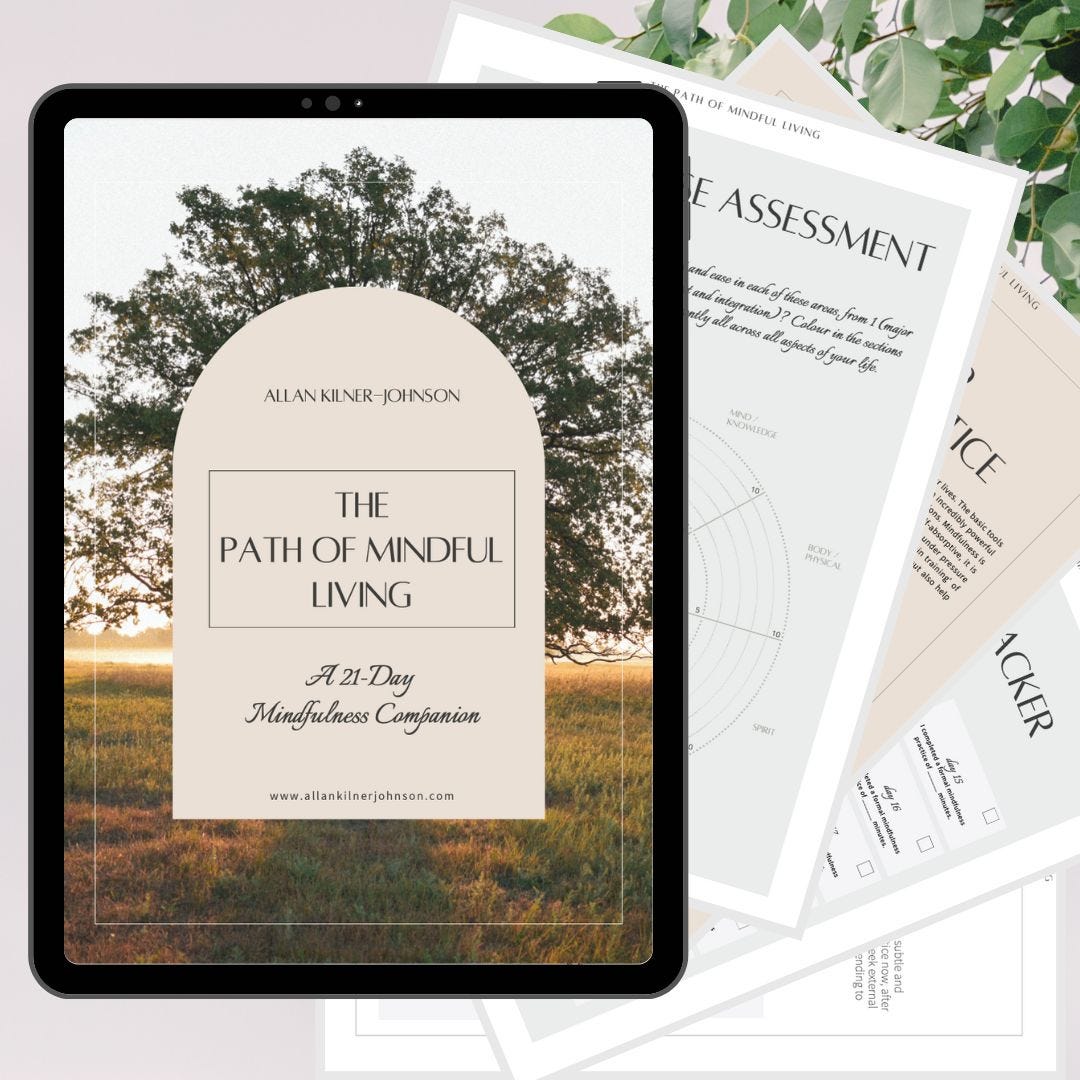
In The Path of Mindful Living: A 21-Day Mindfulness Companion, I lead you through a series of self-guided mindfulness exercises and show you how to bring mindfulness into your daily life. Readers of Integrative Creativity can download the workbook and pullout charts for only £6