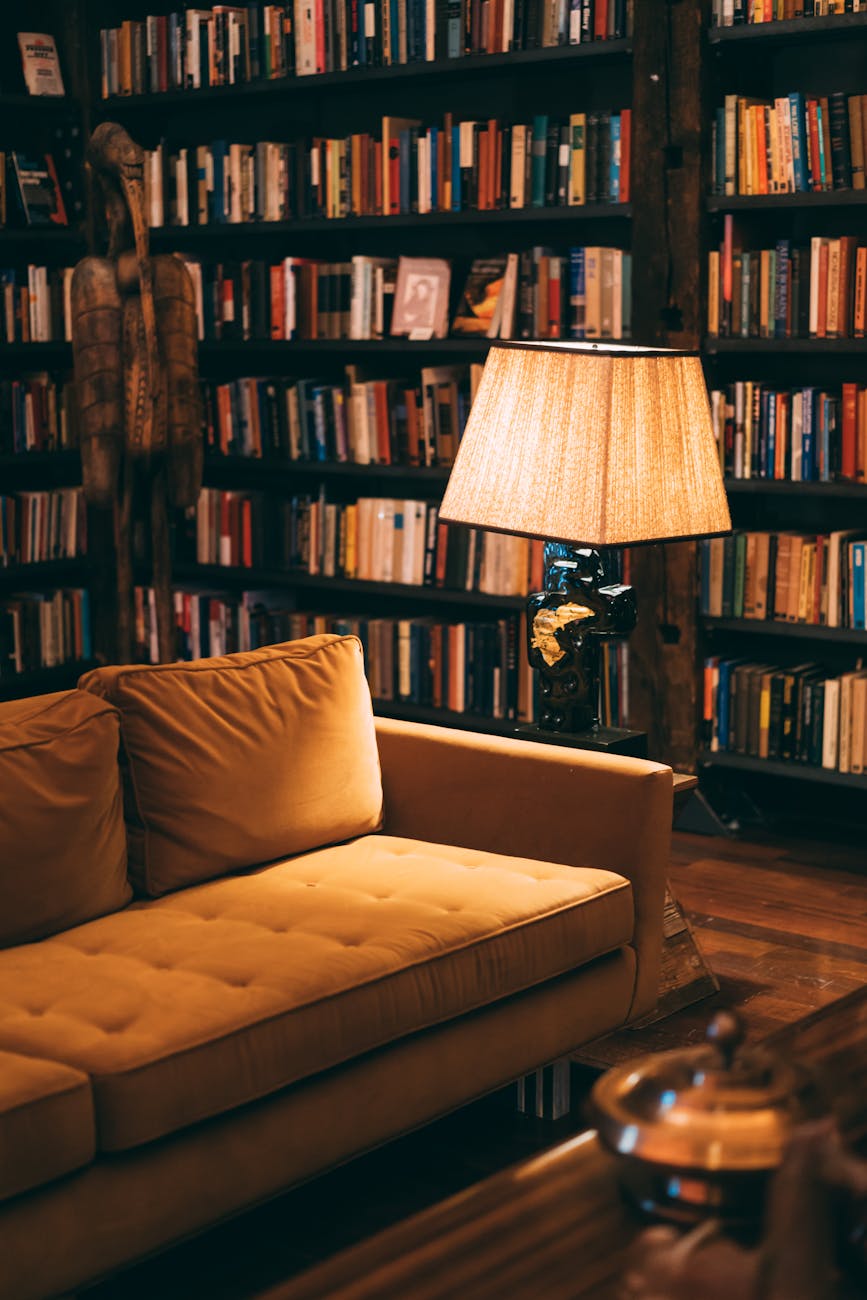
A personal library is never just a collection of books. It is a portrait of the self across time, and you can learn a huge amount about a person by the books that they have chosen to travel with them across that time. One’s own bookshelves are a living archive of who we have been, who we have longed to become, and who we may yet be. The books half-finished or cherished, the books read in the happy moments, the books purchased when we needed a lift. Unlike the tidy impersonality of the public library, the personal library is unruly, inconsistent, and idiosyncratic, its shape dictated less by the systemising logic of the Dewey Decimal System than by the peculiarities of taste, impulse, and circumstance. My shelves–spread across my study at home and my office at the university–when I look at them honestly, resemble a layered self-portrait that is part map, part diary, part dream, and through which I can unmistakably recall key moments in my life. The books that have travelled with me not only capture what I know but also what I have avoided, forgotten, or left unresolved.
Books we keep are often less about what we have read than about what we intend to read or read again. The unread shelf is one of the most intimate mirrors of the mind because it reflects not accomplishment but aspiration. Umberto Eco called this the ‘antilibrary’: the space of books not yet opened, which serve as reminders of all that lies beyond the edge of our present knowing. In Japan, tsundoku is the habit of buying books for the joy of owning them rather than the intention of reading them. When I look at certain volumes—some of which I bought decades ago and still haven’t touched—I feel less guilt than possibility. They are placeholders for a moment that might arrive slowly, or not at all, but whose presence reassures me that my intellectual life is not finished, not fully determined.
Reordering a shelf is often a kind of reordering of thought. Five years ago, I moved into a new office on campus, and, in spite of my best intentions, I still haven’t organised my books like I would have wanted, but that is a project for my sabbatical. And at home, I am preparing to move to a new flat, so I have been spending a fair bit of time sorting through my collection, donating some, moving others to my office, or setting some free into the wild as a Book Fairy. I have moved so many times in adulthood that my collection of books at home is regularly evolving under the simple pressures of space and time, and I’ve had to develop a somewhat loose relationship with those books, knowing that, as with everything, I can’t hold on to them forever. This is the hidden power of the library as a mirror. Our bookshelves are a form of externalised cognition, a way of staging our fears and hopes outside the confines of the mind.
Letting go of books can be difficult because they also hold memory, intimacy, and attachment. Certain volumes are less significant for their content than for the personal histories they embody. I have books given to me by mentors who shaped my early studies, others still carrying the marginalia of my younger, more anxious self. Some are battered, underlined, dog-eared—too fragile to lend but too precious to part with. In their presence, I find a strange companionship. They are transitional objects in Winnicott’s sense: things we hold onto not only for what they teach but for how they carry fragments of relationship and selfhood. These books resist being reduced to anything except being a part of the texture of a life.
As I’m choosing what books to let go of, I recall that the gaps in our libraries are just as telling as the books that line our shelves. If a library is a mirror, it reflects not only presence but absence: the silences we keep, the topics we resist, the voices we have yet to admit. I sometimes notice that my shelves are thin on contemporary fiction, which says something about my longstanding attachment to modernism and its afterlives. Other omissions—books I once borrowed and never replaced, fields I always meant to explore but never did—speak of hesitation, avoidance, or perhaps simply the finitude of time. Jacques Derrida reminds us that every archive preserves by excluding, gathering by leaving out. Our private libraries enact this paradox: they are as revealing in what they omit as in what they display.
There is also something quietly resistant in the very existence of the personal library. In an age of Kindle files and algorithmic recommendations, a wall of physical books feels like a slow, analogue refusal of efficiency. Digital texts are searchable, portable, infinitely replicable, but they lack the unruly density of shelves. But the personal library allows for accidents and rediscoveries, for stumbling across what we had forgotten. I sometimes find myself pulling down a volume at random and finding exactly the thought I did not know I needed. The shelves resist the flatness of digital feeds, offering instead a landscape shaped by serendipity and memory.
Yet even in their solitude, libraries are relational. Our shelves testify not only to solitary identity but to the communities we belong to: friends who recommended titles, colleagues who insisted on ‘essential’ readings, teachers whose voices linger in the texts they assigned (the work of W.G. Sebald falls very much into this category for me, and even though I have copies of all of his works gifted to my by an early mention and although I know that one day I will turn to him with the awe he is so regularly afforded, I know that that time hasn’t quite yet come for me. But it will.).
Quite often, while working in my university office, a visitor pauses before my shelves and points out a title, sparking conversations that might never have arisen otherwise. In this sense, the private library is not wholly private; it is porous, extending outward into dialogue. My own work in groups—whether through coaching or the Artist’s Way Circle I’m running this autumn—often reminds me that what we read, and how we gather around reading, is never a solitary affair. Libraries mirror not only the mind but also the networks of relation that sustain it.
Curating a library, then, is less about control than about cultivating a conversation. Books speak to each other across time and genre, staging unexpected encounters. I love those moments when a novel resonates with a philosopher, or when a fragment of mystical writing suddenly illuminates a passage in Freud. The library, seen this way, is not a static repository but a living dialogue, a set of voices waiting to be overheard. To tend a library is to arrange the conditions under which these conversations might occur.
Ultimately, our personal libraries remind us that identity is always a work-in-progress. Just as we are never finished as thinkers or as people, our shelves are never truly complete. They change as we change, expanding, contracting, reordering, accumulating silences and rediscoveries. To stand before them is to confront not a finished self but a process of becoming. Perhaps this is why libraries are so comforting: they mirror back to us not perfection but movement, reminding us that our lives, like our shelves, are full of possibility still unfolding.
I feel this sense of unfolding strongly at the moment, as I move between projects—teaching, writing, coaching, and group facilitation. My shelves are in transition, just as I am. There are new books arriving on attachment and literature, old companions being re-read, volumes I suspect I will never get to but cannot quite let go of. It feels fitting that, at the same time, I am gathering others into shared explorations of creativity and practice. If you are curious about these conversations, you might want to join me for The Art of Creative Practice—a space where, much like our shelves, we bring together disparate influences and let them speak to one another.
To tend a private library is to tend to the life of the mind. But more than that, it is to honour the shifting textures of memory, aspiration, and relation that define who we are. As you look at your own shelves this week, you might pause to notice not only what they contain but what they reveal—about where you’ve been, where you are, and where you might yet be heading.
✨ Upcoming Workshop: Mindfulness for Creative Practice
Thursday 23 October, 7.30-9.00pm (UK time)
Step away from the noise and distractions of everyday life and reconnect with your creative practice. This 90-minute online workshop is designed for anyone who wants to explore mindfulness as a tool to enhance focus, deepen flow, and spark inspiration.
Drawing on principles from Mindfulness-Based Stress Reduction (MBSR) and Mindfulness-Based Cognitive Therapy (MBCT), the workshop combines evidence-based mindfulness techniques with practical creative exercises. Together, we’ll explore how to:
- Quiet the inner critic and reduce creative blocks
- Build sustainable habits that nourish your practice
- Harness attention and presence to enhance imagination
- Connect with a supportive community of fellow creatives
Through a blend of guided exercises, reflective practices, and techniques you can return to again and again, you’ll discover how mindfulness can open new pathways into your creative life. Whether your medium is writing, painting, music, research, or design, these methods are adaptable to any form of creative work.