I’ve been thinking a lot lately about what it means to really read something.
Partly this has come from my work running the new Writer’s Flow Circle, which has already been a genuinely energising experience sitting alongside a group of thoughtful, committed writers who are all, in different ways, trying to deepen their relationship to their own work. What’s become clear, very quickly, is that writing problems are almost always reading problems in disguise.
When one of my 1-1 coaching clients says “I feel stuck,” or “I don’t know what I think,” or “I’ve lost confidence in my voice,” what often sits underneath is a fractured reading life: too many inputs, too quickly consumed, with too little time for digestion.
There’s a familiar temptation to read instrumentally, to gather, to assemble, to skim. At times useful, yes. But it can also be subtly corrosive if it becomes the default mode. We live in a culture that rewards speed and visibility. To have read something is often more about being able to reference it than to have truly encountered it.
The philosopher Maryanne Wolf writes about this in Reader, Come Home, where she describes the shift from “deep reading” to what she calls “bi-literate reading”, a split between fast, digital skimming and slower, immersive engagement. The more we train ourselves to skim, the harder it becomes to sustain attention.
This isn’t new, of course. It sits somewhere in the lineage of thinkers like Mortimer Adler in How to Read a Book, and further back in the monastic tradition of lectio divina, the slow, attentive, almost meditative reading of sacred texts
Here are a few practices that are deeply effective:
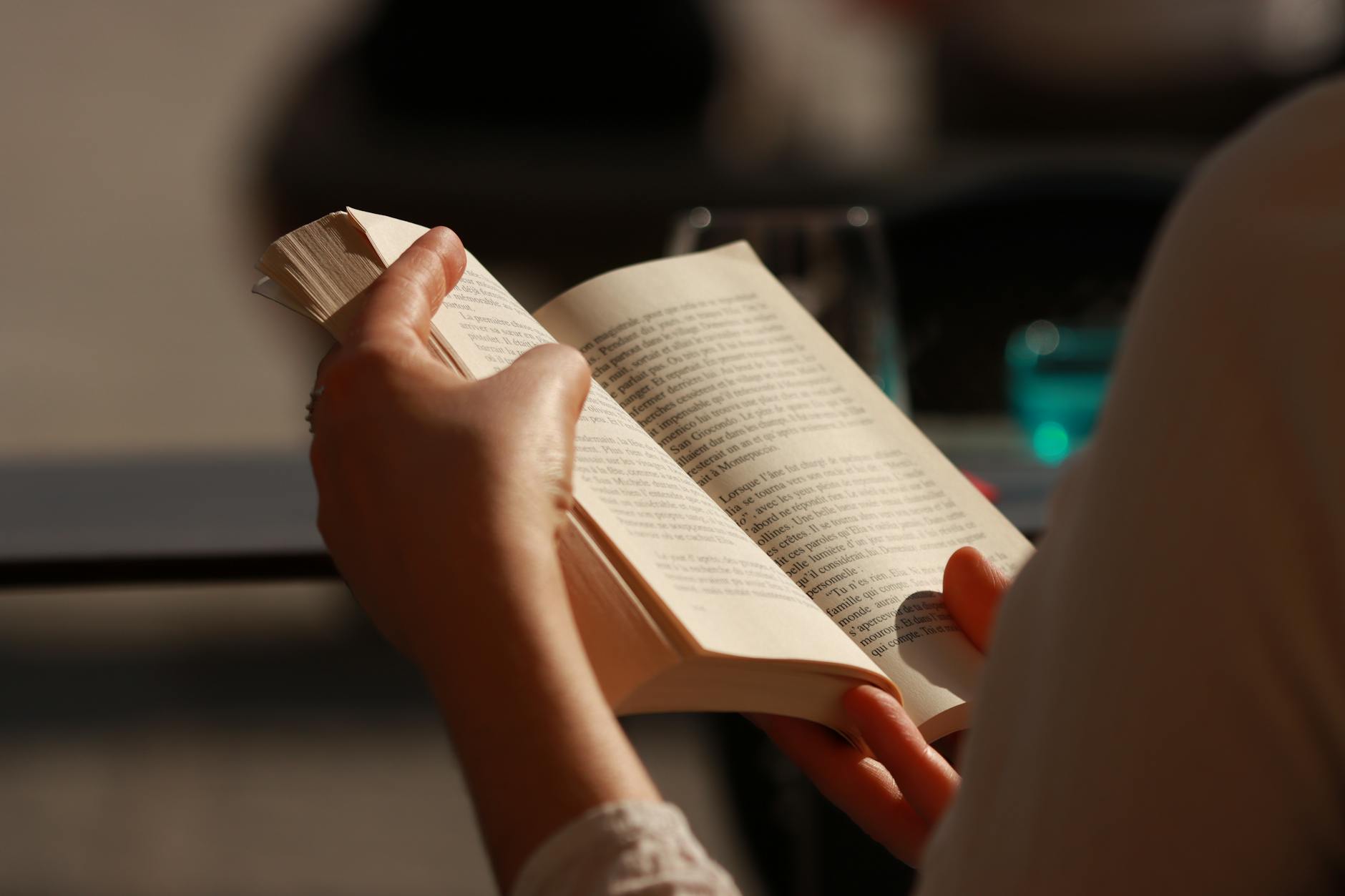
1. Time-boxed immersion Rather than vaguely intending to “read more,” set a defined container. Even 25 minutes of uninterrupted reading can be enough to drop beneath the surface.
2. Read before you input This is a small but hugely significant shift: reading before opening email or social media. The quality of attention is noticeably different.
3. Pair reading with reflection Not extensive note-taking. Just a few lines afterwards: What stayed with me? What resisted me? What do I want to return to?
4. Re-read without guilt Depth often comes from returning, not progressing. There’s something very rich and important and valuable in allowing a text to unfold over time.
The more I work with writers, the more I see that reading and writing are not separate activities. They’re two expressions of the same underlying process. When reading becomes shallow, writing often becomes strained; when reading deepens, writing tends to follow, not immediately, but reliably.
If you’ve felt scattered in your reading lately—or if books have started to feel more like obligations than encounters—it might be worth experimenting with a slightly different approach this week. Choose one text. Give it more time than feels necessary. Let it be incomplete. And notice what happens.
If You’d Like to Go Further
If this resonates, there are a few ways to continue the work together.
I’m currently offering free Clarity Calls for those interested in ongoing 1–1 creativity coaching. These are relaxed, exploratory conversations where we look at your current creative process—what’s working, what isn’t, and where you might want to go next.
I’m also running a couple of upcoming sessions that build on these themes:
Weekly Creative Flow Coworking Session: Decluttering Your Creative Mind Monday 27 April | 10.00–12.00 (UK time) | Free A gentle, structured space to clear mental noise and reconnect with focused creative work. Register: https://www.meetup.com/the-art-of-creative-practice/events/313785594/
And, if you’re in London, I’ll be hosting a series of in-person workshops at Treadwell’s Books over the coming months. Keep an eye out for more details!
In 2026, I’ll be undertaking a deliberately anachronistic experiment.
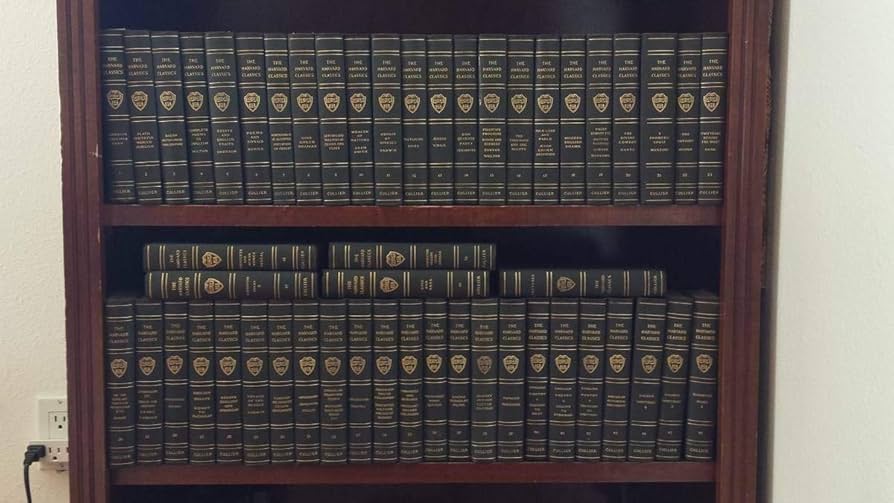
Each day for the coming year, I’ll be reading for around fifteen minutes from the so-called ‘Five-Foot Shelf’, the early twentieth-century Harvard Classics series assembled by Charles W. Eliot and promoted as a complete liberal education for the working adult. I’ll be following Eliot’s original prescription closely: not bingeing, not accelerating, not ‘optimising’, but reading at the pace he proposed, in the order he set out, according to the widely circulated ‘fifteen minutes a day’ schedule that accompanied the series.
What interests me is not whether Eliot’s claim still holds in any literal sense, but what happens when such a rhythm is taken seriously now, by someone already saturated in reading, already professionally formed, and already deeply aware of the limits of any canon.
Because I read constantly for my day job.
As an English literature professor, reading in depth is not optional; it is the ground of the work. I read intensively, repeatedly, and often narrowly. I return to the same texts across years and decades. I read them historically, theoretically, critically. I annotate, teach, publish, and argue with them. Some of the works on the Five-Foot Shelf fall squarely into this category: texts I’ve read many times, taught in multiple contexts, or written about in peer-reviewed research.
Others, however, are unfamiliar, sometimes embarrassingly so. Texts I’ve skimmed but never lived with, heard cited but never read end-to-end, or vaguely assumed I would ‘get to’ one day. Encountering these side by side, under the same modest daily constraint, is part of the experiment.
It’s probably worth saying, explicitly, that this project is not an attempt to resurrect a Great Books curriculum or to smuggle the ‘canon’ back in through the side door. I am well aware of the canon wars, and sympathetic to many of the critiques: the exclusions they exposed were real, consequential, and long overdue. The idea that a single, authoritative list of texts could stand in for ‘universal’ culture is no longer tenable, and nor should it be.
What interests me, then, is not the Five-Foot Shelf as a claim to authority, but as a historical artefact and a formative device. It is a record of how liberal education was once imagined, packaged, and sold to hard-working, well-meaning people for whom formal education was not a practical reality. Reading it now allows us to ask not ‘Is this the canon and is it good or right?’ but ‘What did this structure think reading was for?’ What habits of mind did it privilege? What kinds of judgment did it aim to produce?
There is also value—both intellectual and ethical—in encountering texts that do not immediately affirm our assumptions or reflect our intellectual formation. Not because they are beyond critique, but because critique itself is deepened by sustained engagement rather than dismissal at first contact. The fifteen-minutes-a-day format matters here. It resists both reverence and rejection, asking instead for patience, repetition, and the willingness to let one’s responses evolve over time.
In that sense, the project is as much about format as it is about content. A fixed sequence, a modest daily commitment, and a year-long horizon create conditions that are increasingly rare in contemporary reading life. What emerges under those conditions—agreement, resistance, boredom, insight, irritation—tells us something not only about the texts, but about ourselves as adult readers navigating a fractured, accelerated intellectual landscape.
This project is about breadth, deliberately undertaken alongside a professional life structured around depth.
In contemporary intellectual culture, depth is rightly prized. It is associated with rigour, expertise, and responsibility. Breadth, by contrast, is often treated with suspicion: dilettantism, surface knowledge, or the scattered attention of the generalist.
Liberal education, as it was originally imagined, did not ask readers to choose between breadth and depth. It assumed that serious engagement required both: immersion in particular problems and exposure to forms of thought beyond one’s immediate specialism. Breadth was not a substitute for depth; it was a condition for judgment.
The Five-Foot Shelf was an attempt—flawed, exclusionary, ambitious, and yet sincere—to provide such breadth to adults who were already working, already formed, already busy. Its claim was not that fifteen minutes a day would make one an expert, but that it could sustain a relationship with the wider inheritance of thought, language, and ethical imagination.
Depth sharpens tools. Breadth calibrates them.
Depth teaches us how to see clearly within a frame. Breadth reminds us that frames exist.
As someone whose professional life is structured around long reading days, sustained writing periods, and deep immersion, this constraint feels oddly corrective. It returns reading to a scale that is neither performative nor instrumental.
What matters is not how much ground is covered, but the continuity of attention. This is one of the lessons adulthood keeps teaching us: formation happens not through intensity alone, but through return.
One of the persistent myths of academic life is that learning culminates in mastery. That once one has specialised, published, and secured a position, one’s relationship to knowledge stabilises.
In practice, the opposite is often true. Expertise narrows responsibility. It brings obligations: to texts, methods, and debates that demand constant upkeep. Over time, this can subtly crowd out curiosity—the kind not immediately justified by relevance or outcome.
Some of the most important intellectual experiences of adulthood occur not when we deepen what we already know, but when we allow ourselves to become beginners again, within a structure that does not require us to justify that choice.
This is lifelong learning in its older, less marketable sense: not continuous upskilling, but sustained openness. I am an academic, and I will always read for work. But I also read for pleasure, understanding, and character development. The distinction matters.
One of the things institutions once did—however imperfectly—was structure intellectual aspiration. They told us what counted, what came next, and what completion looked like. As those structures loosen or disappear, the burden of decision shifts inward.
What do I want to know? What deserves my attention now? What kind of reader—and thinker—am I still becoming?
The Five-Foot Shelf functions here not as an authority, but as a scaffold. It provides a sequence that frees me from constant choice, while still leaving me responsible for the meaning I make of it.
This is why setting personal educational goals matters so much in adulthood. Without them, learning becomes reactive, fragmented, or indefinitely deferred. With them, even modest commitments—like fifteen minutes a day—can accumulate surprising force.
An Invitation
If this project speaks to you, it’s likely because you’re someone who thinks carefully about how ideas, attention, and intention interact. You may have more ideas than hours, more commitments than containers, and a sense that what’s missing is not motivation but shape.
This 90-minute online workshop, taking place on Monday 5 January 2026 (7:30–9:00pm GMT), offers a structured, spacious way to step back from the rush of the new year and decide—deliberately—what the next three months are for. It’s for creatives, thinkers, and reflective practitioners who value depth, but know that depth needs rhythm if it’s going to survive contact with real life.
During the session, I’ll guide you through my Reflect & Reset Map system: an evidence-based framework that combines reflection, prioritisation, and light structure. Together, we’ll clarify what genuinely matters to you in January, February, and March, translate that into a small number of meaningful commitments, and shape a plan that respects both your inner life and your outer responsibilities.
If you’re starting 2026 with questions about focus, learning, creative work, or how to hold serious intentions without burning out, this workshop is an ideal place to begin. Bring your journal and your favourite hot drink. I look forward to seeing you there!
I started this year with a strange mix of endings and fresh beginnings. The email confirming my promotion to full professor arrived in early January while I was making coffee, and I remember feeling not triumph but a kind of wry tenderness towards my younger self who had wanted this so badly. Titles come long after the inner effort that earns them, and the moment of arrival is often anticlimactic, yet it still signifies something. Three months later, I stepped down after six years as Associate Dean, closing a chapter of leadership that had greatly shaped my professional identity.
At the beginning of the year, I set a Goodreads challenge to read 52 books, mostly as a reminder to read not only in my discipline but also beyond it, and to let myself wander into other registers. What I didn’t expect was just how deeply the year’s reading would fold into everything else I was doing. The books became companions to the rhythms of the sabbatical, to the shifting layers of my personal work, and to the communities that formed around me as welcomed additions.
One of the brightest of those communities was the Surbiton Literary Salon, first dreamed up over dinner in January with the simplest impulse: the desire to talk about books in good company at my local pub. We began with a handful of us in a small room in our local, a bottle of wine circulating and no agenda beyond the shared pleasure of reading. That little gathering grew into a genuinely warm and inspirational group that expanded month after month, and together we travelled from the quiet, meditative brilliance of Samantha Harvey’s Orbital to the philosophical charm of The Elegance of the Hedgehog, a book that sparked one of our liveliest discussions about intelligence, loneliness, and the elegance of human contradiction. From there, we moved through Days at the Morisaki Bookshop, which reignited my intense desire to visit Japan, and The Satsuma Complex, which divided the group’s opinions more than any other.
Angela Thirkell’s Wild Strawberries brought a welcome return to lightness, those bright, English comic notes that somehow disguise their structural precision. Harriet Tyce’s Blood Orange plunged us into a much darker register, and it was astonishing how different members of the group held different emotional keys to it. And then The Resilience Project brought an earnestness and sincerity that balanced the year’s heavier themes. The Women opened unexpectedly deep discussions about duty, silence, and the emotional architecture of courage, and Festive Spirits by Kate Atkinson arrived just as the nights grew longer. By the end of the year, the Salon had become, for me and the 15 or so of us who gather every month in a friend’s well-appointed front room, a steady, quietly joyful ritual of sharing our reflections on books. A reminder that literature is not an individual encounter but a relational one.
Parallel to this, I began leading a Sunday evening Course in Miracles study group, which continues to deepen. Guiding a group through A Course in Miracles is a very different kind of teaching that depends less on interpretation and more on presence. We read it in philosophical, ecumenical language, without doctrinal commitments, which seems to open a gentler, more spacious terrain. Each week invites a shift in perception: forgiveness not as moral duty but as a choice of vision, responsibility not as blame but as agency, devotion not as obedience but as attention. The text asks much of us—stillness, honesty, love—and somehow the group met it with all three.
Then there was The Art of Creative Practice, the coaching and creative development circle I founded on Meetup. I began it lightly in September with free coworking sessions, almost experimentally, but it quickly grew into one of the most rewarding parts of my year. The group attracted writers, artists, and creatives of all stripes who were less interested in productivity hacks than in understanding the emotional and psychological textures that underpin their work. What has struck me most is the courage people have brought to the process, the willingness to inhabit contradiction and complexity with humour and grace. It reminded me again that creativity is not a technique but a relationship with one’s own inner landscape.
All of this shaped the way I read. Books became part of an ongoing unfolding of my year, sometimes offering clarity, sometimes challenge, sometimes simple companionship. Elaine Aron’s The Highly Sensitive Person and Judith Orloff’s The Empath’s Survival Guide, for example, woven between sessions of creative coaching, gave me new language for the quieter traits that many group members shared but rarely articulated. These texts reframed sensitivity not as fragility but as attunement, something to be cultivated, not resisted. It created echoes with other books I encountered this year that explored the subtler dimensions of mind and meaning: Steve Hagen’s Buddhism Plain & Simple, Yung Pueblo’s Clarity & Connection, and Marianne Williamson’s writings on the intersections of love, perception, and the ethical imagination. Attending a live weekend workshop with Williamson this summer was one of my highlights of the year.
Money and prosperity, too, became an unexpected theme, not in the acquisitive sense, but as a study of relationship and mindset. Lynne Twist’s The Soul of Money, Catherine Ponder’s The Dynamic Laws of Prosperity, and Joseph Murphy’s The Power of Your Subconscious Mind all, in different ways, opened space for reconsidering the beliefs we inherit about value, sufficiency, and trust. These books arrived alongside my own work in reshaping my financial habits and sense of abundance, and they echoed the larger project of creating a life that feels aligned, intentional, and quietly elegant.
Some books were simply pleasures that reoriented me. Maugham’s The Magician—a thinly veiled portrait of Aleister Crowley—was delightfully pulpy and relevant to my occult research. Fiction formed its own thread of discovery. Reading Madame Bovary again reminded me of the surgical precision of Flaubert’s attention, the cruelty and tenderness interwoven in the same gesture. Garcia Marquez’s One Hundred Years of Solitude returned me to a world that felt like a dream I once lived inside, a universe where the magical and the mundane breathe the same air. Faulkner’s The Sound and the Fury challenged me all over again, as it always does, and Brave New World felt unnervingly prescient (and not at all what I remember it being when I read it years ago).
As I write this, I’m preparing the next cycle of work, finishing my book, continuing The Art of Creative Practice, deepening into the Course in Miracles Study Group, tending the Surbiton Literary Salon, and beginning several new coaching cohorts in the new year. If this year taught me anything, it’s that intellectual life thrives when held in community, when nourished by a wide diet of ideas, and when approached not with performance but with presence. Here’s to another year of reading, learning, becoming—and to the books that will meet us where we are, and gently carry us somewhere new.
My 2025 Reading List
Ackroyd, Peter, Introducing Swedenborg
Aron, Elaine N., The Highly Sensitive Person
Atkinson, Kate, Festive Spirits: Three Christmas Stories
Barbery, Muriel, The Elegance of the Hedgehog
Brann, Amy, Neuroscience for Coaches
Brookner, Anita, Hotel du Lac
Brown, Dan, The Secret of Secrets
Caine, Margaret, Footloose in Cornish Folklore
Chanek, Jack, Tarot for the Magically Inclined
Chaucer, Geoffrey, The Canterbury Tales
Cuylenburg, Hugh van, The Resilience Project
Davies, Owen, Art of the Grimoire
Dean, Liz, The Ultimate Guide to Tarot Spreads
Eggers, Dave, The Monk of Mokha
Faulkner, William, The Sound and the Fury
Fitzgerald, F. Scott, The Great Gatsby
Flaubert, Gustave, Madame Bovary
Garcia Marqués, Gabriel, One Hundred Years of Solitude
Hagen, Steve, Buddhism Plain & Simple
Hannah, Kristin, The Women
Harvey, Samantha, Orbital
Hayes, Nick, Wild Service
Hollinghurst, Alan, Our Evenings
Holiday, Ryan, Courage Is Calling; Right Thing, Right Now
Horowitz, Mitch, Occult America
Houston, Keith, The Book
Kerr, Gordon, A Short History of Coffee
Matthews, Michael, Bigger Leaner Stronger
Matousek, Mark, Lessons from an American Stoic
Mortimer, Bob, The Satsuma Complex
Morlok, Franziska, Bookbinding
Murphy, Joseph, The Power of Your Subconscious Mind
Osman, Richard, The Impossible Fortune
Ponder, Catherine, The Dynamic Laws of Prosperity
Pueblo, Yung, Clarity & Connection
Saumarez Smith, Ferdinand, Eleusis and Enlightenment
Sertillanges, Antonin,The Intellectual Life
Shen Congwen,Border Town
Stibal, Vianna, Seven Planes of Existence; You and the Creator; Digging for Beliefs; Advanced ThetaHealing; ThetaHealing
Tarbuck, Alice, A Spell in the Wild
Thirkell, Angela, Wild Strawberries
Twist, Lynne, The Soul of Money
Tyce, Harriet, Blood Orange
Warner, Sylvia Townsend, Lolly Willowes
Williamson, Marianne, The Law of Divine Compensation; The Mystic Jesus
Last weekend I spent a few hours wandering through the Small Publishers Fair in London, where tables of hand-bound chapbooks, risograph zines, and small press essays lined Conway Hall like devotional offerings to the printed word. There was something really wonderful about it: a room buzzing not with algorithmic chatter, but with paper, ink, and the human hand.
Lately, this question of preserving ideas has been preoccupying me. As I’ve been working on my forthcoming projects—both scholarly and personal—I’ve found myself turning again to the physicality of books, not just as containers of knowledge but as archives of consciousness. The handmade box-making I’ve been experimenting with at home (a small project that began as a way to store my growing stack of old notebooks) has become a kind of meditative practice: measuring, cutting, folding, gluing, all in careful rhythm. It’s taught me something about form and memory—about how enclosure can protect, but also invite reverence.
Walter Benjamin once wrote that every book has a double life: one as a vessel of ideas, and another as an artefact that carries the traces of its readers. Marginalia, stains, folded corners all become evidence of encounter. When I teach or write about modernism, I’m always struck by how that movement both exalted and feared this materiality. Woolf, Joyce, and their contemporaries wanted language to transcend its own physical limits, yet they depended utterly on print.
My own shelves are full of books that now hold more of me than of their authors, filling with underlinings, exclamation marks, and the occasional coffee ring or grease smear. They are records not only of what I’ve read, but of who I was when I read it. In a sense, they preserve moments of thought—snapshots of consciousness mid-formation. To lose those, or to surrender entirely to digital ephemerality, would be to lose something essential about how we think in time.
There’s a similar intimacy in the act of making. When I’m gluing the corners of a handmade box or rolling out pastry dough, I notice how my thinking slows, finds rhythm in repetition. Craft requires patience, but it also invites reflection—it’s an embodied philosophy. David Pye, in The Nature and Art of Workmanship, distinguishes between the “workmanship of risk” (where every action could alter the outcome) and the “workmanship of certainty” (where machines guarantee precision). The handmade book, like the handwritten note, belongs to the first category: it lives in the space of risk, imperfection, and care.
In an era of constant digital revision, the printed page still says: this is what I thought, then. It invites us into a conversation with our past selves. Even my old notebooks, boxed and labelled, feel like small dialogues across time—some pages embarrassedly naive, others startlingly prescient.
There’s a line from Italo Calvino that I often come back to: “The classics are those books that exert a peculiar influence, both when they refuse to go away and when they hide in the folds of memory.” I think the same could be said of our own notes, letters, recipes, and marginalia. They refuse to go away; they wait patiently for us to rediscover them.
At the Small Publishers Fair, I was reminded how vibrant this world of small-scale making still is. Stalls dedicated to poetry, philosophy, and experimental art books, each one a testament to the persistence of the tactile imagination. Many of the presses represented there are acts of devotion, sustained by people who believe that ideas deserve bodies. To hold one of their books is to participate in a lineage of care: the slow publishing ethos that values depth over reach.
In the evenings lately, with autumn deepening and the smell of spiced raisins still in the kitchen, I’ve found myself reflecting on what it means to live archivally, or, to put it another way, to be a steward of one’s own thought. It’s a gentle calling, really: to keep what matters, let go of what doesn’t, and tend the rest with attention.
So whether you’re keeping a commonplace book, baking from a family recipe, or printing a limited-run essay for a small press, you are participating in this broader human act of preservation. You’re ensuring that thought continues to have texture—that it lives in the world not just as code or content, but as something we can touch, smell, and remember.
And maybe that’s what the physical book still teaches us, in its quiet way: that ideas, like relationships, need form to flourish. They ask for bodies, boxes, bindings, and for the gentle friction of being held.
UPCOMING EVENTS
If this resonates, you might enjoy joining one of my upcoming gatherings:
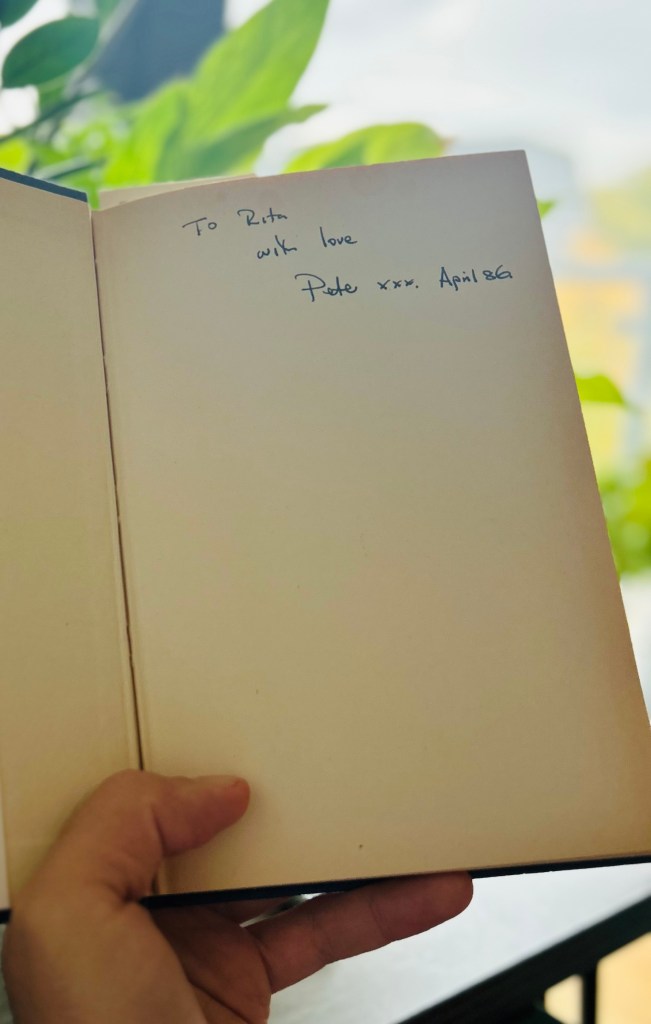
As I usually do, I bought a used copy of this month’s selection for my neighbourhood book club: Hotel du Lac, Anita Brookner’s marvellous 1984 Booker Prize-winning novel about making sense of people and the shame we inhabit. The copy I received was a marvellous 1980s edition, its cover gently worn, the paper slightly yellowed with age. Inside was an inscription in assertive biro: ‘To Rita with love, Pete xxx. April 86.‘
I love finding ephemera like that in used books (once, I found a four-leaf clover that a child had pressed between pages and forgotten in 1972). That simple handwritten note in Hotel du Lac became a fragment of someone else’s life, a small piece of history folded into my own. It reminded me that buying a book is rarely just about acquiring a text — it is, at its best and fullest expression, a gesture of self-formation. Choosing a book can be a conscious act of orienting yourself toward a new way of thinking, a new rhythm of attention, a new life project. In that way, book buying is a practice of becoming.
Every book purchase marks a threshold, a crossing into a new state of thought, feeling, or attention. When I choose a book, I am often choosing not only the ideas it contains but also the possibility of becoming someone who holds those ideas. That threshold might be a commitment to learn something new, to deepen a habit, or to allow oneself to enter an unfamiliar world.
For me, Hotel du Lac became not just a novel but a threshold to conversation — in our book club meeting tonight we will speak about solitude, desire, love, and the quiet transformations of everyday life, I’m sure. The purchase itself became the first step into that dialogue.
Choosing which books to buy is also an ethical act — a choice about the economy of your attention and the kind of knowledge you wish to cultivate. In our age of algorithm-driven recommendations and one-click convenience, the act of selecting a book has become even more deliberate. It is an assertion: of attention, of values, of resistance to the noise of the digital marketplace.
I try to keep this in mind. When I choose a book, I am choosing the kind of life I wish to live. That is why I prefer second-hand bookshops, curated lists, and the serendipity of browsing. The gift of finding a well-loved copy of Hotel du Lac was not just about economy but about entering into a relationship with the book that carries the traces of other readers and a past moment in time.
My first job as a teenager was as a bookseller at Borders Books, and I’ll never forget the linger last hour before closing when the shop was almost empty and I wandered to and fro reshelving books that had been cast aside and getting lost myself in the shelves. There is something profound in the act of browsing: the way attention moves differently among stacks of books, the accidental discoveries, the impulse that turns browsing into a purchase. This ritual carries a rhythm: the searching, the selection, the return home, the opening of the book for the first time. It is a small act of pilgrimage.
This ritual has shifted for me over recent years. I buy more online and second-hand now, but I also savour the moments when I am in a physical shop, taking time to feel the books, the paper, the weight of them in my hands. Buying a book in that way is an act of attention — a slow, deliberate counterpoint to the speed of modern life.
The books we choose to live with often become companions in our ongoing process of becoming. That inscription in Hotel du Lac reminded me of this. A book is not simply an object; it is a living presence. It carries the imprint of its past readers and acquires a new life each time it meets another. In choosing it, we invite it into our own narrative.
Some books grow with us. They take on new meaning as we return to them at different stages of life. They become landmarks in our own inner journeys. It’s for that reason that buying books can be a form of investment in the future self we aspire to become.
When I buy a book, I am buying a possibility: a possibility of becoming a reader who thinks differently, who sees differently, who lives differently. Each purchase is a small apprenticeship in self-making.
Here are some ways to make book buying a mindful practice:
Keep a wishlist and revisit it periodically.
Choose one book that challenges your usual thinking every month.
Seek out books outside your comfort zone.
Return to books that have shaped you before.
If we approach book buying as a practice of becoming, every purchase becomes a small act of self-cultivation. This month, my purchase of Hotel du Lac was not just for a book club — it became a quiet practice of curiosity, of connecting with a history, of choosing to open myself to a particular conversation. In this way, every book bought with attention becomes a threshold, an ethical choice, a ritual, a companion, and an investment in becoming.
If you choose to see book buying this way, your library becomes not simply a collection of texts but a landscape of your own growth. What will your next purchase become for you?
Upcoming Events
If this resonates, you might enjoy joining one of my upcoming gatherings: