Understanding Metaconsciousness for Personal Growth

Photo by meo on Pexels.com

At this time of year, I always notice a subtle change in the quality of my attention. The external world doesn’t necessarily slow down, but something inwardly does. Even the light feels different. Darker, yes, but also more permeable. I’ve been feeling that contrast keenly over the last few weeks, particularly as I prepare for the turn into a new year.

It’s also been on my mind recently while reading Kate Atkinson’s Festive Spirits for my local book club’s Christmas meeting. Atkinson’s stories, playful and unsettling in equal measure, brush up against the unseen dimensions of experience without making grand metaphysical claims. They hover at the threshold. That, in its own way, is where much of my thinking about superconsciousness currently lives: not as an abstract spiritual pinnacle, but as a working edge of awareness that we keep rediscovering in different vocabularies.

In my last book and in much of my recent teaching, I’ve returned again and again to the idea that a large proportion of what we call “consciousness” is, in fact, automatic. It is hormonal, patterned, reactive, efficient. William James hinted at this more than a century ago when he described habit as the “enormous fly-wheel of society.” Freud, in his own way, mapped the vast subterranean machinery of the psyche. Contemporary neuroscience has largely confirmed what contemplative traditions have long suggested: most of what we do, think, and feel happens before we decide.

This is where the idea of metaconsciousness becomes so important, the capacity to notice that we are being moved by processes that are not, in any simple sense, “us.” It is the moment when you realise you are mid-reaction and something in you steps back just enough to witness it. Not to suppress it. Not to spiritualise it. Just to see.

But superconsciousness, as I’m increasingly working with it, points to something slightly different again. It is not merely awareness of the machinery. It is awareness that is not exclusively organised by the machinery at all. It gestures toward a dimension of mind that is less bound to survival, identity maintenance, or historical conditioning. Roberto Assagioli—whose work in psychosynthesis continues to shape my own—described the superconscious as the source of creativity, meaning, ethical insight, and transpersonal experience. Not an escape from the human, but its latent extension.

One of the things I’ve become more cautious about over the years is how easily “human potential” gets packaged as something to be maximised, extracted, or branded. The language of fulfilment can slide so quickly into performance metrics. Abraham Maslow’s later writings—often neglected in organisational culture—are far more subtle than his pyramid suggests. Self-actualisation, for Maslow, was never a static achievement, but an ongoing alignment with what is most alive and truthful in us.

Superconsciousness names a direction of travel, not a finish line.

In my own life, this shows up less in fireworks and more in micro-adjustments: choosing not to override tiredness with willpower; noticing when the body says no long before the intellect catches up; letting an idea take months instead of forcing it into productivity. It shows up in teaching too—in learning when not to fill the silence, when to let a group sit with not-knowing.

Even reading Festive Spirits this December has felt like a small act of this alignment. In between sessions, planning for the new year, and working with clients, sitting with a beautifully written short story by the fire (or, more accurately, a very convincing YouTube fire) has felt like a reminder that imagination itself is a superconscious faculty. We don’t manufacture it. We host it.

There is a tendency to associate higher states of awareness with peak experiences: mystical visions, altered states, moments of transcendence. And certainly, those exist. But what interests me far more now is how the superconscious expresses itself in the ordinary:

  • In ethical instincts that arise before rational justification
  • In sudden creative insight that reorganises months of confused thinking
  • In moments of compassion that interrupt long-established narratives about self and other
  • In the quiet certainty that a particular season of life has ended—even when nothing dramatic has occurred

This is not about becoming perfect. It is about becoming less confined.

I notice that many of the people I work with—particularly academics, creatives, and reflective professionals—are weary not because they lack insight, but because their insight has nowhere to land. They understand their patterns. They often know exactly where those patterns came from. But knowing is not the same as reorganising the centre of gravity from which one lives.

Superconsciousness, in this sense, is not an abstract spiritual add-on. It is deeply practical. It changes: how decisions are made, what counts as success, how time is experienced, where authority is located.

And perhaps most importantly, it reshapes the relationship between effort and surrender. Not everything meaningful can be solved through optimisation.

As this year draws to a close, I find myself more attuned than usual to thresholds between exhaustion and renewal, between endings and beginnings, between old strategies and new capacities for trust. This is exactly the territory that both my coaching work and my group workshops increasingly inhabit: not self-improvement as escalation, but re-orientation.

If this reflection resonates, there are a few gentle ways to continue the conversation:


🌿 1–1 Coaching

If you’re navigating a threshold of your own—professionally, creatively, or existentially—I offer integrative 1–1 coaching rooted in psychosynthesis, contemplative practice, and depth psychology.

You’re very welcome to book a free 15-minute Clarity Call here:
👉 https://allanjohnson.co.uk/coaching/


✨ Reflect & Reset: Quarterly Planning Workshop

5 January | 7.30–9.00 PM GMT | £10
A spacious, grounded evening to review the last season and consciously set the next one—without forcing premature certainty.
Register here:
👉 https://www.meetup.com/the-art-of-creative-practice/events/311948616


🧘 Integrative Meditation

12 January | 7.30–8.30 PM GMT | £4
A guided practice evening bringing together somatic awareness, imagination, and reflective presence.
Register here:
👉 https://www.meetup.com/the-art-of-creative-practice/events/311944273


Superconsciousness, for me, is no longer a speculative peak. It is a daily negotiation between who I have been conditioned to be, who I consciously try to be, and who sometimes appears unannounced in moments of clarity, creativity, or courage. It does not always feel elevated. Often it feels quiet. Sometimes inconvenient. Occasionally unmistakably right.

And perhaps that, more than anything, is the true measure of human potential: not how high we rise, but how deeply we learn to listen.


More to Explore

The Emperor’s Notebook: Stoic Leadership Today

Picture this: You wake in a marble palace. You are the most powerful person in the world. The emperors before you drowned in their own indulgence, in greed, or fear. Outside, the crowd calls your name.

But you don’t begin your day with a performance. You don’t summon generals or scribes. You sit with a notebook. And you write—not to boast, not to issue decrees, but to remind yourself to be kind. To remind yourself that today you will meet resistance. And that this resistance is not your enemy. It is your path.

This happened. We still have the notebook.

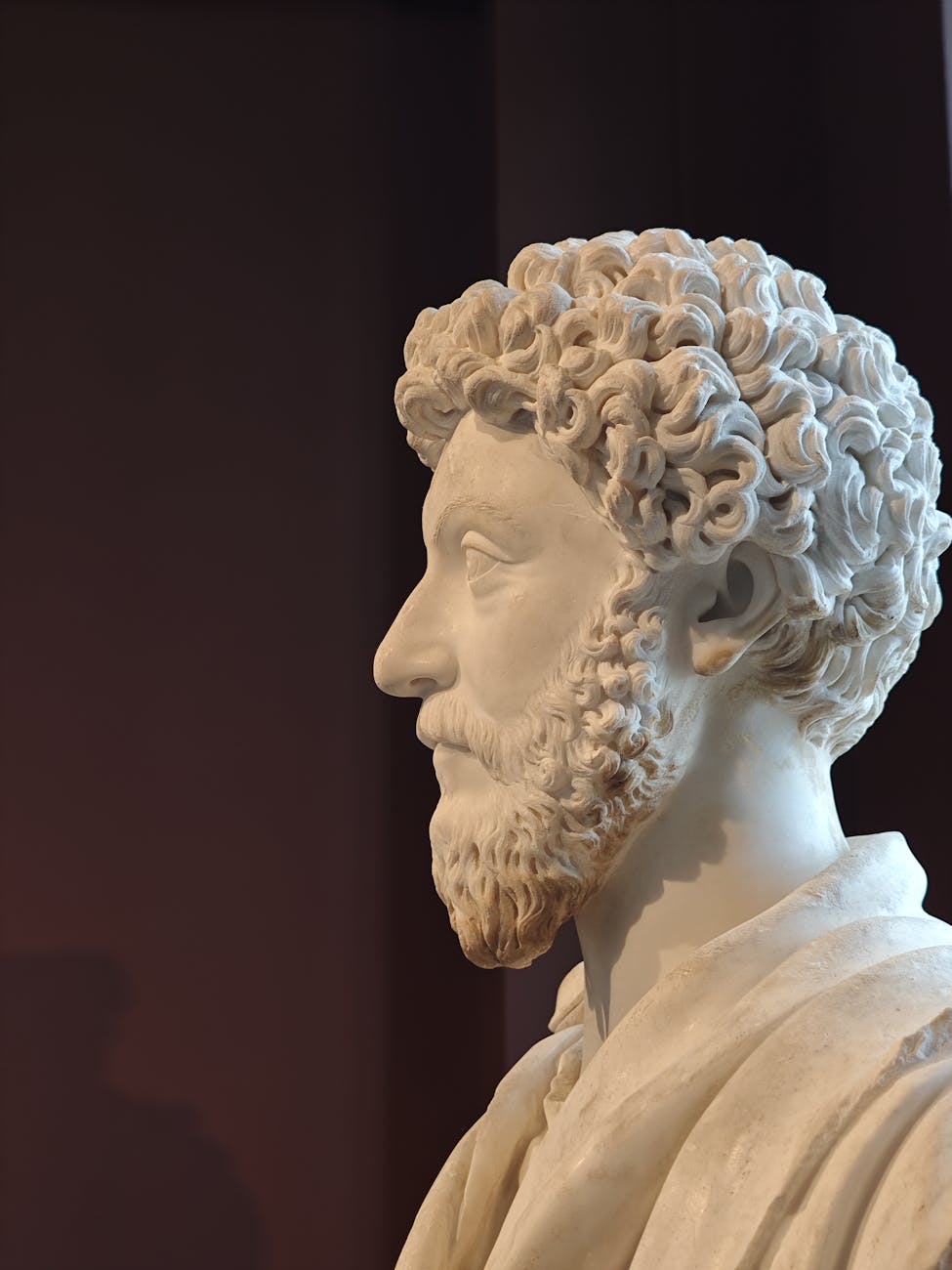
It belonged to Marcus Aurelius, emperor of Rome and one of the most profound Stoic philosophers. His Meditations are not a book written for others. They are personal reminders. Field notes from the front lines of his own mind.

And if that sounds like the opposite of modern leadership—where visibility is everything, where charisma sells and speed is mistaken for insight—that’s precisely why Marcus matters.


Too often today, stoicism is reduced to mere aesthetics. Ice baths. Cold showers. Grit, hustle, and rejection of feeling. We romanticise resilience as if it means silencing the soul.

But stoicism, properly understood, is less about hardening and more about softening into clarity. It’s not the rejection of emotion—it’s the training of emotion. Not the renunciation of the world—but a recalibration of one’s place within it.

Marcus Aurelius didn’t write the Meditations to impress. He wrote them to endure. To remember what he believed in when the palace and the politics threatened to make him forget. This wasn’t a performance. It was a quiet transformation.

And it invites us to our own.


During my time in leadership, I’ve learned that the heaviest burden is not decision-making. It’s visibility.

When we are visible, we are misunderstood. When we are misunderstood, we are attacked. And the work of leadership becomes not just a matter of making good choices, but of remaining whole while those around us cast fragments of who they think we are.

That’s what Marcus teaches us: that leadership is not a performance. It is presence. It is the quiet art of being with our responsibilities without collapsing into them. Of taking pressure and transmuting it into clarity.

And this is not reserved for emperors. Leadership takes many forms. Raising a family. Building a team. Guiding a creative project. Holding space for a friend. Or simply—no less meaningfully—learning to lead oneself.


Marcus didn’t dominate a room. He attended to it. And that attention—to self, to others, to the rhythm of nature and the seasonality of emotion—is what made him powerful.

He reminds us: You will meet frustrating people today. And your task is not to change them. Not even to fix them. But to notice them—and not let them disturb the integrity of your own mind.

This, in many ways, is the true work of self-leadership: not pretending the world is different than it is, but accepting what is and holding to what matters.


If we strip away the glamour from leadership, what remains is not emptiness—but depth.

Because what stands in the way becomes the way.

This is Marcus’s central teaching. And it’s a reminder we need more than ever in a world of spectacle. Where it’s easy to think we’re only as good as our last presentation, our last post, our last win.

But real strength doesn’t come from spectacle. It comes from silence. From beginning the day not with declarations, but with a return. A return to what we believe. A return to who we choose to be.


If you know the weight of being the person who holds it all together—at work, in your family, in your inner world—I’ve created an online course integrating these Stoic principles into daily practice. It’s not about quick wins. It’s about sustainable clarity. You’ll find a link below if that’s of interest.

And wherever you are on your path—remember this:

You don’t need to dominate the room to lead.

You just need to meet the day with presence.

Even, and especially, when marble palaces crumble and the crowd calls your name.


Unlock your potential with mindfulness! Discover how a few mindful moments can help spark breakthrough, overcome blocks, and transform your personal and professional journey. Subscribe to my blog today for more on the art of being present.

Embracing Presence: A Path to Mindfulness and Fulfilment

Have you ever had the feeling that life is passing you by? As if you were constantly stuck in the past or worried about the future? What if the real key to happiness and fulfilment lies in something as simple as connecting with the present moment and being fully present? Many spiritual and mindfulness practises emphasise the importance of living in the now, as this can help to reduce stress and anxiety, increase appreciation for the simple pleasures of life and improve overall wellbeing. By cultivating a sense of mindfulness and focussing our attention on the present, we can experience a greater sense of peace and contentment, allowing us to make the most of each moment as it unfolds.

When we talk about presence, we mean the opposite of being in the future or in the past. Much of our waking life is dominated by our worries about the past and our fears about the future. What gets lost in between is the present moment. Dwelling on the past often leads to regret, while worrying about the future often leads to anxiety. It is important to realise that living in the present does not mean ignoring the lessons of the past or neglecting the future. Rather, it is about finding a balance between learning from the experiences of the past and carefully preparing for what is to come while fully enjoying the beauty and possibilities of the present. This mindset can lead to a deep sense of gratitude, mindfulness and a deeper connection with the world around us.

The present moment is the only time we have control over. We have no control over the past and we cannot fully control the future — although we can influence it through our actions in the present. Therefore, the present is the most valuable and important time to focus on. When we are fully in the present, we can make the most of every experience, connect more deeply with others and appreciate the beauty that surrounds us. When we focus on the present, we can also better manage our thoughts and emotions, leading to a greater sense of inner peace and contentment. When we embrace the present moment, we can make conscious choices and take intentional action to shape our future in a way that aligns with our values and goals.

Writer and Zen practitioner Natalie Goldberg sums up the essence of presence beautifully with her quote: ‘Every moment is enormous, and it’s all we have.’ We rarely think about the fact that all that really exists is this one moment of awareness. This quote from Goldberg captures the true essence of presence and why it is so important. Presence allows us to appreciate each moment as it unfolds and to fully engage with the richness of our experience and the interconnectedness of all things. When we embrace presence, we can also enjoy the beauty of simple things and feel gratitude for the ordinary, developing a deeper sense of fulfilment and satisfaction in our daily lives. When we embrace the practise of presence, we become attuned to our surroundings and develop a greater sense of empathy and understanding for others. It also provides us with the clarity to make conscious choices and respond thoughtfully to the ebbs and flows of life, rather than being consumed by worries about the future or regrets about the past. In essence, presence is not just a state of being, but a gateway to a more mindful, purposeful and enriched existence.

Imagine spending time with a close friend or loved one, knowing that this may be the last time you will see them face-to-face. How would your behaviour change in this conversation? If you knew this was your last conversation, your attention to every detail and nuance in the moment would increase. This increased attention is a new form of presence where every detail and nuance is noticed, appreciated and valued. You may find that you enjoy the way their eyes sparkle when they smile or the tone of their laughter. Every gesture and expression becomes precious and imprinted in your memory with unrivalled clarity. The words exchanged carry a weight that transcends the ordinary and takes on an almost tangible meaning. In this state of heightened presence, time seems to slow down, allowing you to savour and appreciate every moment. The shared experiences, the dreams and the unspoken realisations are distilled into a precious essence and form a tapestry of memories that will endure beyond the boundaries of time.

A very good friend of mine, who later became an important artist, told me something that has stayed with me since we were teenagers. She said, ‘whenever something really special happens in your life, stop for a moment and recognise it.’ This simple practise of taking a moment and saying, ‘this is a really special moment, a really special time,’ is something I still do regularly. Anchoring the uniqueness of the present moment in my consciousness is a powerful practise. Reflecting on the individual details of the experience, the emotions felt and the impact of the moment has allowed me to cultivate gratitude and deep appreciation for the richness of life. It is fascinating how these small pauses can add depth and meaning to our daily lives and fill it with a sense of wonder and joy. Each time I engage in this practise, I find myself embracing the beauty of the present moment and understanding the significance of these unique experiences that form the tapestry of my life.

When we talk about the present, past and future in English, we engage in a complex interplay of linguistic constructions that profoundly affect our understanding of time. Unlike some other languages, English does not have a true future tense. Instead, we rely on auxiliary verbs and other linguistic devices to convey actions or events that have not yet occurred. This approach not only reflects the flexibility and adaptability of the English language, but also emphasises the intricate relationship between language and temporal perception. Think of phrases like ‘I will go to the store later today’ or ‘I am meeting my friends for dinner tonight.’ Through these expressions, we manifest a cognitive shift towards prospective thinking by subtly directing our awareness towards future events. This linguistic nuance embedded in our everyday communication plays an important role in the way we conceptualise time. It often causes us to anticipate and plan for the future rather than fully engaging with the present moment.

Poets have long been fascinated by the role of language in shaping our understanding of time. They seek to capture the fleeting moments and evoke deep emotions with their words. One such tradition that has been particularly successful in this endeavour is the haiku, a poetic form that beautifully captures the essence of the present moment. Originating in Japan, haiku are revered for their concise and evocative style, often depicting scenes from nature or daily life in just a few lines. This form of poetry emphasises simplicity, brevity and mindfulness and encourages both the poet and the reader to appreciate the subtle beauty of the here and now. Influenced by Zen Buddhism, the haiku form emphasises that being fully aware and present in each moment is not only an artistic endeavour, but also a deeply spiritual practise. Zen philosophy teaches that the present moment is the only reality we truly have, and it exhorts us to let go of distractions, judgements and worries and instead embrace the fullness of each passing moment. By encouraging us to look inward, observe without judgement and immerse ourselves fully in the present, haiku poetry offers a powerful reflection of Zen philosophy and challenges us to cultivate a heightened awareness of the world around us.

How often do we assume that we will only be happy if something happens in the future? Phrases like ‘I wish I had…’ or ‘I will be happy if…’ postpone the possibility of happiness and joy to an indefinite point in the future. Instead of focusing only on the future, we should transform our hopes and dreams for tomorrow into something like ‘I am grateful for’ and ‘I am content now’. By shifting our mindset to gratitude and contentment, we can find happiness in the present moment instead of always waiting for a future event. By returning to the present in each moment, we are not shirking responsibility for the future, but fully embracing it and enriching our lives in every moment, especially the moment we actually have control over. Gratitude and contentment in the present allows us to live a more fulfilling life, appreciating the beauty of each moment and finding joy in everyday experiences.

By remembering that the past is gone and the future is to come, we can focus on the present moment and our awareness of it. This practise allows us to cultivate a sense of mindfulness and appreciate the beauty of each moment. When we embrace the present moment, we can savour the small pleasures of life, be it the warmth of the sun on our skin, the laughter of a loved one or the stillness of nature. By being fully present in our lives, we can also deepen our connections with others, build meaningful relationships and enrich the tapestry of our existence. Let’s continue our journey to live more in the present and appreciate the richness this brings to our lives and the lives of those around us.


Subscribe to my free newsletter for more tools, guided meditations, and productivity insights.

If you want to start putting these ideas into action, you can sign up for Integrative Meditation (Level 1). This course represents the culmination of years of learning, practice, and personal growth. Integrative Meditation is a comprehensive framework designed to enhance your mental and emotional well-being. It draws on Mindfulness-Based Cognitive Therapy (MBCT), positive psychology, neuroscience, Acceptance and Commitment Therapy (ACT), journaling, and breathwork to support you in reducing stress, enhancing focus, building emotional resilience, and discovering your true self.