Journaling as a Thinking Process

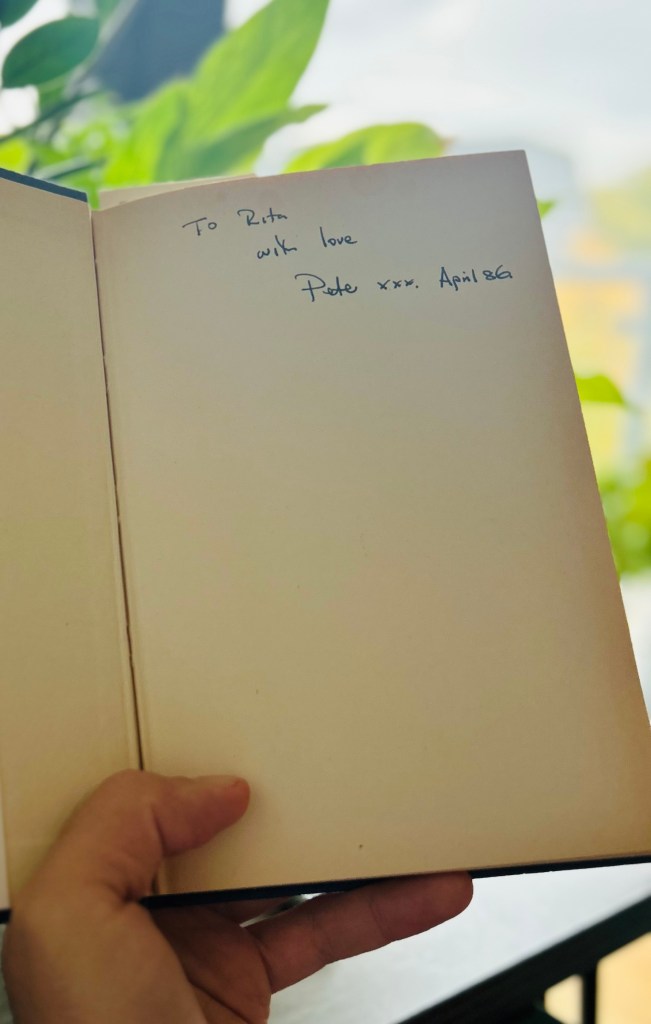
I’m the kind of person who really loves the -ember months, you know: September, October, November, December, spooky season, PSLs, sweater weather, cosy throws, piles of books and cups of tea. Even as an adult, I still treat myself to shopping for back-to-school supplies, my set of new pens, a beautiful notebook, a pad of notecards. And as is so often the case this time of year, I’ve been thinking a lot about writing lately—not the big writing projects, not my next book that has been hovering in draft form for too long, but the more intimate, private act of journaling. The kind of writing that doesn’t begin with an audience in mind, but with a simple intention: to notice, to clarify, to think. Writing to get cosy with.

This practice has been quietly foundational for me. Some days it is a place to record the traces of a dream before the day sweeps it away. Other days, it’s a notebook page where I sketch out the shape of an idea, a plan, a dream that feels still just beyond reach. And sometimes, if I’m honest, it’s little more than the banal recounting of my to-do list, things I need to buy, or minor annoyances still weighing on me. But even in those moments, journaling does something important. It reminds me that thought is not just an invisible current in the mind; it is something that can be externalised, shaped, and returned to.

The philosopher Hannah Arendt wrote that thinking itself is a kind of dialogue, an inner conversation between me and myself. Journaling, in that sense, is a way of giving that dialogue a more durable form. It’s a way of ensuring that fleeting insights don’t evaporate, but have the chance to develop into something more sustained.

There’s a temptation to imagine journals only as records of the past, those childhood diaries with locks and keys, filled with secrets that we might cringe to reread, or those teenage of angst and whingeing. I have many examples of both. But even in those examples, a journal is still always a tool for invention. The monks who kept commonplace books weren’t merely keeping records; they were building repertoires of thought that could be recombined in new and surprising ways.

When I journal, I notice that same shift. I might begin with the day’s details—what I’m reading, what I need to do next—but somewhere in the act of writing, connections spark. A line from Woolf collides with something I overheard on the bus. A fragment of a lecture I once gave resurfaces beside a description of the changing light on my balcony garden (sadly now largely barren as I prepare to leave this flat after several years). The page becomes less about recording and more about thinking with.

This is one of the reasons I encourage students and coaching clients alike to develop their own journaling practices. It’s not about producing beautiful prose; it’s about cultivating a space where the mind can stretch into unexpected directions.

At the moment, my own journaling practice feels especially necessary. September has always been a transitional month for me: the academic year begins again, new projects gather momentum, and the end of summer invites reflection on what has—or hasn’t—shifted over the past few months.

Recently, I’ve been writing in the mornings with coffee that I’ve started brewing with increasing precision with a V60 and scale, sometimes before the world is properly awake. I’ve found that this time of year asks me to slow down, even when everything around me is speeding up. My journal becomes a place where I can give shape to that paradox.

In these quiet pages, I notice the themes that recur: what it means to balance leadership and teaching; how to weave contemplative practices into daily life; where writing itself is pulling me next. These aren’t polished arguments—they’re more like fragments waiting to be assembled. But without journaling, they might never find their way into language at all.

Several thinkers have shaped the way I understand journaling as a thinking practice. Julia Cameron, of course, is central: her practice of ‘morning pages’ in The Artist’s Way remains one of the most accessible and transformative ways to encounter journaling. She invites us to write three pages, longhand, every morning, without editing or censoring. The point is not literary craft but mental hygiene, clearing away the clutter that keeps us from more original insights.

Another companion is John Dewey, whose philosophy of education placed such emphasis on reflection. Dewey argued that genuine learning happens when experience is turned over in the mind, tested, connected. Journaling is, in many ways, the simplest technology for making that reflection visible.

And then there is Joan Didion, who once said, ‘I write entirely to find out what I’m thinking.’ That sentence could be the motto both for journaling as a practice, and for my entire life.

One of the questions people often ask me is: What happens to all this writing? Do you go back and read it? Do you publish it?

The truth is that most of it remains private, and that’s part of the point. Of course, there are occasional fragments that spark something bigger, and find their way into a draft or an article. But there is something liberating about knowing the page doesn’t demand performance. More often, I find that themes crystallised in my journals resurface later as a sort of inspired spark in a lecture, a coaching session, or a blog post. The journal becomes a kind of compost heap for thought, where scraps and off-cuts break down into fertile soil, ‘breeding / Lilacs out of the dead land, mixing / Memory and desire’ to quite Eliot’s eminently autumnal Waste Land.

If you’re curious about beginning—or rekindling—a journaling practice, here are a few approaches that I’ve found useful:

  1. Set a container. Whether it’s Cameron’s three pages or simply ten minutes with a timer, give yourself a boundary. Paradoxically, limits make the practice feel more spacious.
  2. Write by hand if possible. The slowness of handwriting often brings a different quality of attention. That said, typing can work too—especially if it helps you keep pace with fast-moving thoughts.
  3. Don’t censor. The journal isn’t for anyone else’s eyes. Let yourself be clumsy, repetitive, contradictory. That’s where the interesting material often hides.
  4. Return to your entries selectively. You don’t need to reread everything. But every so often, leaf back through your notebook. Notice what recurs. Pay attention to what surprises you.
  5. Link journaling to other practices. For me, journaling often dovetails with meditation or with my reading life. It’s less a stand-alone ritual and more a node in a larger web of reflection.

If journaling is, at its heart, a practice of listening—both to the self and to the world—then it naturally lends itself to creative community. That’s why I’m so looking forward to starting a new Artist’s Way Circle on 23 September.

For twelve weeks, we’ll walk together through Cameron’s classic text, supporting one another as we experiment with morning pages, artist dates, and the many other tools she offers for creative recovery. Journaling will be our daily companion, but the circle itself will be a space for sharing insights, frustrations, and breakthroughs along the way.

If you’ve been feeling the tug to reconnect with your creative self—or if you simply want to explore how journaling might change the way you think—I’d love for you to join us. You can find the details here.

Ultimately, journaling reminds me that thought is not finished before it appears on the page. Writing is not simply a vehicle for communication, but a method of discovery in its own right. In a world that often prizes speed, certainty, and polished outputs, there’s something quietly radical about sitting down with a notebook and allowing thought to unfold in its own time.

For me, it remains one of the simplest and most profound ways to live more reflectively, more attentively—and perhaps even more creatively.


More to Explore

Forgiveness According to A Course in Miracles

Lately, I’ve been reflecting a lot on forgiveness—not the dramatic, cinematic kind that requires a public confession or a sweeping, transformative act—but the quiet, often unseen practice that happens in the small, daily choices of how we engage with the world. A Course in Miracles provides a particularly compelling framework for this kind of forgiveness, one that gently redefines our usual understanding of what it means to forgive and, perhaps more radically, who it is we are forgiving.

In my early days of studying the Course, I found myself repeatedly stalled by the language. The texts are often dense, abstract, and insistently paradoxical: “Nothing real can be threatened,” it says, and yet the world continues to threaten everything we cherish. The first time I read this, I thought, ‘Well, that’s comforting… but how does it help me with my emails and my deadlines?’ Yet, with ongoing study, what initially seemed theoretical began to resonate in everyday life. Forgiveness in the Course is less about condoning behaviour or minimising harm than about recognising the illusory nature of grievance itself—a shift in perception that allows the mind to release the burden it carries.

One of the passages that has stayed with me most is from the Workbook (Lesson 122): “Forgiveness offers everything I want.” It is easy to skim over this but in practice, it prompts a radical reorientation. When I notice irritation bubbling up in a meeting, or resentment at a friend’s perceived slight, I try, however imperfectly, to pause and ask: What is my mind holding onto here, and what might I gain if I released it? Sometimes the answer is a subtle lightening of mood; other times, it is simply recognising that my insistence on being right costs me more than the imagined offence ever could.

The Course aligns in intriguing ways with contemporary work on attachment and interpersonal dynamics. Researchers like Daniel Siegel have shown that holding onto anger or hurt is, at its core, a way of maintaining control over a relational landscape. Forgiveness, in the sense that the Course uses it, disrupts this dynamic not by changing the other person but by changing our relationship to the story we tell ourselves about them. It is a deeply relational act, even if it does not require confrontation or restitution. In this sense, the Course and attachment theory converge: both recognise that true freedom often arises when we disentangle ourselves from patterns of reactivity and take responsibility for our own experience of the world.

Forgiveness is to give-for. To forgive is not just to cancel a debt or erase an injury; it is to create a space where something else can appear. Forgiveness is generative precisely because it involves taking away what we cling to. In the act of giving-for, we let go of what we might otherwise hold on to—resentment, grievance, the illusion of control—and in doing so, we make room.

That space does not stay empty for long. The psyche, like nature, dislikes a vacuum. When we forgive, we carve out a space where something new can take root. Often it is peace, sometimes clarity, sometimes the possibility of a different kind of relationship. The point is not to decide in advance what will fill the space, but to trust that it will be filled by something that loosens the grip of the past and guides us towards a future not already shaped by hurt.

In this way, forgiveness is less about the other person and more about the conditions we create within ourselves. By making space, we stop defining ourselves through the wound. The pull of the old story weakens, and the self is free to reconfigure. To forgive is not to condone, nor is it to forget—it is to make room for the future.

The risk, of course, is that we may hesitate, fearing that if we release what has anchored us, we will be left unmoored. Yet the paradox of forgiveness is that what feels like a loss is in fact a preparation. To give–for is to trust in the fertility of the void. In my own practice, I have noticed that forgiveness tends to arise more naturally when it is paired with compassion. 

Thích Nhất Hạnh’s writings on “loving-kindness” are a fantastic complement to the Course’s metaphysics. Both invite us to hold ourselves and others gently, to acknowledge imperfection without judgment, and to see beyond the immediate form of conflict. 

Forgiveness, then, is not a one-off act but a series of small, attentive gestures: a reconsideration of a conversation that went wrong, a letting go of imagined slights, or even a moment of patience with one’s own internal critic. It is worth noting that the Course’s approach to forgiveness is not sentimental. It does not ask us to sweep abuse under the rug or to equate forgiveness with naive tolerance. Instead, it challenges the mind to see differently: to recognise that the story of injury, while compelling, is not the ultimate reality. In the Course, forgiveness is not about giving others what they do not deserve, but is about giving ourselves release from the prison of resentment. In this, there is both liberation and clarity: we are freed to act from a space of choice rather than a feeling of obligation, from love rather than fear.

Practically speaking, there are several ways to bring the Course’s teaching on forgiveness into daily life. One approach is to keep a small journal of resentments and imagined grievances, and then, as a reflective exercise, attempt to see the situation through the lens of the Course: what part of my mind is holding onto this, and what might I perceive differently if I allowed forgiveness to operate? Another method, particularly helpful when emotions are strong, is to practice brief meditative pauses—one or two minutes—where you consciously soften your stance and breathe into a sense of release. Over time, these small interventions accumulate, subtly shifting patterns of thought and feeling.

In everyday life, I often find that these practices manifest in unexpected ways. A tense exchange with a colleague might resolve itself not through debate but through a quiet internal decision to release judgment. A moment of impatience with family can be softened simply by noticing the story I am telling myself and choosing to let it go. These are not grand miracles but small, lived interventions—the kind that quietly build into a different way of being. 

If you are curious to explore forgiveness in the context of the Course in a communal, reflective setting, I warmly invite you to my weekly Course in Miracles study group. We focus on both the theoretical principles and their practical applications, supporting one another in integrating the Course into our daily lives. It is a space where questions are welcomed, experiences are shared, and the abstract becomes tangible within real, lived contexts.

Forgiveness, ultimately, is a practice rather than a verdict. The Course reminds us that what we release in our minds, we release in our lives: the minor grievances, the lingering judgments, the habitual narratives that tether us to fear. In making room for forgiveness, we create space for freedom, clarity, and, perhaps most quietly, a gentler way of moving through the world.

Find your Calm this Labor Day – Just £11.99 This Weekend Only

Labor Day is about more than just a long weekend. It’s a moment to pause, step back, and reconnect with what matters most. What better time to begin a practice that reduces stress, boosts focus, and helps you feel more present in your life?

That’s precisely what my course Integrative Meditation | Level 1 is designed to do. And for this weekend only, you can enrol for just £11.99 (regularly £14.99).

👉 Click here to claim the Labor Day offer before it ends


Why This Course?

Most meditation programs stop at relaxation. Integrative Meditation goes deeper. Drawing from Mindfulness-Based Cognitive Therapy (MBCT), neuroscience, positive psychology, Acceptance and Commitment Therapy (ACT), journaling, and breathwork, this 4-week programme gives you a science-backed framework to rewire your brain and build resilience for the long term.

Here’s what you’ll gain:

  • Less stress & anxiety: Learn practical tools to calm your mind and regulate your body’s stress response.
  • Freedom from negative thinking: Break the cycle of self-doubt and transform limiting beliefs into self-compassion.
  • Sharper focus & productivity: Train your attention, reduce distractions, and get more done with clarity.
  • Stronger emotional resilience: Quiet the critical inner voice and bounce back from setbacks with greater ease.
  • A deeper sense of self: Go beyond labels and roles to connect with your authentic purpose and values.

And unlike one-off guided meditations, this course helps you establish a lasting practice—through short knowledge lectures, guided meditations, and reflective journaling you can fit into just 30 minutes a day.


Why Now?

Because the habits you start today will shape your tomorrow. With the long weekend ahead, you can finally give yourself the space to begin a meditation practice that sticks.

For just £11.99 this Labor Day weekend, you’ll get:

  • 6+ hours of on-demand video
  • 42 guided lessons across 4 weeks
  • 9 downloadable resources & 1 article
  • Lifetime access on all devices
  • Certificate of completion

Normally £14.99, this offer is only available until Monday night.


Ready to Begin?

Click below to start Integrative Meditation Level 1 for just £11.99 and begin rewiring your mind for peace, focus, and resilience.

👉 Claim your spot before the sale ends

This Labor Day, give yourself the gift of calm.

Literary Walks: How Reading Cities Shapes the Way We Live in Them

I notice how literature lingers in the pavements in London. I’ve found this more and more the longer I’ve lived here. After all, ‘when a man is tired of London, he is tired of life’, as Samuel Johnson wrote. Even on the most ordinary days, when I’m simply walking to the shops or having a coffee, a remembered passage from Woolf or Dickens reshapes the atmosphere, giving a quiet strangeness to what otherwise might seem familiar. Literary walks don’t need to be formal, nor do they require a tour group—although there is a place for those. Instead, they are an everyday practice of letting what we’ve read colour what we see, and in turn allowing the city to read us back.

Cities are always already read, even before we open a book about them. Our streets teem with signs and symbols: shopfront typography, graffiti tags, the peculiar poetics of street names, layering like muddy sediment the history of an ancient city, each one carrying some buried narrative. Roland Barthes, in Mythologies, reminds us that everyday signs are never innocent, but instead they come loaded with cultural meaning. Michel de Certeau goes further, describing walking itself as a kind of writing: each step a form of mark-making, each turn a marginal note. Perhaps this is why walking has become one of my most reliable contemplative practices; I can never quite shake the sense that London is, in spite of its sublime history, an unfinished text, and that my role as a walker is not only to read but to annotate.

Reading literature set in a city makes us feel less like visitors and more like participants. When I first read Mrs Dalloway, I hadn’t spent much time in London, but the rhythm of Woolf’s sentences gave me an immediate familiarity with the city. Later, when I actually walked those spaces and traced Clarissa’s journey on foot with my students the novel gave me entry points into belonging to a city that didn’t seem materially my own. Literature offers a way of settling without appropriation: it lets us walk streets we may never ‘own’ or even afford to live on, but with a kind of kinship. For me, reading the urban canon—Joyce’s Ulysses for Dublin, Smith’s NW for Willesden—has softened the edges of new places, helping me to live in them with curiosity rather than defensiveness.

Walking with a book’s shadow creates a double vision: the city as it is, and the city as it is imagined. Every time I find myself near Holborn, I see Dickens’s London superimposed on the glassy facades of insurance firms; the ghosts of debtors’ prisons and fog-bound alleys live on in the shadow of a Costa or Pret. And I can’t help but notice how nearly every pub in the vicinity has a plaque reporting that Dickens used to drink there and recounting a famous 17th-century stabbing that took place there. To walk with these texts is to carry a palimpsest in mind, where past and present are layered, sometimes clashing, sometimes harmonising. In my own recent walks, especially since returning to more teaching this year after six years in leadership, I’ve been acutely aware of this doubling. The university campus is also both a physical environment and a palimpsest of earlier student generations—I grow older, but my students, disconcertingly, stay the same age every year. Literature trains us to notice these overlays, and walking keeps the lesson alive.

Literary walking is not only about cities, it is also about the walker. What we bring to the page and to the street matters as much as what the author provides. Some days my walks are brisk and pragmatic; on others, they slow into reverie. I notice how my mood shapes the city I ‘read’, whether the buildings feel inviting or alienating, whether the metaphors I attach are hopeful or heavy. Theorists of psychogeography often emphasise dérive—the unplanned journey or drift—as a mode of breaking free from capitalist rationalisation of space. Yet for me, walking with literature offers a slightly different promise: not only resistance, but companionship. A door knocker shaped like a lion’s head, a tree whose branches look suddenly archetypal, a narrow side alley that seems like it should have its own subplot. Reading tunes our attention and primes us to see texture where before there was only function. 

There is also a social dimension to literary walking. Books are companions, but so too are the people we share them with. When I’ve brought novels into reading groups or teaching seminars, I’ve been struck by how each reader brings a different walk through the same text. These conversations remind me that the city is never read alone—it is always interpreted collectively, shaped by a multiplicity of histories. I think of my own upcoming groups—the Living a Course a Course in Miracles study group or the weekly Creative Flow Sessions that are beginning this autumn—as spaces where such collective interpretations of experience can flourish, even if not always tethered to literal walking.

In many ways, literary walking is about staying with a place rather than consuming it. When I moved to Hong Kong, I was initially so overcome by the immensity of it that I bought a fancy camera to help me train my vision on the particulars; when I visit Stockholm, my favourite city in the world after London, I find a space that is, inversely, more human-scale. London is a capital somewhere in between, neither entirely comforting to the human spirit or form, nor entirely forbidding. One never tires of London because it takes work, practice, and grit to live in London. 

Cities are often perceived as destinations to be ‘done’, sights to be checked off in rapid succession. But literary walking resists that tempo. It asks us to linger, to reread, to take a slower pace. To walk with a book in mind is to inhabit a place rather than extract from it. In this sense, walking becomes a small ecological ethic, a way of living lightly while seeing deeply. The practice is never finished, just as no book is ever fully read. Each walk is another opportunity for literature to accompany us, shaping how we see and how we are perceived.


An Invitation to Walk With Me (Figuratively at least)

What books have changed the way you walk your city? I’d love to hear your reflections—share them in the comments or reply if you’re reading this via newsletter. If you’d like to explore more practices that blend literature, creativity, and contemplative living, you’re warmly invited to join our Weekly Creative Flow Sessions  this autumn or the new 18-month reading cycle of A Course in Miracles.

As autumn approaches, I hope your own walks—whether with books, with friends, or simply with yourself—offer you fresh ways of seeing the cities you call home.


Transform Your Life: Limited Coaching Spots Available

I’m reaching out to subscribers first to say that I have a small number of one-to-one coaching spots opening up this autumn. I’d love to see if working together can help you gain clarity, focus, and momentum in your life.

Sometimes the most challenging part is knowing where to start, which is why I’m offering a free 15-minute clarity call, where we can:

  • Talk through your goals and current challenges
  • See if coaching or an integrated approach is the right fit for you
  • Outline practical next steps to start creating real, lasting change

My coaching spots are always very limited, so I encourage you to book now if this feels like the right time to take a step toward growth. You can learn more about my style, training, and approach here.

If you’ve been thinking about getting clarity, focus, and momentum in your life, now is the time to act. In a free 15-minute clarity call, we’ll:

  • Explore your goals and challenges
  • Identify whether coaching or an integrated approach is the right fit
  • Map out practical next steps to create meaningful, lasting change

👉 Reserve Your 15-Minute Clarity Call Now →