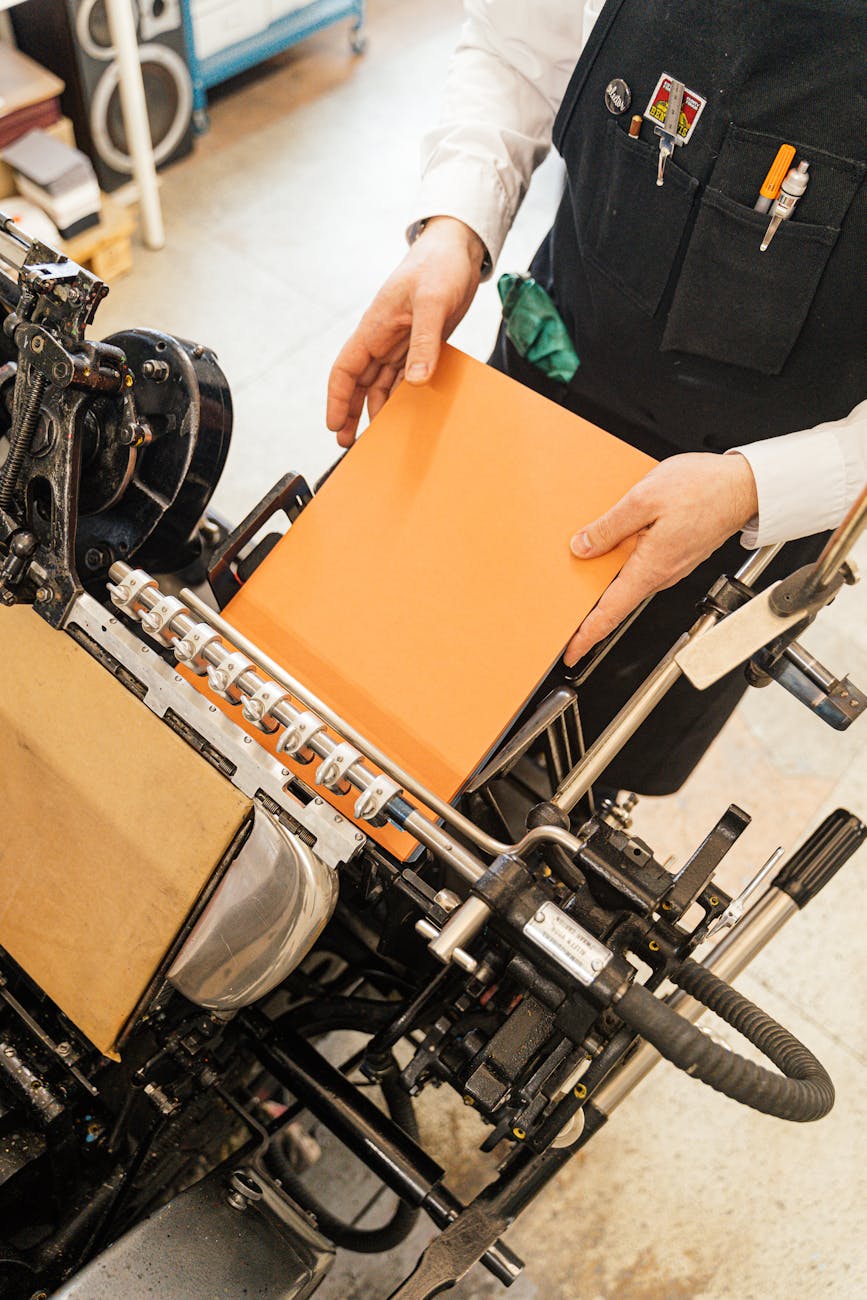
There is something about the craft of bookbinding. It re-educates the hands, and through them, the nervous system. It returns time to its proper scale.
I’ve been thinking about this more since settling into my new flat, which—by a small but meaningful stroke of grace—includes a dedicated studio space. For the first time in years, my tools don’t need to be packed away between sessions. Paper can sit under weights overnight without being disturbed, and work can pause without being dismantled.
Already this matters more than I expected. Bookbinding, after all, resists the logic of efficiency. Adhesive must dry. Grain direction must be respected. Linen thread must be drawn tight but not too tight. You cannot rush a spine without paying for it later. The work teaches you—firmly but kindly—that attention cannot be compressed.
Simone Weil famously wrote that “attention is the rarest and purest form of generosity.” Bookbinding operationalises this insight. You can’t bind a book while thinking three steps ahead. If your attention wanders while folding signatures, the error will propagate. If you rush the punching of sewing stations, the whole text block will pull askew. You can’t persuade paper fibres to behave differently through force of will; you must cooperate with them.
In this sense, bookbinding has become a counter-practice to much of contemporary creative life. Online, speed is rewarded. Visibility is currency. Iteration is encouraged, but only when it looks like momentum. The slowness of binding—a practice that may take days or weeks before anything finished appears—feels almost monastic by comparison.
And yet, paradoxically, it has made me more productive, not less.
One of the biggest misconceptions about patience is that it means waiting. In practice, patience is active–it’s a verb (metaphorically at least) because you are always doing something: sharpening a blade, squaring a stack, testing tension, laying out the next stage so it will be ready when the moment comes.
This mirrors something I see repeatedly in coaching work, particularly with highly sensitive or intellectually driven creatives. There is often an underlying anxiety that if one is not producing, one is stagnating. But many forms of growth happen beneath the threshold of visible output.
Since moving into the new flat and setting up the studio, I’ve noticed a subtle shift in how I approach my other work—writing, teaching, contemplative practice. I’m more willing to let something rest unfinished.
There is also, I think, an ethical dimension to working with materials in this way. Richard Sennett, in The Craftsman, describes craftsmanship as a dialogue between hand and material, where resistance becomes instructive rather than frustrating. This is not mastery-as-domination, but mastery-as-listening.
In bookbinding, materials remember what you do to them. Paper creased carelessly will never quite forgive you. Cloth stretched unevenly will telegraph the mistake forever. This permanence sharpens responsibility. You learn to slow down not because slowness is virtuous, but because it is necessary.
This has felt especially grounding during a period of personal transition. A new home, even a welcome one, requires recalibration. New light patterns. New noises. New routines. The studio has become a place where that recalibration can happen somatically, not just cognitively. Through repeated, careful gestures, the body relearns safety.
It’s hard not to notice the symbolic resonance here. Books are already threshold objects—containers of thought, memory, and voice. Binding them by hand heightens this awareness. You become acutely conscious of the labour that precedes reading, of the infrastructure that makes inwardness portable.
All of this feeds into a broader theme that’s been shaping my work lately: the power of small, well-held experiments. Not performative reinventions, but modest shifts in practice that reorient attention.
Perhaps the deepest lesson bookbinding has taught me is that care compounds. What feels like slowness at the outset becomes reliability later. Structures hold. Work lasts. You spend less time repairing what was rushed.
This is true of creative practice, of relationships, of inner life. Patience is not something we adopt once and for all; it is something we rehearse through forms that demand it of us.
For now, I’m grateful for a studio that allows this rehearsal to continue—quietly, materially, without display. And I’m grateful, too, for the conversations that extend from it: in workshops, in coaching, in shared spaces of attention.
Upcoming Events
Integrative Meditation
- 19 January | 7.30-8.30 PM GMT | £4
Creative Flow Co-Working Session: The Power of Tiny Experiments
- 26 January | 10 AM-12 PM GMT | FREE
- Register here: https://www.meetup.com/the-art-of-creative-practice/events/312151260/
Highly Sensitive Creatives: Energy, Boundaries, and Creative Rhythm
- 27 January | 7.30-9.00 PM GMT | £12
- Register here: https://www.meetup.com/the-art-of-creative-practice/events/312712764/
