Time Orientation and the Trap of Living Elsewhere

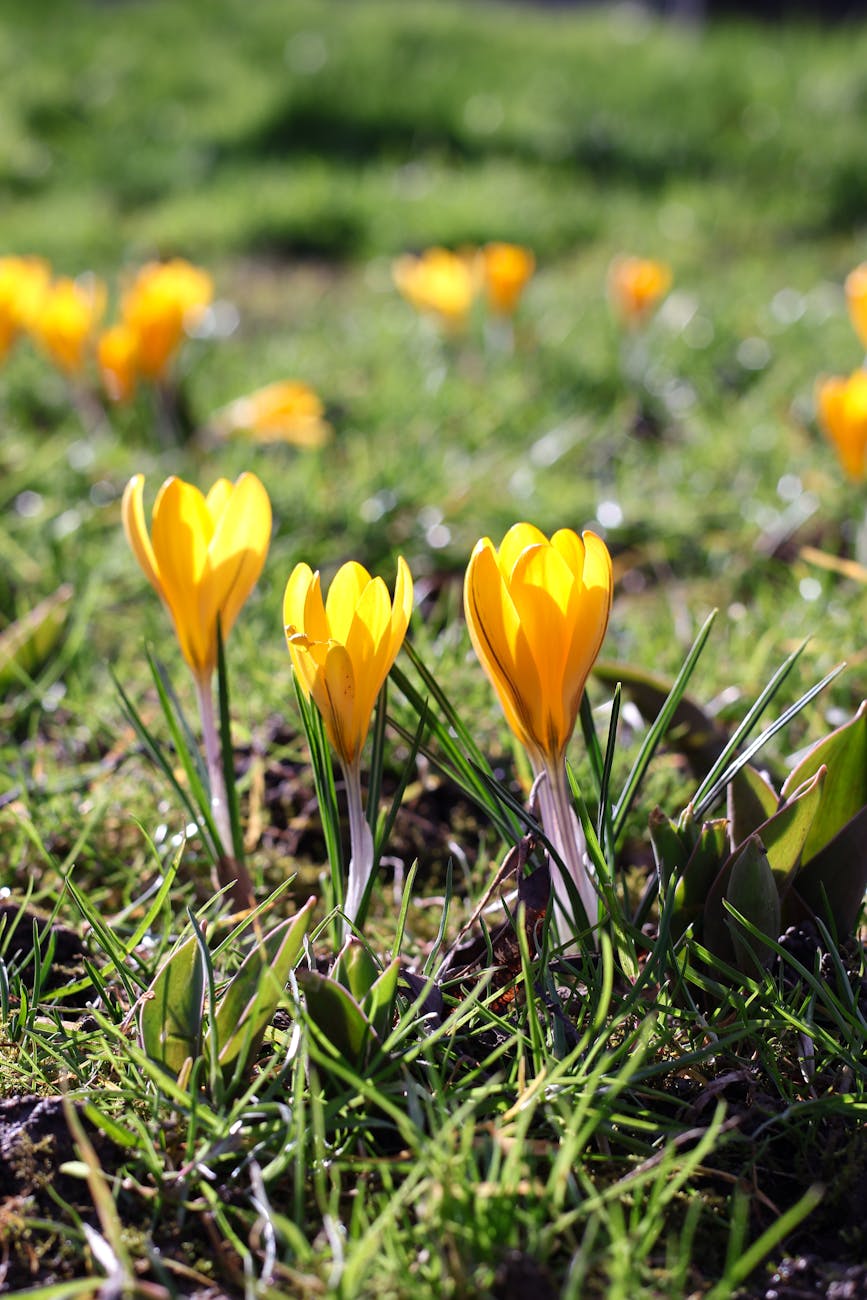
Photo by king Ho on Pexels.com

I left a tarot workshop yesterday with an insight that was startlingly clear: I spend a great deal of time living in the future. Card after card suggested anticipation, projection, preparation, movement toward what comes next.

The irony was not lost on me. Present-moment awareness — mindfulness, contemplative attention, the cultivation of presence — sits at the centre of my teaching and much of my writing. I talk frequently about inhabiting experience rather than managing it, about learning to notice rather than constantly optimise. And yet, as anyone who works in this space knows, the practical reality of such work involves a surprising amount of future-thinking: planning programmes, designing workshops, mapping trajectories, building structures that do not yet exist.

At the moment my notebooks are full of precisely this energy: outlines for new offerings, teaching plans, lists of ideas, and preparations for the opening this Spring of my new online community space, Innerworks (more on this very soon). All meaningful, all exciting — and all subtly orienting attention toward what is not yet here.

The cards were not criticising ambition or creativity. They were pointing to something more delicate: the ease with which we begin to live ahead of ourselves.

Psychologists sometimes describe this as time orientation — the habitual direction in which our attention leans. In The Time Paradox, Philip Zimbardo and John Boyd argue that individuals tend toward past-, present-, or future-oriented modes of living, each with advantages and distortions. Future orientation, often celebrated in productivity culture, enables planning, discipline, and achievement. But pushed too far, it produces a life experienced primarily as preparation.

Philosophers have long recognised this tendency. Martin Heidegger described modern existence as characterised by projection — the self constantly thrown forward into possibilities. Henri Bergson distinguished between measurable clock time and lived duration, reminding us that real experience unfolds qualitatively, not as a sequence of tasks awaiting completion.

There is a peculiar paradox when presence becomes one’s professional field. Teaching mindfulness, creativity, or contemplative practice requires organisation. Workshops must be scheduled. Communities must be built. Emails must be sent. Ideas must become structures.

The work of helping others arrive in the present inevitably involves calendars. Over the past months, as I’ve been developing new programmes and thinking carefully about how to support creative and reflective communities more deeply, I’ve noticed how easily meaningful planning slides into subtle deferral. The mind begins narrating life as a sequence of upcoming thresholds:

Once this launches.
Once this settles.
Once this next phase begins.

The tarot workshop simply named what I already half knew: I had begun relating to the present primarily as a staging area. And the strange thing is that the more meaningful the work becomes, the easier this trap is to fall into. Purpose intensifies projection.

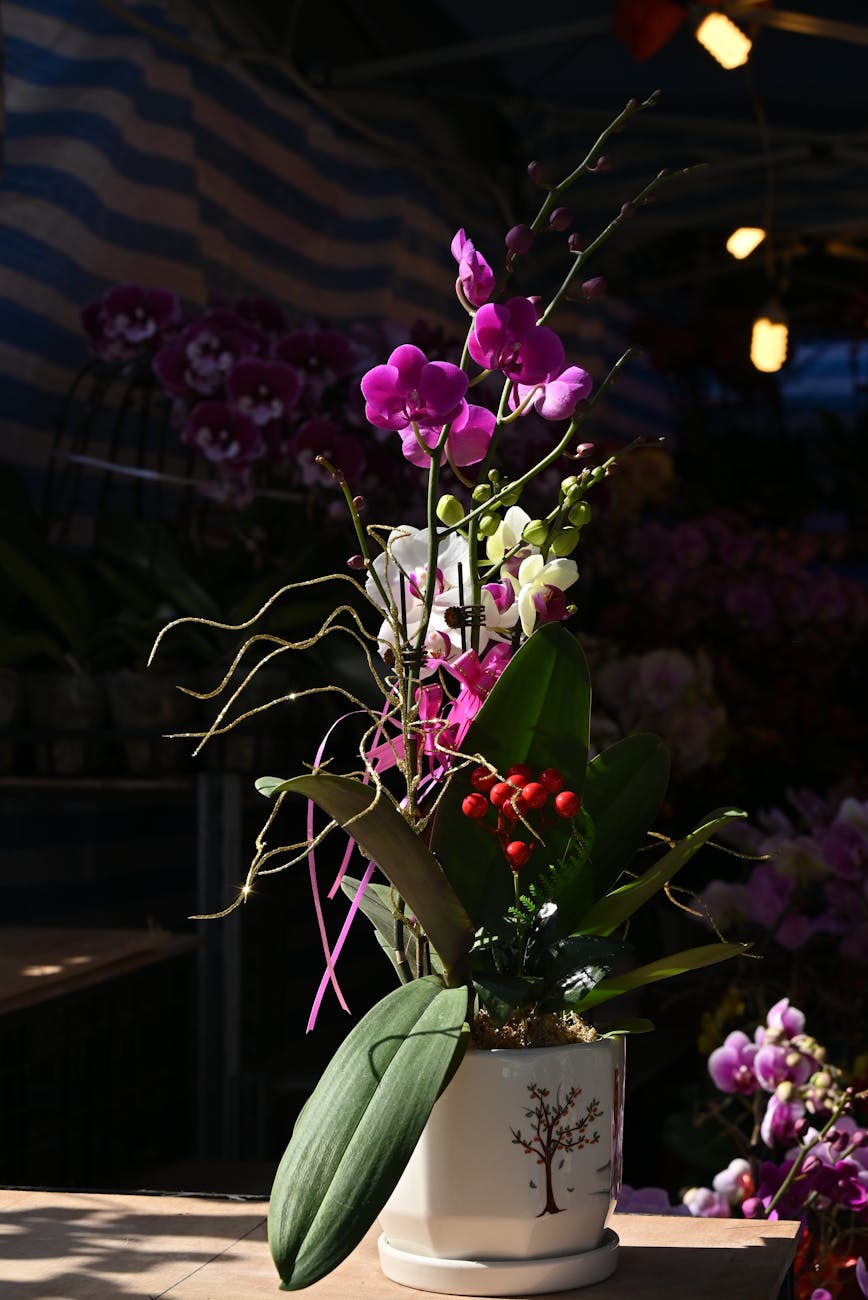
This weekend my partner and I visited the Orchid Festival at Kew Gardens — its 30th anniversary this year, and something that has become part of our late-winter rhythm. It is, objectively speaking, an exercise in logistical patience. Timed tickets, queues, dense crowds moving slowly through glasshouses thick with humidity and colour.

And yet something happens once you are inside. Orchids have an almost unreasonable beauty. Shapes that seem designed rather than grown. Colours that look improbable even while directly in front of you. People shuffle forward, phones lifted, conversations softening. Despite the press of bodies, time loosens.

Standing there — surrounded by impossible blooms and sharing the experience with someone I love — I noticed a rare stillness. Nothing needed to happen next. The present moment was sufficient.

The trap of living elsewhere is subtle because it disguises itself as responsibility. We believe we are being diligent, visionary, prepared. And often we are. The future matters. Planning matters. But presence is not opposed to planning; it is what prevents planning from becoming exile. The challenge, then, is not abandoning future-thinking but returning, repeatedly, to lived immediacy.

This insight has shaped how I’m approaching my upcoming workshops. Increasingly, I see creativity itself as a form of time practice — a way of restoring balance between imagination and presence.

Creative work asks us to plan and to surrender, to envision and to attend. Writing, especially, teaches patience with unfolding. You cannot inhabit a sentence that you are already trying to finish.

That’s partly why I’m so excited about the programmes beginning this March. They are designed not simply as skill-building spaces but as environments where people can rediscover a different relationship to time that supports both aspiration and groundedness.

If this reflection resonates, you might consider joining:

5 Days of Creative Abundance
9–13 March | 7.30–8.00 PM GMT | £29
A short, gentle immersion designed to reset creative momentum and reconnect with possibility through small daily practices.
Register here:
https://www.meetup.com/the-art-of-creative-practice/events/313206797/

The Writer’s Flow Circle: A 12-Week Group Coaching Circle
Beginning Monday 23 March | 7.30–9.00 PM UK time | £180
A sustained space for writers seeking structure, accountability, and deeper alignment with their creative rhythms.
Register here:
https://www.meetup.com/the-art-of-creative-practice/events/313207235/

Both, in different ways, are invitations to stop postponing creative life until conditions feel perfect.

The lesson from yesterday’s tarot spread was not that I should stop imagining the future. It was simply a reminder to visit the present more often — to stop treating it as a corridor leading elsewhere. Presence is not a permanent achievement. It is a practice of return. And perhaps that is why moments like the Orchid Festival linger: they reveal that life is not waiting for us at the end of our plans. It appears briefly, vividly, whenever attention and experience coincide.

The future will arrive soon enough. In the meantime, there is always this moment.

The Ethics of Attention: Reading, Writing, and Living in a Distracted Age

Photo by Oziel Gu00f3mez on Pexels.com

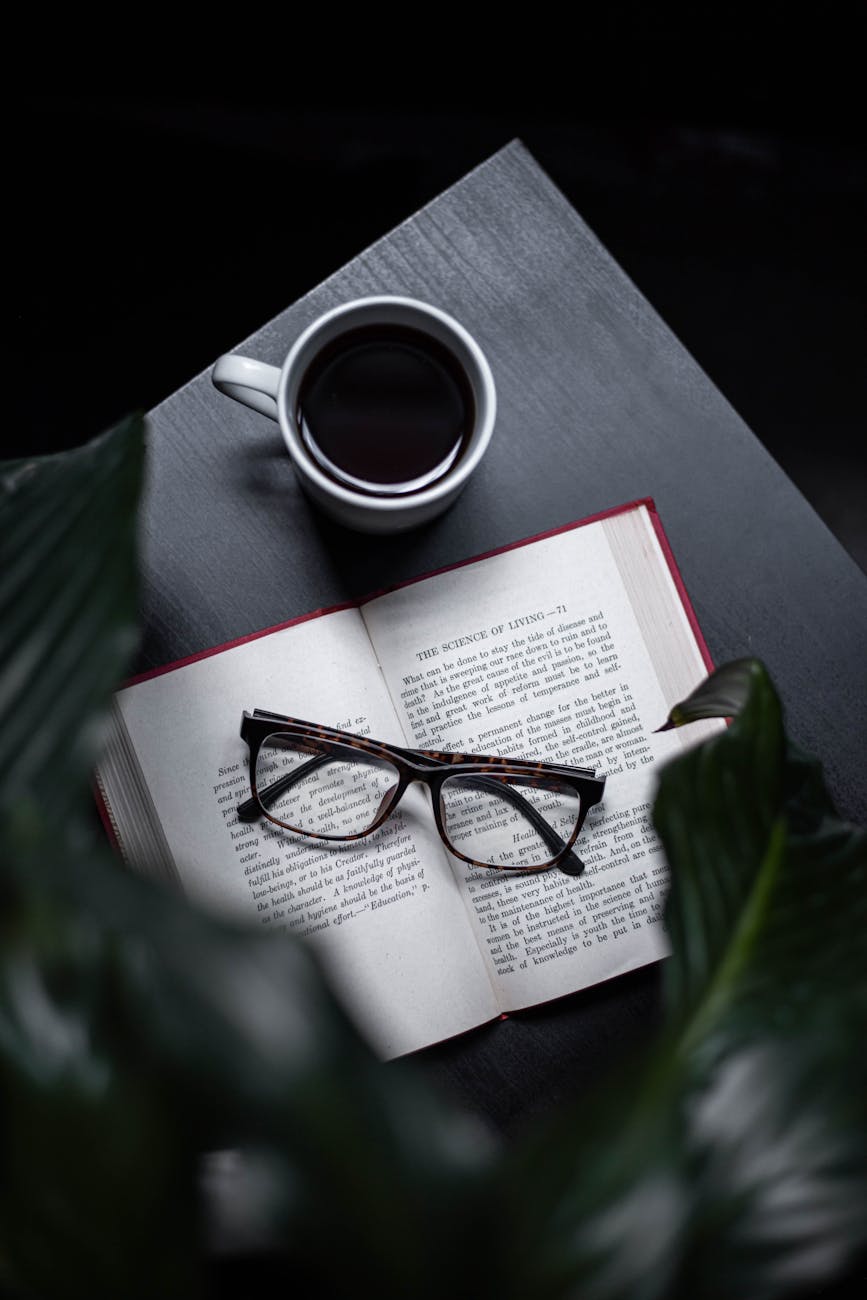
As I prepare for some very exciting spring workshops and begin working with a new cohort of 1–1 clients, I find myself returning again and again to the question: what kind of attention are we cultivating? And to what ends?

At the same time, I am collaborating with colleagues at the University of Surrey on a research study exploring the relationship between mindfulness and originality. I have designed an 8-week Mindfulness for Originality programme that we are currently trialing, and we will be studying its outcomes over the coming months. The premise is simple but, I think, quietly radical: that sustained, non-reactive attention is not the enemy of creativity but its precondition.

This runs counter to a certain romantic myth of originality as frenzy. But when we examine the intellectual lives of figures like Hannah Arendt, James Baldwin, or Virginia Woolf, what we find is not scattered brilliance but disciplined depth. Woolf’s diaries are full of labour—patient, iterative, attentive labour. Originality emerges not from distraction but from fidelity.

The philosopher Byung-Chul Han argues that we have moved from a disciplinary society to an achievement society, in which the violence is internalised. We exhaust ourselves trying to be endlessly responsive. The result is not freedom but fragmentation. In Stolen Focus, Johann Hari traces how economic and technological systems have steadily eroded our capacity for sustained attention, not as an accident but as a business model.

The ethics of attention, then, must reckon with power.

Who profits when we are distracted? Who benefits when we can’t read a long book, hold a complex argument, or sit with a difficult feeling?

Nicholas Carr’s The Shallows made this argument over a decade ago, but the evidence has only intensified. We are training our brains toward interruption. And yet, paradoxically, we long for immersion.

I see this longing in my coaching practice. People do not come to me because they lack ideas. They come because they cannot hold their ideas long enough to deepen them. They skim their own lives.

Reading, in this context, becomes a form of resistance.

To read a demanding text—say, a passage from To the Lighthouse or a dense philosophical argument—is to enact a countercultural choice. It says: I will not be hurried. I will not reduce this to a headline. I will allow complexity to exceed me.

But attention is not only about texts. It is about how we inhabit our own projects.

In the 8-week programme we are trialling at Surrey, one of the early exercises invites participants to notice the precise moment at which they reach for distraction during creative work. Not to judge it. Not to suppress it. Simply to witness it. The findings, even anecdotally, are striking. Original insights tend to arise not in the first burst of enthusiasm but in the stretch just beyond discomfort—when one stays.

There is an ethics here, too. To stay with one’s work is to honour it. To stay with another person is to dignify them. To stay with oneself—especially in the face of uncertainty—is to cultivate integrity.

This is why I am so passionate about the upcoming 5 Days of Creative Abundance workshop (9–13 March, 7.30–8.00 PM GMT, £29).

Yes, it is a practical, energising, five-day immersion into creative flow. Yes, it will give you tools, structure, and momentum. But underneath that, it is an experiment in attention.

For five evenings, we gather. We turn toward what matters. We practise not skimming our own creative impulse.

Abundance, as I understand it, is not accumulation. It is depth. It is the experience of discovering that when you attend properly to one idea, it unfolds. When you give something your full presence, it yields more than you expected.

There is a quiet confidence that arises from this. Not the performative confidence of broadcasting productivity, but the grounded confidence of knowing you can enter and remain in meaningful work.

If you have been feeling scattered, thinly stretched across platforms and obligations, this workshop is designed for you. If you sense that there is more in you—but you can’t quite access it amid the noise—this is for you.

I am intentionally keeping the price accessible (£29) because I want the barrier to entry to be low. But do not mistake accessibility for superficiality. The container will be strong. The invitation will be serious.

You can register here:
https://www.meetup.com/the-art-of-creative-practice/events/313206797/

And if you are ready for more sustained support, my 1–1 coaching work continues alongside these group offerings. In those spaces, we go deeper. We examine not only habits of attention but the attachment patterns and identity narratives that sustain them. We design structures that protect what is most alive in you. It is precise, relational, and tailored.

Attention, I am increasingly convinced, is a form of stewardship.

In an earlier book project, I explored the ethics of mediation in mail-order occultism—how printed texts promised transformation across distance. I am struck now by how similar the stakes feel. Every medium shapes consciousness. The question is whether we use the medium deliberately or allow it to use us.

Marshall McLuhan’s famous dictum that “the medium is the message” was not a celebration; it was a warning. If our dominant medium fragments attention, then our inner lives will fragment accordingly—unless we intervene.

This intervention need not be dramatic. It begins with small, repeatable acts. Reading ten pages with full presence. Writing one paragraph without checking a phone. Listening to a friend without composing a response.

It also requires community.

One of the reasons I continue to run workshops—even as I refine my focus and prepare for new directions—is that collective attention is amplifying. When we gather around a shared intention, distraction loses some of its grip.

There is something profoundly moving about watching a group of people choose depth together.

In my own life, this season feels like a threshold. New 1–1 clients. Spring workshops taking shape. Research that, I hope, will contribute something meaningful to the conversation about mindfulness and creativity. It is not frenetic expansion. It is intentional cultivation.

And so I return to the ethical question.

What deserves your attention?

Not what clamours for it. Not what monetises it. What deserves it?

Your most original ideas do not shout. They wait. They require a certain stillness before they reveal themselves.

If you would like to practise that stillness—and discover what abundance might mean in your creative life—I would love for you to join me for the 5 Days of Creative Abundance.

Register here:
https://www.meetup.com/the-art-of-creative-practice/events/313206797/

Attention is not merely a mental resource. It is the substance of a life.

And how we give it—what we allow it to shape—may be one of the most consequential ethical decisions we make.

What Makes a Book Feel alive?

Photo by Rahime Gu00fcl on Pexels.com

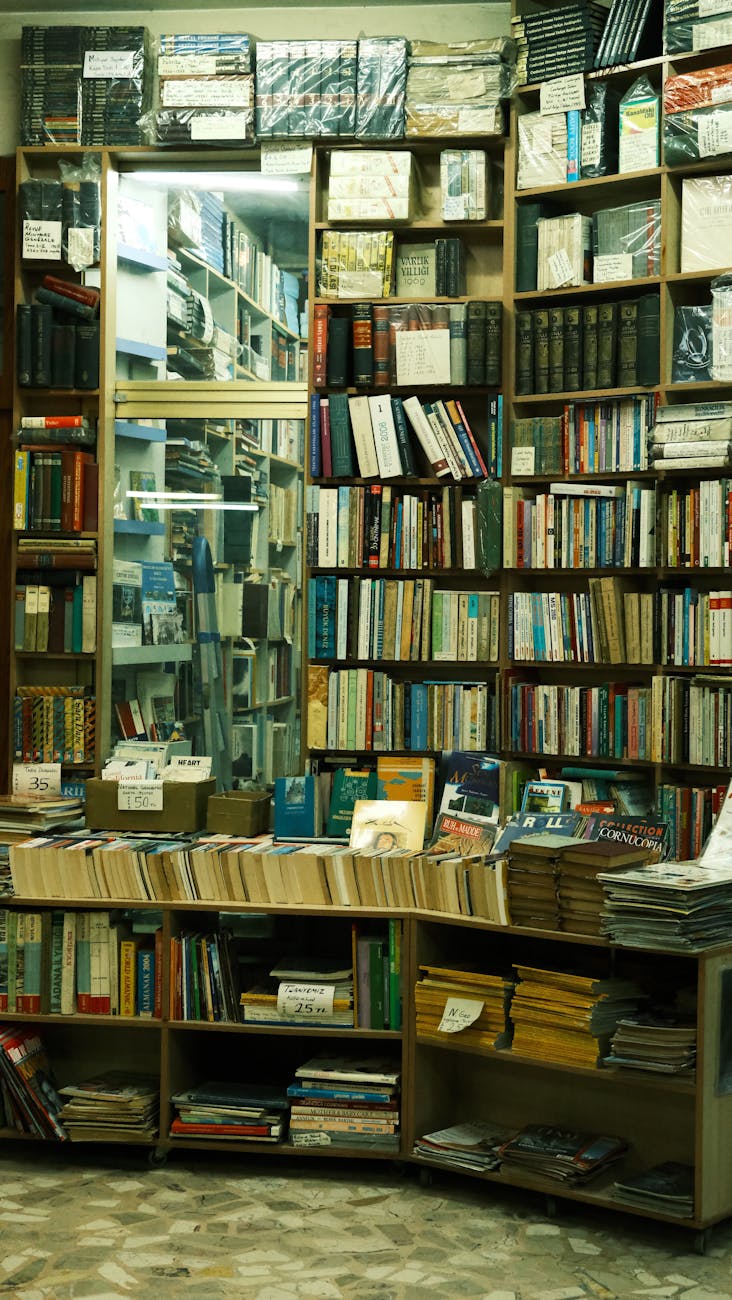
What makes a book feel alive? I’ve been circling that question recently, not in a purely theoretical way, but in the way a question circles you when something in your life has sharpened it. This week, my Dad’s first novel, The Pueblo Affair, came out today, a Cold War espionage thriller seeded in his experiences in military intelligence and carried, in one form or another, for nearly six decades. Watching that story move from memory and manuscript into the public world has made me think carefully about what distinguishes a book that merely exists from one that feels inhabited.

There are many competent books. There are books that are structurally sound, stylistically polished, even strategically positioned. Yet some of them remain curiously inert. By contrast, other books — sometimes imperfect, sometimes uneven — seem to generate their own atmosphere. You step into them and feel pressure, motion, and stakes. The difference, I suspect, begins with whether the book is organised around a living question.

In The Art of Fiction, John Gardner writes about the importance of sustaining a “vivid and continuous dream.” That phrase has always stayed with me, but what strikes me more now is that vividness alone is insufficient. A dream can be vivid and still feel unnecessary. The books that endure tend to be structured around questions that have not gone cold for their authors. When Virginia Woolf writes Mrs Dalloway, she is not merely experimenting with stream of consciousness; she is asking what it means to exist in time after rupture, after war, inside a fragile social fabric. When James Baldwinwrites about love and race, the prose carries the voltage of lived moral urgency. Even the pacy espionage worlds of John le Carré are animated by a relentless interrogation of loyalty, betrayal, and institutional compromise.

What I see in my Dad’s novel is precisely that persistence of question. What does it mean to serve something larger than yourself when the structures you serve are morally ambiguous? Aliveness also depends, I think, on moral temperature: there is a felt seriousness about human choice, consequence, and limitation. This is true of literary modernism, which has been central to my own scholarship, but it is equally true of genre fiction when it is done well. An espionage thriller that merely orchestrates plot twists can entertain; one that probes the cost of secrecy and divided loyalty begins to breathe.

Where do we misrecognise ourselves in others? How do our attachment patterns shape narrative form? A living book is anchored in particularity. It smells of specific rooms, contains the weight of actual objects, carries the tonalities of real conversations. In The Pueblo Affair, the atmosphere of late-1960s intelligence culture, the soundtrack of the era, the moral ambiguity of clandestine meetings in Washington bars, all contribute to a sense that the narrative has density. Specificity signals that the writer has metabolised experience rather than merely arranged information.

When writers attempt to anticipate reception, market trends, or institutional approval at the expense of their real preoccupations, the work thins. When they are willing to risk clarity about what matters to them, the prose acquires voltage.

Watching my Dad publish his first novel at this stage of life has so wonderful. As I continue writing, teaching, and working with other creatives, I am increasingly convinced that our task is less to manufacture creativity and more to remove the obstructions to it. When the writer is alive to their own question, their own moral temperature, their own tempo, the book has a chance to live as well.


Upcoming Events

Creative Flow Co-Working Session: Reclaiming Your Time |23 February | 10 AM-12 PM GMT | FREE

Register here: https://www.meetup.com/the-art-of-creative-practice/events/312151263/

Beyond Time Management: A More Natural Way to Organise Creative Work | 24 February | 7.30-9.00 PM GMT | £12

Register here: https://www.meetup.com/the-art-of-creative-practice/events/313062163/

5 Days of Creative Abundance | 9-13 March | 7.30-8.00 PM GMT | £29

Register here: https://www.meetup.com/the-art-of-creative-practice/events/313206797/

The Writer’s Flow Circle: A 12-Week Group Coaching Circle | Beginning Monday 23 March | 7.30-9.00 PM UK time | £180

Register here: https://www.meetup.com/the-art-of-creative-practice/events/313207235/


More to Explore

Why We Need Beauty in Everyday Life

Beauty has become strangely suspect in our society today as too indulgent, too easily confused with luxury, escapism, or branding, or too uncaring in a world filled with sadness and despair. We talk about beauty as if it were optional, as if it were something to be enjoyed after the serious work is done. But I’m increasingly convinced that beauty is not a reward at the end of the process. It is one of the conditions that makes a life—or a creative practice—habitable in the first place.

This isn’t a new argument. Elaine Scarry, in On Beauty and Being Just, writes that beauty presses us toward attentiveness, generosity, and care. The great philosopher and novelist Iris Murdoch described moral life as a training of attention, where learning to see clearly—lovingly, even—was inseparable from ethical development. Beauty, in this lineage, is not decoration. It is an education of perception.

What is new, perhaps, is how thoroughly beauty has been crowded out of everyday life by urgency, performance, and abstraction. We live inside systems that prize speed over texture, output over craft, visibility over depth. In those conditions, beauty gets reduced to a moodboard or a purchase, rather than something slowly made, tended, and lived with.

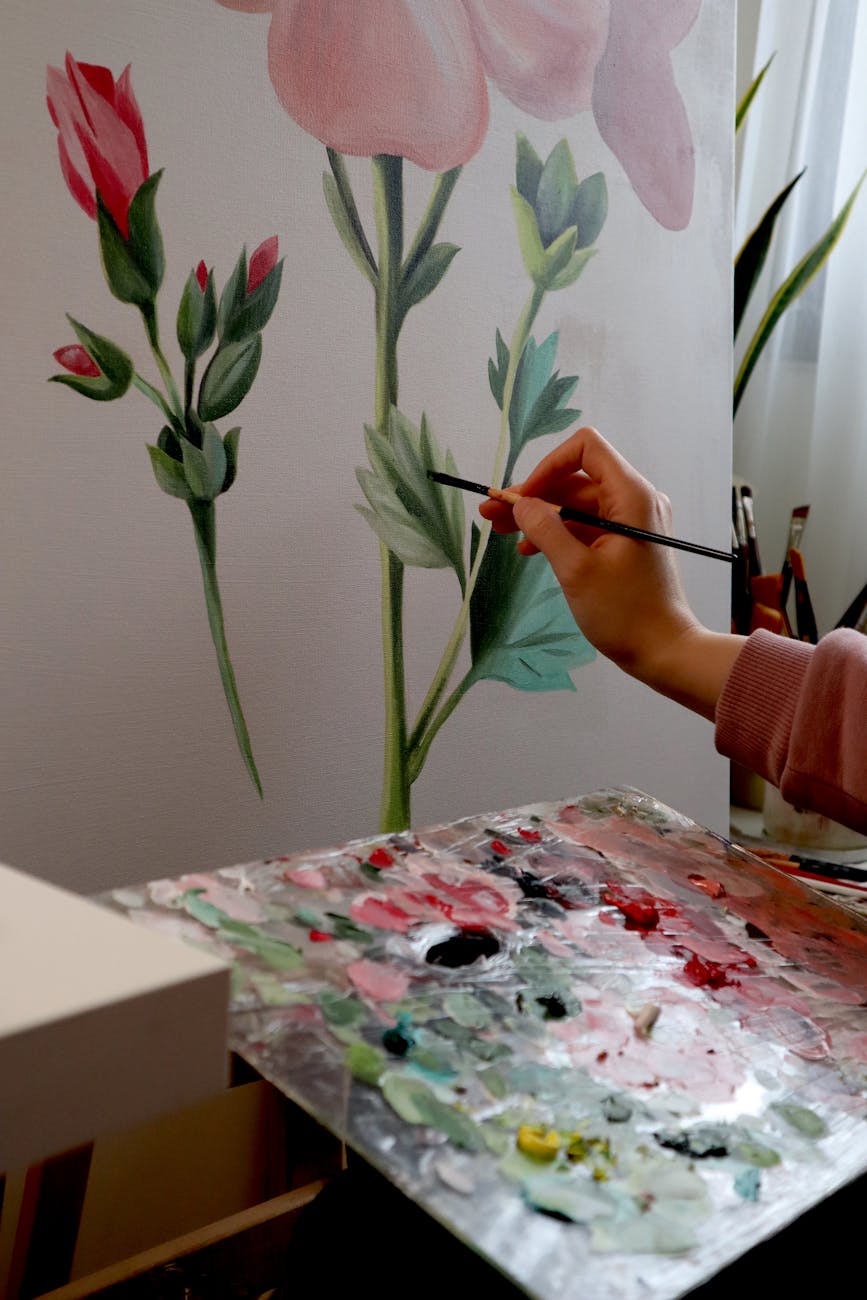
I’ve been thinking about this a lot recently, partly because of a bit change in my own life. For the first time ever, I now have a dedicated studio space. Writing has always been my primary genre, and I’ve long had a study for reading and writing. But this is different. The studio space (perhaps a grand phrase for a nook in my hallway) is dedicated specifically to other forms of making. There, I’ve been deepening into my bookbinding practice and working with printmaking as an adjacent art form. I recently had a first go at basketweaving, with the very practical intention of making baskets to organise my supplies. The baskets are imperfect, slightly unruly, unmistakably beginner objects. And I love them.

None of this is productive in the way productivity culture understands the term. But all of it has made my days feel more coherent, and, ultimately, more inhabitable. Beauty, here, isn’t about refinement or taste. It’s about the relationality of being in contact with materials, rhythms, and limitations that writing alone doesn’t always provide.

William Morris famously argued that we should have nothing in our homes that we do not know to be useful or believe to be beautiful. That line gets quoted endlessly, often stripped of its political teeth. Morris wasn’t advocating for aesthetic minimalism; he was protesting industrial alienation. Beauty, for him, was bound up with labour, dignity, and the refusal of shoddy work—both material and spiritual.

In our own moment, the danger is not mass production alone, but abstraction. So much of our creative life now happens at one remove: ideas about ideas, plans for work, identity statements about what kind of person we are or hope to be. Beauty interrupts that abstraction. It brings us back into contact. This matters for creativity because creativity does not thrive on pressure alone. It thrives on nourishment. And nourishment is often sensory, spatial, temporal. The feel of tools. The pleasure of order that isn’t obsessive. The satisfaction of materials finding their place.

I see this again and again in my work with writers, artists, and academics. Their creative lives have been stripped of beauty in the name of seriousness. Desks become battlegrounds. Time becomes an enemy. Work becomes a referendum on self-worth.

Under those conditions, abundance sounds either naïve or manipulative—another thing to perform, another mindset to adopt correctly. But abundance, as I understand it, has very little to do with positivity or belief. It has to do with noticing what is already available and learning how to stay in relationship with it.

Beauty helps with that. Beauty slows us down just enough to notice. It widens attention without demanding that we be exceptional. It restores a sense that life—and work—can be met, rather than conquered.

This is one of the underlying currents running through my latest work, and it’s very much present in the upcoming 5 Days of Creative Abundance programme I’m hosting in March. The series isn’t about doing more or trying harder. It’s about restoring conditions in which creativity can move again—conditions that include time, permission, structure, and yes, beauty.

Across the five sessions, we’ll be exploring how creativity becomes knotted up with pressure and identity performance, and how to loosen that knot without abandoning seriousness or commitment. We’ll look at how to make time more porous, how to let work approach you rather than always forcing it, and how to keep creative energy circulating so it doesn’t feel so easily depleted. Underlying all of this is a simple proposition: creativity does better when it feels welcomed into your life, rather than squeezed into it.

When you care about how things feel, how spaces hold you, how materials respond, you are already practising a different relationship to your work. One that is less extractive. Less adversarial. More sustainable.

If that resonates, the Creative Abundance programme might be a good place to explore it further. The sessions are short, live, and recorded if you can’t make them in real time. They’re designed to meet people who are tired of hype, allergic to rigidity, and still deeply committed to their work.

Beauty won’t solve everything. But without it, we ask our creative lives to run on willpower alone. And willpower, as many of us know by now, is a brittle fuel.

Sometimes what we need is not a new strategy, but a more liveable ecology. A desk that invites us back. A practice that feels companionable. A sense that what we are doing belongs to a life, not just a ledger of outputs.

Beauty helps us remember that. And remembering, in this case, is not nostalgic. It’s practical.

If you’d like to spend a week exploring what abundance might look like when it’s grounded in attention, care, and lived experience, I’d love to have you join us in March.


Upcoming Events

Creative Flow Co-Working Session: Deepening Your Craft

16 February | 10 AM-12 PM GMT | FREE

Register here: https://www.meetup.com/the-art-of-creative-practice/events/312151262/

Beyond Time Management: A More Natural Way to Organise Creative Work

24 February | 7.30-9.00 PM GMT | £12

Register here: https://www.meetup.com/the-art-of-creative-practice/events/313062163/

5 Days of Creative Abundance

9-13 March | 7.30-8.00 PM GMT | £29

Register here: https://www.meetup.com/the-art-of-creative-practice/events/313206797/

The Writer’s Flow Circle: A 12-Week Group Coaching Circle

Beginning Monday 23 March | 7.30-9.00 PM UK time | £180

Register here: https://www.meetup.com/the-art-of-creative-practice/events/313207235/


More to Explore

The Way We Live Matters More Than The Way We Think

It’s easy to forget that philosophy was never meant to be a spectator sport.

Long before it became something we studied, it was something people did. Philosophy began as a way of arranging a day, training attention, shaping character, and orienting oneself toward what mattered in life. It didn’t live in texts, but in habits: how one woke, walked, ate, spoke, listened, and rested.

In other words, philosophy was practical.

This has been on my mind a lot recently, perhaps unsurprisingly. I’ve just come to the end of my sabbatical and I’m now taking on responsibility for running the MA in English Literature and the MA in Creative Writing at the University of Surrey. This transition made me acutely aware of how much of our thinking is shaped not by what we claim to believe, but by what we repeatedly do.

One of the great misunderstandings of modern intellectual life is the assumption that clarity comes first, and practice follows: if only we had the right theory, the right worldview, the right explanation, then our lives would fall into place.

But lived experience tends to run the other way around.

As Pierre Hadot points out in Philosophy as a Way of Life, ancient philosophy was grounded in spiritual exercises, that is, concrete practices designed to transform perception and conduct. Stoicism wasn’t a set of ideas about fate or reason; it was a disciplined training of attention. Epicureanism wasn’t a theory of pleasure, but a daily practice of simplicity, friendship, and fear reduction. Even Plato’s dialogues, for all their abstraction, were designed to do something to the reader: to unsettle, provoke, and reorient.

Closer to our own time, thinkers as varied as Simone Weil, Iris Murdoch, and Michel de Certeau have reminded us that attention, habit, and repetition shape the moral and imaginative texture of a life long before explicit reflection enters the scene. We do not first decide what matters and then act accordingly; rather, what we attend to, rehearse, and ritualise slowly teaches us what matters.

This is why everyday rituals are philosophical, whether we acknowledge them as such or not.

By “rituals,” I don’t mean anything grand or mystical—though they can be. I mean the small, repeated actions that quietly structure our inner lives: how we begin the morning, how we transition into work, how we respond to resistance, how we close a day. These acts rarely feel important, but they are formative.

A life without intentional ritual isn’t neutral; it is simply shaped by default rituals of the world outside: algorithms, inboxes, urgency, comparison, and distraction.

During my sabbatical, this became unavoidably clear. Writing a book is less an act of inspiration than one of sustained fidelity: returning to the page when enthusiasm fades, when doubts arise, when the work resists being done. What carried me through wasn’t motivation, but a set of simple, repeatable practices and routines that made thinking possible at all. A system.

This is where much contemporary advice culture goes astray. We are encouraged to optimise outputs while leaving the deeper structure of our lives untouched. But philosophy—real philosophy—asks a more demanding question: What kind of person is this way of living making me into?

This is also why I’m increasingly wary of purely instrumental approaches to creativity. Writing, thinking, and teaching are not just tasks to be managed; they are forms of life. How we organise our time, relate to resistance, and hold ourselves in periods of uncertainty is not secondary to the work—it is the work.

Much of my recent teaching, coaching, and writing has been circling this insight from different angles: that sustainable creativity requires a different relationship to time, effort, and selfhood than the one most of us have inherited.

This integrative dimension is central to my current work, including the practices I’ll be sharing in upcoming sessions. Whether through meditation, reflective co-working, or rethinking how we organise creative labour, the aim is the same: to help people cultivate forms of attention that make meaningful work—and a more humane life—possible.

If this resonates, you might be interested in the following upcoming offerings:

Integrative Meditation
2 February | 7.30–8.30 PM GMT | £4
A guided session focused on attention, integration, and gentle inner alignment.
Register here:
https://www.meetup.com/the-art-of-creative-practice/events/312077761/

Creative Flow Co-Working Session: Reframing Resistance
9 February | 10 AM–12 PM GMT | FREE
A shared, reflective working space for engaging resistance as information rather than failure.
Register here:
https://www.meetup.com/the-art-of-creative-practice/events/312151261/

Beyond Time Management: A More Natural Way to Organise Creative Work
24 February | 7.30–9.00 PM GMT | £12
An exploration of rhythms, seasons, and structures for sustained creative practice.
Register here:
https://www.meetup.com/the-art-of-creative-practice/events/313062163/

Perhaps the most important thing philosophy can do for us now is remind us that a life is not shaped primarily by what we profess, but by what we practice. Everyday rituals—chosen with care—become a quiet form of resistance against fragmentation, haste, and superficiality.

And in a culture saturated with noise and abstraction, this return to lived, embodied wisdom may be one of the most radical gestures still available to us.