Book Buying as a Practice of Becoming

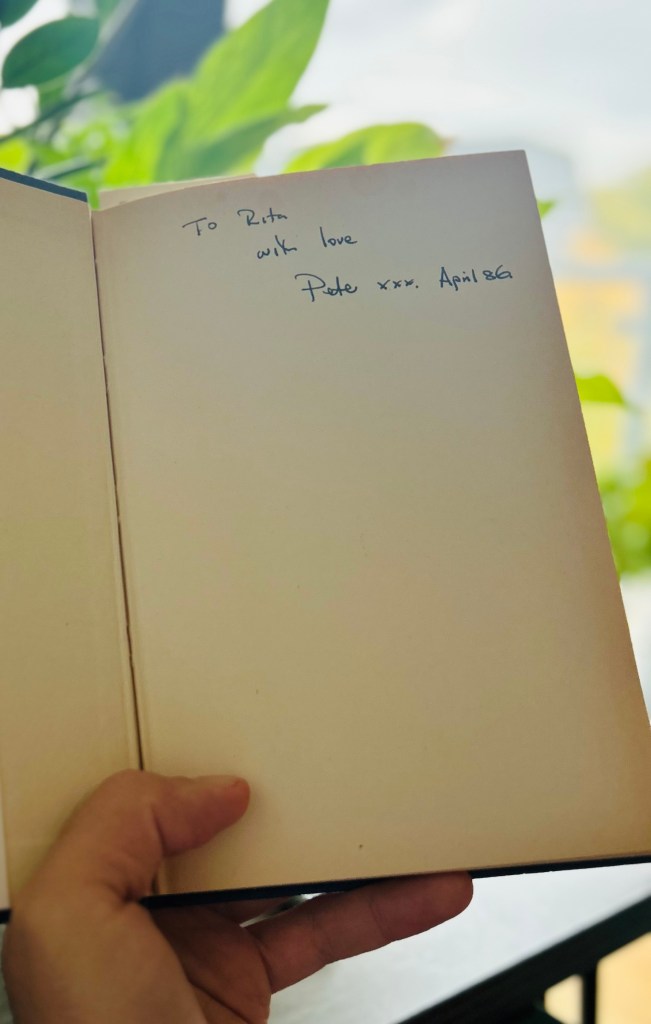
As I usually do, I bought a used copy of this month’s selection for my neighbourhood book club: Hotel du Lac, Anita Brookner’s marvellous 1984 Booker Prize-winning novel about making sense of people and the shame we inhabit. The copy I received was a marvellous 1980s edition, its cover gently worn, the paper slightly yellowed with age. Inside was an inscription in assertive biro: To Rita with love, Pete xxx. April 86.

I love finding ephemera like that in used books (once, I found a four-leaf clover that a child had pressed between pages and forgotten in 1972). That simple handwritten note in Hotel du Lac became a fragment of someone else’s life, a small piece of history folded into my own. It reminded me that buying a book is rarely just about acquiring a text — it is, at its best and fullest expression, a gesture of self-formation. Choosing a book can be a conscious act of orienting yourself toward a new way of thinking, a new rhythm of attention, a new life project. In that way, book buying is a practice of becoming.

Every book purchase marks a threshold, a crossing into a new state of thought, feeling, or attention. When I choose a book, I am often choosing not only the ideas it contains but also the possibility of becoming someone who holds those ideas. That threshold might be a commitment to learn something new, to deepen a habit, or to allow oneself to enter an unfamiliar world.

For me, Hotel du Lac became not just a novel but a threshold to conversation — in our book club meeting tonight we will speak about solitude, desire, love, and the quiet transformations of everyday life, I’m sure. The purchase itself became the first step into that dialogue.

Choosing which books to buy is also an ethical act — a choice about the economy of your attention and the kind of knowledge you wish to cultivate. In our age of algorithm-driven recommendations and one-click convenience, the act of selecting a book has become even more deliberate. It is an assertion: of attention, of values, of resistance to the noise of the digital marketplace.

I try to keep this in mind. When I choose a book, I am choosing the kind of life I wish to live. That is why I prefer second-hand bookshops, curated lists, and the serendipity of browsing. The gift of finding a well-loved copy of Hotel du Lac was not just about economy but about entering into a relationship with the book that carries the traces of other readers and a past moment in time.

My first job as a teenager was as a bookseller at Borders Books, and I’ll never forget the linger last hour before closing when the shop was almost empty and I wandered to and fro reshelving books that had been cast aside and getting lost myself in the shelves. There is something profound in the act of browsing: the way attention moves differently among stacks of books, the accidental discoveries, the impulse that turns browsing into a purchase. This ritual carries a rhythm: the searching, the selection, the return home, the opening of the book for the first time. It is a small act of pilgrimage.

This ritual has shifted for me over recent years. I buy more online and second-hand now, but I also savour the moments when I am in a physical shop, taking time to feel the books, the paper, the weight of them in my hands. Buying a book in that way is an act of attention — a slow, deliberate counterpoint to the speed of modern life.

The books we choose to live with often become companions in our ongoing process of becoming. That inscription in Hotel du Lac reminded me of this. A book is not simply an object; it is a living presence. It carries the imprint of its past readers and acquires a new life each time it meets another. In choosing it, we invite it into our own narrative.

Some books grow with us. They take on new meaning as we return to them at different stages of life. They become landmarks in our own inner journeys. It’s for that reason that buying books can be a form of investment in the future self we aspire to become.

When I buy a book, I am buying a possibility: a possibility of becoming a reader who thinks differently, who sees differently, who lives differently. Each purchase is a small apprenticeship in self-making.

Here are some ways to make book buying a mindful practice:

  • Keep a wishlist and revisit it periodically.
  • Choose one book that challenges your usual thinking every month.
  • Seek out books outside your comfort zone.
  • Return to books that have shaped you before.

If we approach book buying as a practice of becoming, every purchase becomes a small act of self-cultivation. This month, my purchase of Hotel du Lac was not just for a book club — it became a quiet practice of curiosity, of connecting with a history, of choosing to open myself to a particular conversation. In this way, every book bought with attention becomes a threshold, an ethical choice, a ritual, a companion, and an investment in becoming.

If you choose to see book buying this way, your library becomes not simply a collection of texts but a landscape of your own growth. What will your next purchase become for you?


Upcoming Events

If this resonates, you might enjoy joining one of my upcoming gatherings:


More to Explore

Morning Rituals for a More Grounded Day

The early bird 40% off offer for The Artist’s Way Circle: A 12-Week Creative Journey closes at midnight tonight. In this powerful small-group experience, we will work through Julia Cameron’s classic book together, sharing insights, deepening our practice, and building a creative community that makes the journey feel less solitary and more alive.


For me, mornings have become less about rushing into productivity and more about creating a small pocket of time that feels set apart, a threshold into the day. This is, after all, what Julia Cameron invites us to do in The Artist’s Way: show up to the blank page before we show up to anyone else.

A ritual isn’t a routine; it is a way of marking time as meaningful. When I light a candle before writing, or make my coffee slowly in my V60 instead of rushing, I am reminding myself that this time is not just another item to cross off a list, it is where my life begins for the day. Mircea Eliade, in The Sacred and the Profane, writes about ritual as a way of stepping into ‘sacred time’, a space where the ordinary becomes charged with significance. For me, this might mean lighting a special candle that reminds me of that changing of the seasons going on at the moment, or pausing for a moment on the balcony to notice the light on the plants before I open my laptop. These small gestures are a way of crossing the threshold deliberately, rather than being dragged into the day half-awake.

Groundedness begins in the body. No amount of list-making and project management will make a difference if I wake up already scattered and tense. The first thing I try to do now is move. I have been trying to get into running again, which I alternate with indoor rowing (my preferred cardio of choice). And after years of not making progress or any form of commitment to resistance machines at the gym, I’ve taken up strength training with two simple dumbbells, which has been an absolutely fantastic development in my fitness journey–the trainers on FIIT have revolutionised my entire outlook on dumbbells. This comes alongside my yoga practice, which has been with me for nearly 25 years. The point is less about physical fitness (although, as I get older, I am becoming increasingly aware of the need to build lasting wellness) and more about arriving in my body. As Bessel van der Kolk reminds us in The Body Keeps the Score, our sense of safety and clarity begins somatically, not intellectually. If I can bring my nervous system into a calmer, more coherent state first thing, the rest of the day feels less like a battle.

Creativity thrives in spaciousness, not in haste. This is where Morning Pages come in—Julia Cameron’s influential practice of writing three longhand pages first thing in the morning. They are not intended to be polished or even interesting; they are more like clearing mental static, a way to compost the thoughts that would otherwise clutter the mind all day. I find that pairing them with something tactile—a favourite notebook, a good pen—enhances the ritual. (In The Artist’s Way Circle, we’ll not only practice Morning Pages but also discuss what they unlock: the surprising insights that surface when we permit ourselves to be imperfectly present.)

Not every ritual has to be still. A ten-minute stroll before sitting down to write can be as clarifying as a meditation cushion. The Go Jauntly app has been such a fantastic presence for me. Thich Nhat Hanh speaks beautifully about walking meditation as a way to arrive in the present moment, and I find that even putting on a playlist and tidying the kitchen can create that same bridging effect between sleep and wakefulness. The point is to let the mind settle before reaching for the phone, before taking on the noise of the world.

During my sabbatical, I’ve been focusing on testing and adjusting my daily habits so that when I return to a busy routine of teaching and administration in the new year, I will have a clear understanding of what best supports my growth and development. Protecting the first hour of the day is, I’ve come to see, an act of self-respect. Seneca reminds us that we are often more careful with money than with time, though time is the one thing we can never get back. I’ve started following a ‘no-scroll rule’ in the first hour of the day, and replaced it with going straight to the gym.

The key is not to design the perfect morning but to make a start, consistently. There have been mornings where the ritual falls apart—when I oversleep, or skip the gym entirely—but I’m learning that a ritual that only works on perfect days isn’t really a ritual at all. The point is to keep coming back. James Clear’s Atomic Habits puts it simply: habits compound over time. A short, wobbly practice is better than a grand plan you never do.

This time of year feels like an invitation to recommit. I’ve always felt that September carries more of a ‘new year’ energy than January—it must be the academic calendar still in my bones. This month, I’m choosing to double down on the things that anchor me: lighting a candle before email, a few minutes of breathing exercises, and breakfast that feels nourishing rather than hasty. I’d love for you to consider what this season might invite for you.

Ultimately, a grounded morning is an act of creative resistance. In a culture that would have us wake up and immediately start scrolling, choosing ritual is choosing presence. So tonight, ask yourself: how do you want your mornings to feel for the next twelve weeks? And if you are ready to experiment—with ritual, with creativity, with spaciousness—I’d love for you to join us in The Artist’s Way Circle. The early-bird 40% discount closes at midnight tonight, and there are just a few spots left. Your mornings—and your creative life—might look completely different on the other side.


More to Explore

Autumn Creativity Awaits: Upcoming Events

As the leaves turn and the pace of life shifts, autumn is the perfect season to nurture your creative self. Whether you’re a writer, artist, academic, or thinker, this fall I’m offering a range of events designed to support your practice, spark fresh ideas, and help you stay focused and inspired.

🎨 Weekly Creative Flow Sessions – Free
Dedicated time to write, draw, or work on your projects alongside other creatives. No pressure, just presence, energy, and support. Quiet, structured sessions to help you start, focus, and finish your creative work in good company.
RSVP here

📖 12-Week Artist’s Way Circle
Dive deep with Julia Cameron’s classic book, The Artist’s Way, bringing the work to life in community with practical exercises and reflections to reclaim your creative voice. Weekly 90-minute circles for reflection, sharing, and growth.
Join here

🧘 Mindfulness for Creatives – Evening Workshop
Learn mindfulness techniques specifically for creatives and academics. Cultivate focus, flow, and inspiration in your daily practice in this 2.5-hour workshop filled with science-backed insights and practical exercises and tools.
Reserve your spot here

Autumn is a season of new beginnings and renewed energy. Whether you’re seeking free flow time, structured accountability, or a transformative creative journey, there’s a place for you in these sessions. I’d love to see you there—let’s make this autumn a season of inspiration, focus, and creative growth.

Embracing Craft in Academia: Reflections on Sabbatical

Academia, for all its bureaucratic scaffolding and metricisation (neither of which, in spite of what many would have us believe, is newly arrived on the scene), has always seemed to me less an outcome and more a craft. The language we use is linear and progressive—impact, output, key performance indicators—but the experience is slower and quieter. What looks from the outside like a trajectory of advancement often feels, from the inside, like the painstaking rhythms of practice: revisiting texts, refining an argument, shaping a paragraph until it carries its own weight.

Beginning a period of sabbatical this month has sharpened this distinction for me. Having the time to work on my next book, on liberal theology in early-20th-century America, is an extraordinary privilege, of course, but also a perturbing reminder that the rhythms of academic life are neither fixed nor inevitable. After a six-year term as an associate dean, when my diary wasn’t my own and a truly uninterrupted hour for writing was out of the question, I now find myself in a space where mornings are less prescribed, afternoons more open, and evenings less weighed down by the day’s unanswered emails.

This shift has interrupted the treadmill to which I had grown accustomed: no more weekly meetings or administrative reports, fewer obligations to the tempo of the institution. The contrast is striking. Career logic dictates constant forward motion, progression, and visibility. Sabbatical interrupts that, slowing time to the pace of craft: immersion, attention, revision. After years of deliberately (and at times aggressively) climbing a ladder, it feels now like I am stepping back into the workshop of what I have actually been trained to do: pore over the historical record to better understand what modernist literature means, and, in doing so, cultivate my own scholarly sensibilities in order to train students to do the same.

The language of career encourages us to think in terms of advancement, but the language of craft invites us to think in terms of depth. Career implies a vertical climb: promotion, recognition, and external markers of success. Craft, by contrast, is iterative and circular: you return to the same problems with new tools, you revisit the same materials with a slightly steadier hand. In my ways, this sabbatical is feeling like an unmistakable return, and whether or not my hand is indeed steadier, it is at the very least different to when I began my career.

Pierre Bourdieu’s account of ‘academic capital’ in Homo Academicus explains much about why universities are structured to reward careerist accumulation: advancement depends on how well one plays the game, converting intellectual labour into recognisable forms of capital. But Richard Sennett’s celebration of craft in The Craftsman reminds us that the deeper meaning of scholarly work is found elsewhere: in the long hours of slow reading, the shaping of sentences, the iterative labour of interpretation. Bourdieu undoubtedly shows us the internal logic of the field, but to treat scholarship as craft is to resist the abstraction of labour into capital and to remain grounded in the work itself, the feel of words under the hand, the quiet satisfaction of making something well.

Craft is built not through dramatic leaps but through the slow accumulation of skill over time. Looking back, I see this clearly in my own trajectory. As an undergraduate, I was awkward but diligent; I once arrived late to an exam with an analogue alarm clock whose battery had died, holding it up as evidence. From those unpolished beginnings to my current role as teacher and writer, what has mattered is not sudden transformation but steady honing.

This accumulation resists the logic of outputs. Like any craft, academic practice is tethered to the materiality of tools, spaces, and habits. The scholar’s equivalents of the potter’s wheel or carpenter’s chisel are the library, the notebook, and the annotated text (I’ve also grown accustomed to my ReMarkable tablet but still feel uneasy when I see my disused notebooks glaring back at me from the shelf). 

My own sabbatical days so far have been marked by relocating books and rediscovering notes I had once scribbled in margins, while rearranging my desk into something that feels more like a workshop than an office. Bruno Latour reminds us in Reassembling the Social that tools are never neutral; they co-constitute practice. Academic work, though often presented as disembodied thought (the ‘output’, the ‘paper’, the ‘impact’), is always materially situated. The desk, the chair, the pen, the screen: they are part of the making.

The pressures of modern academia can make it dangerously easy to forget the craft beneath the career, but the dangers of modern academia can make it just as tempting to ignore the career beneath the craft, an evasion that only feeds the very thing we hoped to resist.

I know this from experience. Six years in middle leadership brought tremendous satisfaction but also a creeping drift away from the hands-on craft of my own research. Strategy and oversight are necessary, but they can displace the intimate contact with sources and sentences that drew me to academia in the first place. Sabbatical is, in that sense, a time to retool: to remember the making at the heart of the work. As Stefan Collini asked in What Are Universities For?, what are we serving if we forget the scholarly craft that justifies the institution itself?

My hope for this sabbatical is to deepen the craft. A book will come out of it, but as a tool rather than a product. I want to give myself permission to linger in primary texts, to sketch ideas without rushing to publication, to think slowly. Projects on attachment and literature, and on contemplative approaches to pedagogy beckon, but I want to approach them less as tasks to be completed than as materials to be worked with patiently.

To see scholarship as craft is to reclaim its artistry from the machinery of career. Universities will continue to speak the language of metrics, rankings, and progression, an essential role, because it is this machinery that maintains the workshop in which scholarship can take place. But we don’t have to speak in the same register. To resist or even repudiate the machine is not to undermine the institution but to create the very conditions in which scholarship can breathe: the space for slow thought, patient practice, and the kind of intellectual labour that no metric can capture.

The machinery of career will always hum in the background, but we needn’t let its clatter drown out the quieter sound of practice itself. If these reflections resonate, I explore them further in The Art of Academic Practice on Substack, a space for thinking together about how scholarship might remain both sustainable and alive.

What is a Course in Miracles?

If you were to glance at the cover of A Course in Miracles, you might find it a little intimidating.

Gold-embossed title. No back cover blurb. Dense text. Three volumes.

It doesn’t exactly scream “approachable.”

Add to that a name like A Course in Miracles—and it’s understandable why many people assume it’s either ultra-religious, uncomfortably mystical, or some obscure New Age self-help project from the 1970s.

But here’s the truth, and it might surprise you: The Course is none of those things.

It’s not a religion. It’s not a belief system. And it’s not trying to sell you a new worldview.

At its heart, A Course in Miracles is a method of mental and emotional clarity. A structured way of exploring your perceptions, undoing habitual fear-based thinking, and reclaiming the peace that’s already available beneath the noise of the mind.


So What Is It, Then?

Let’s step back a moment.

The Course was written in the late 1960s and early 70s by Helen Schucman, a clinical psychologist at Columbia University. She described it as a form of inner dictation—words that came to her during a time of personal and professional strain, in response to a growing desire to find “a better way” of relating to the world.

Regardless of how we frame its origin, the Course is remarkable in one key respect: it speaks in symbolic, poetic language, but offers psychologically rigorous insights into how perception works—and how often we are the source of our own suffering without realising it.

It doesn’t ask you to believe in anything. Not in the traditional sense. In fact, one of its opening lines is:

“This is a course in miracles. It is a required course. Only the time you take it is voluntary.”

It’s not referring to belief or theology. It’s referring to a kind of deep inner retraining—a shift in how you meet your thoughts, how you interpret experience, and how you move through relationships, conflict, and uncertainty.


A Practice of Undoing, Not Adding More

Most spiritual systems (and most self-help programs) are about adding more.

More positive habits. More affirmations. More rituals. More goals. More ideas.

The Course is different. It’s not additive—it’s subtractive.

It says, essentially: you don’t need to become better, you need to remember who you already are beneath fear. And the way to remember is by undoing the thoughts that block your natural capacity for peace.

This includes thoughts like:

  • “I need to control this situation to be okay.”
  • “If I don’t prove my worth, I’ll be rejected.”
  • “Other people’s approval determines my value.”
  • “I can’t be happy until X happens.”

Rather than challenging those thoughts intellectually, the Course invites you to bring them into awareness and notice what they cost you. Not in moral terms, but in energy, clarity, and presence.

And then it offers an alternative—a quieter, more honest perception. One that doesn’t come from striving, but from stillness.


So, No Dogma? Really?

There’s a common misunderstanding that A Course in Miracles is part of a larger religious or spiritual institution. But it isn’t. There’s no church. No hierarchy. No initiations. y. And no penalties for disagreement.

The Course explicitly says:

“A universal theology is impossible, but a universal experience is not only possible but necessary.”

That experience, for the Course, is peace.

But not peace as a vague ideal. Peace as a felt experience of spaciousness. Of groundedness. Of being free from the constant effort to defend yourself against life.

Robert Holden, a longtime student and teacher of the Course, often describes it as “spiritual psychotherapy.” He calls it a practical, heartfelt path that clears away the false self—not by condemning it, but by recognising it was never needed in the first place.


What Happens in the Study Group?

This is why the Course is best approached with others.

Not because we need to believe the same thing—but because this kind of inner exploration thrives in gentle company. Somewhere between a book club, a reflection circle, and a slow-burn inner workout, our Sunday evening study group provides a regular space to unpack and embody the Course’s core ideas.

We meet weekly (Sundays 7.30–9.00 pm UK time) and work through the Text in small, digestible sections. There’s no pressure to speak, and no prior knowledge needed. The readings are thoughtfully paced to allow insight to land and ripple in your daily life.

Each session is rooted in quiet attention—not performance. You can reflect aloud, or simply listen and take in what resonates.

Over the course of 18 months, we’ll move through the entire Text—the foundation of the Course—together.

When you sign up, you’ll receive the full reading schedule so you always know what we’re covering.


A Language of Peace, Not Preaching

Because the Course uses words like “miracle” and sometimes borrows spiritual terms from Christian mysticism, some readers initially worry that it’s trying to impose a worldview. But the language is symbolic, not doctrinal.

If a word doesn’t resonate with you, you’re encouraged to reinterpret it in a way that does. The Course doesn’t ask for obedience—it asks for honesty. And it reminds us that truth doesn’t need to be defended; it simply needs to be experienced.

I often tell people: don’t let the language throw you. The Course isn’t asking you to believe in anything “supernatural.” It’s inviting you to recognise how many of your perceptions are distorted by fear—and how peace becomes available when those distortions dissolve.

It’s less “join us” and more “come and see.”


This Is a Practice of Clarity

And clarity, for many of us, is in short supply.

We’re overloaded with information, overwhelmed by choice, and often undernourished when it comes to stillness. What the Course offers is not a shortcut—but a framework. A rhythm. A return.

It’s not for everyone. But if you’re someone who’s felt that traditional paths don’t quite fit… or who’s looking for something deeper than the usual spiritual gloss… you may find in the Course a friend you didn’t know you were waiting for.


🌀 Want to explore with us?
Join the weekly group here → https://www.meetup.com/meetup-group-vjcggkfq/
You’ll receive the full reading schedule upon registration.